‘I can do action’: cafe owner who organised tower block evacuation response aiming to be councillor
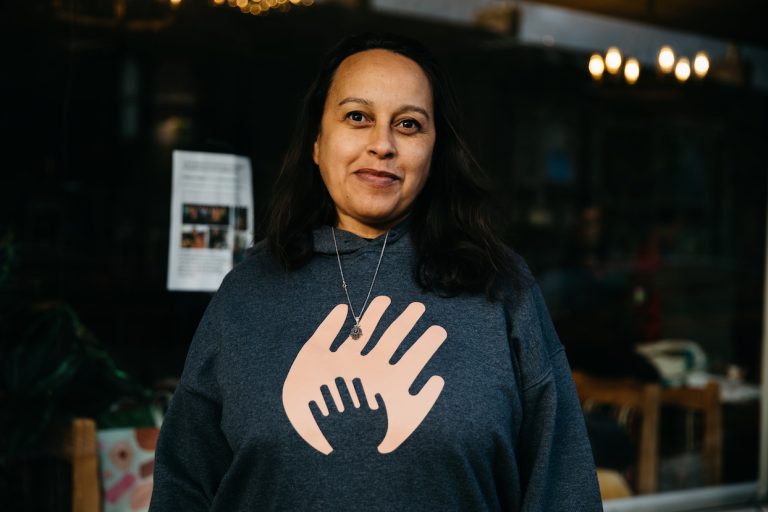
(credit: Alexander Turner)

“Oh gosh,” says Deniece Dixon, holding out her arm in the afternoon sun that’s lighting the window table we’re sitting in at Cafe Conscious, her business on Avonvale Road. “Look at this.”
The hairs on her forearm are standing on end as she thinks back to Tuesday 14 November: the evening Barton House, a council tower block barely 100 metres away, was evacuated over fears it was unsafe.
Several hundred people, including dozens of families with children, were suddenly and chaotically without a home. They are only due to officially be allowed back, from temporary hotel accommodation many say is woefully inadequate, in late February – although some people say they do not feel safe returning and are calling to be rehoused.
Deniece remembers her phone buzzing with news of the evacuation, just as she got home from her other job with the Autism Independence charity. “I put my shoes and coat on, left the house,” she says. “All I knew was, I can open the cafe doors, make tea, coffee, toast.”
Over the following hours, days and weeks, Deniece and her team, mostly volunteers, have gone way beyond providing those basics. They have offered advice and support, helped with electricity and translation services, taken delivery of medicines, and coordinated a bewildering array of donations to meet displaced people’s needs.
In interviews since, mum-of-six Deniece has focused on this community response rather than joining in criticism of the council’s handling of the situation – of which there has been plenty. “Politics” should not distract from the positivity of people pulling together, she has argued.
Now though, she herself is aiming to run to be a councillor in May’s local elections. We sat down to hear about her journey to that decision – and the impact the Barton House evacuation has had on it.
‘We see what is missing’
By the time Barton House was evacuated, Cafe Conscious had evolved from the Jamaican restaurant Deniece opened with her chef husband Wayne nine years earlier, after a time of personal hardship. “My nan died in hospital and my boy got diagnosed with autism six weeks later – that spiralled me into depression,” she recalls.
Recovering, with the aid of a notebook Deniece wrote her thoughts into, the concept of Cafe Conscious – vegan, organic, disability-friendly – was born. After seeing an empty unit available in Barton Hill, the lease was signed in 2014.
Furnishing it, with no spare cash, “took nine months of free-to-collect, eBay, everything – we filled up our front and back gardens and lived out of three rooms in the house”.
While Wayne’s cooking was the initial focus, the cafe always offered more. “I wanted a space parents could come to with children with autism,” Deniece says. “I thought, let me do a poster [at my son’s school] – and all the parents turned up – some would catch two buses – to have that support network.”
Over the years, the venue’s community-based activities grew: coffee mornings for elders, sessions where people with learning disabilities could meet with support workers and, during Covid, a service to feed vulnerable and isolated residents.
“I don’t know what we haven’t done here,” Deniece says. “It has been led by the community – what they, and what we, see is missing, and then we put it in place.”
‘Barton House evacuation was horrible’
Many things seemed to be missing, in terms of the official response, in Barton Hill on 14 November.
“It was horrible – people who didn’t speak English, didn’t know what was going on, walking into the cafe at 12 o’clock with suitcases, and babies, and pushchairs,” Deniece says.
Residents and housing campaigners, including some from outside Bristol with lived experience of evacuation, argue things could have been handled much, much better. Deniece says she still hasn’t had the headspace to process her thoughts on the situation.
But her frustrations – with authority figures offering words of sympathy but little action, and with how people’s lives are still upside down – are clear.
Even in January, at least some residents were still unaware their mail was being stored at the Royal Mail delivery office in Whitehall, Deniece says.
“This lady, doesn’t speak English – she’d been waiting for an operation for her partially sighted son,” she says. By complete chance, another Barton House resident had told the woman about the mail, and she arrived at Cafe Conscious in January with a handful of letters, which Deniece’s friend translated over the phone. “It was appointments for her son – two, in the next few days, that she’s been waiting a year for.”
Incidents like this, Deniece says, are now fuelling her determination to become a councillor – something suggested by another person dropping into Cafe Conscious, to donate supplies. “People were coming in, hugging each other, from Barton House. I thought, ‘You know what? Yeah,’” she says. “I could help more people. I can be on the ground. I can do action.”
‘Nothing is going to give’
It is Lockleaze, near where she spent her childhood, rather than the Lawrence Hill seat that includes Barton Hill, that Deniece has applied to represent. The party? “From the beginning of time, my family have been Labour,” she says.
“I respect the Greens, I respect the Lib Dems, and I hope to work closely with them,” she adds when asked for her views on the committee system of governance that will replace the mayoral model in May. “To me, if our common goal is the environment, the people, whatever, then bloody work together.”
In the meantime, Cafe Conscious is due to relaunch in February as a community cafe rather than a crisis hub – with its bonds to the neighbourhood permanently strengthened by the events of the past few months. If successful, how does Deniece plan to manage being a councillor alongside running the venue, working and being a mum?
“Nothing is going to give,” she says. “Some people have got their hobbies, I just love doing what I do – so it’s win-win.”
Independent. Investigative. Indispensable.
Investigative journalism strengthens democracy – it’s a necessity, not a luxury.
The Cable is Bristol’s independent, investigative newsroom. Owned and steered by more than 2,600 members, we produce award-winning journalism that digs deep into what’s happening in Bristol.
We are on a mission to become sustainable, and to do that we need more members. Will you help us get there?
Join the Cable today