Bristol needs better access to talking therapies

Illustration: Alex Dimond
Bristol, like many cities across the UK, is in dire need of better talking therapy provision. With one in four people in England experiencing some kind of mental health difficulty each year, this need has never been greater.
Currently, doctors can’t meet this challenge. When distressed patients approach their GP, they are often offered only two options: antidepressants or NHS Talking Therapies, provided by private company Vita Health Group, better known as VitaMinds.
Antidepressants work for some people, but they are not appropriate in all instances. Last year, 94% of help provided by VitaMinds was a version of CBT (Cognitive Behavioural Therapy), in the form of computerised self-help and psycho-educational groups.
While CBT can be helpful, this model denies patients access to other helpful therapies. One size does not fit all.
Why we are concerned
I am a retired counsellor with experience working in the NHS, a GP surgery, the community, and private practice.
I now volunteer my time as part of the Talking Therapies Task Group, a subgroup of Protect Our NHS, alongside two other practising therapists and three former patients of VitaMinds services. We campaign for a properly funded NHS and against the privatisation of health services.
We’re concerned that NHS Talking Therapies is a failing service, and that it is falsely presenting its data.
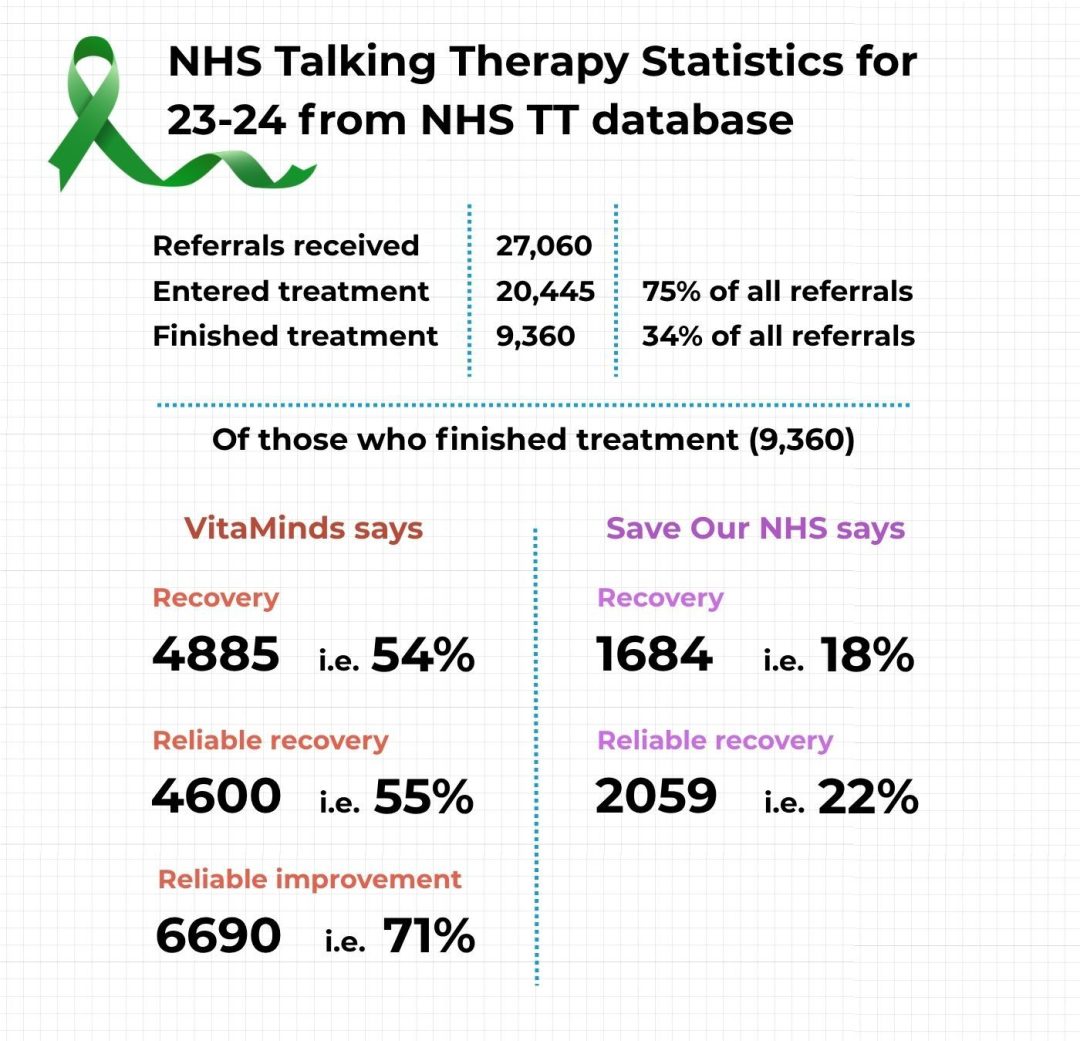
According to the NHS database, last year, two thirds of people who asked for help dropped out of treatment. Of those who started treatment and finished it, VitaMinds claims a ‘reliable recovery’ rate of 55%. However, from analysing their data, we believe it is actually 22%.
This is an exceptionally low success rate, suggesting that the types of talking therapy on offer don’t work for the majority.
Understanding CBT
Put simply, CBT offers techniques to manage symptoms rather than providing a space to explore the meaning of the symptoms within a safe relationship.
It individualises and medicalises mental health rather than examining how the world around us affects and shapes our feelings. It is based on the idea that if we change our ‘unhealthy’ thought patterns to ‘healthy’ ones, we change how we feel and, thus, our behaviour.
The NHS Talking Therapies model assumes that all patients will benefit from the same treatment, without any deviation from the ‘script’. It also neglects the therapeutic relationship, which is an integral part of treatment.
This universalised model of human experience ignores the strong feelings that can override our ability to alter our thoughts and does not offer any options to those for whom it’s not working.
While there are certainly many talented and caring therapists providing CBT in Bristol, their skills are not maximised if they have to treat patients in a short timeframe, using a manual, a scripted approach and patient worksheets.
Why CBT is so prevalent
The dominance of CBT began in 2008 with the introduction of NHS Talking Therapies, a programme established to manage common mental health conditions and reduce the number of people on benefits.
While CBT can be helpful, this model denies patients access to other helpful therapies. One size does not fit all.
NHS Talking Therapies has increasingly outsourced mental health treatment to private companies, overtaking local services which formerly provided a wider range of mental health treatments. CBT is prioritised within the NHS as it fits a standardised model of care, and is also easier to measure against financial targets.
VitaMinds was awarded a 10-year contract in Bristol because it offered a cheap service delivered by a single organisation. Last year, their budget was £12.1 million.
At the time the contract was awarded in 2019, some therapists were concerned that CBT didn’t provide the results it claimed to. Additionally, many of VitaMinds’ therapists were less qualified and experienced than therapists from other disciplines.
17 local therapy services, which offered a variety of different treatments, had their funding cut, leaving VitaMinds with a virtual monopoly over talking therapy provision. We asked the Integrated Care Board, which awarded the contract, to reallocate some of the funding, but they have refused.
The Talking Therapies Task Group is concerned that so many people in desperate need are being failed. VitaMinds offers a mechanical form of therapy, with no external or independent evaluation. It has an exceptionally high drop-out rate, with no evidence that those who drop out are receiving any follow-up contact or monitoring.
Our communities deserve better
The VitaMinds contract shows why privatised services have no place in our NHS, in Bristol or anywhere else. Protect Our NHS (PONHS) Bristol is calling for an externally audited mental health service offering a wide and diverse range of therapies that truly serve our communities.
If you care about this too, sign and share our petition, write to your local councillors, your MP or Wes Streeting, Secretary of State for Health and Social Care.
Many GP practices have a PPG (Patient Participation Group). You can raise your concerns at your PPG and if you would like to join the PPG Forum meetings, contact the forum convenor at: ronmendel1947@gmail.com.
Independent. Investigative. Indispensable.
Investigative journalism strengthens democracy – it’s a necessity, not a luxury.
The Cable is Bristol’s independent, investigative newsroom. Owned and steered by more than 2,600 members, we produce award-winning journalism that digs deep into what’s happening in Bristol.
We are on a mission to become sustainable, and to do that we need more members. Will you help us get there?
Join the Cable today



Report a comment. Comments are moderated according to our Comment Policy.
Let’s be clear: Vita Mind is owned by Spire Healthcare, the owners of the former BUPA private hospitals, which, in itself, is owned by the Australian healthcare firm Ramsay; so we have three private entities involved here each trying to make profit for their shareholders out of the contract with the local commissioners who are given our tax money to treat our local residents.
How much of that money is spirited out of the country into the overseas pockets of Ramsay’s shareholders is knowledge above my pay grade but however much it is it’s not being spent on patient care; it’s being siphoned out of the public purse and spent on private profit whilst providing, as this article assert, a substandard and ill monitored service.
Protect our NHS (Bristol), part of a national campaign group Keep our NHS Public, has been campaigning for fifteen years to do exactly what it says on the tin: keep our National Health Service as a service to the population, paid for out of general taxation publicly owned and publicly run. For people not for profit.
The use of companies such as those mentioned above is a local illustration of the dangers in the national, government led, policy of outsourcing our healthcare to profit driven companies. It is as if successive governments want to see our National Health Service reduced to “a logo and a funding stream” – an idea mentioned by Tony Blair at the Labour party conference in 2002. Whether he meant it as a warning or as an aspiration is also above my pay grade but, to me it’s looking like the latter now that his arch privatiser Alan Milburn seems to be pulling the health policy strings in the current government.