
Nicholas Stone, died after being pushed over by police officers at a protest in Bristol city centre.
It was Saturday 10 January 2026 and he’d come out to oppose a demonstration organised by far-right group Bristol Patriots. Nick, 65, was a retired mental health worker for the NHS. His daughter, Celia, described him as “a very gentle and kind man” with a passion for human rights and equality.
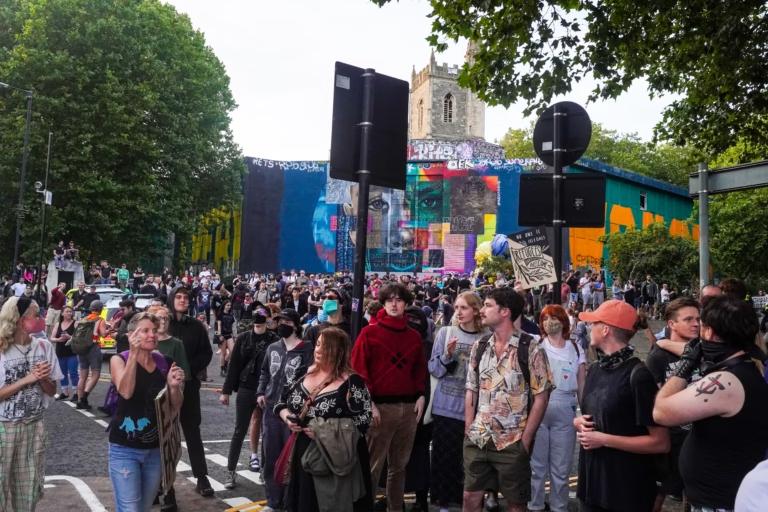
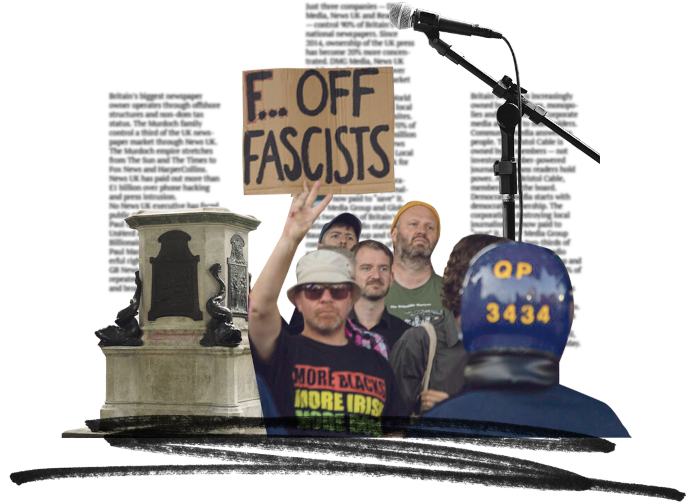
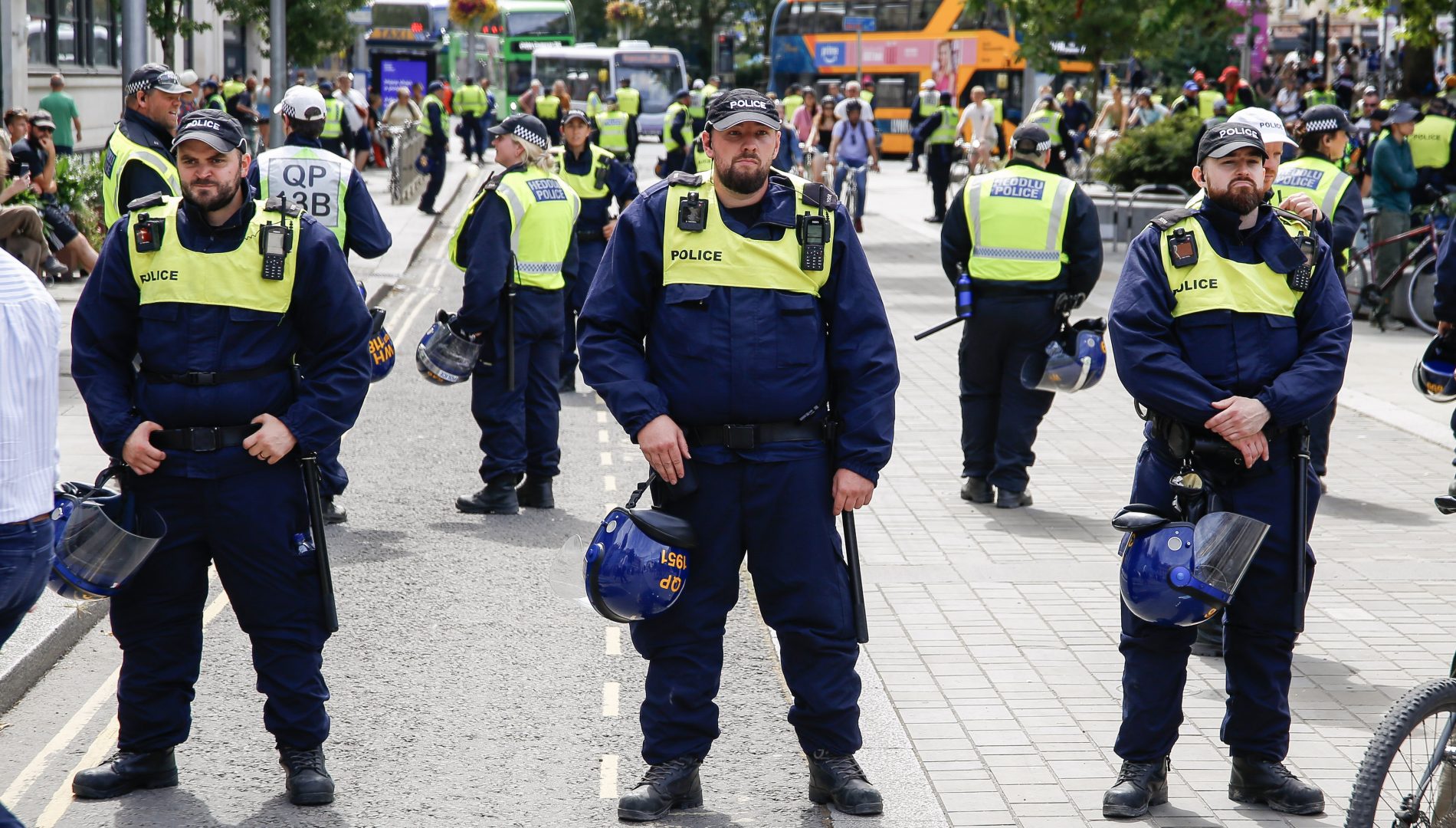
That morning, while Bristol Patriots only managed to gather around three dozen people, several hundred antifascists turned up en masse to face them. In response, the police began to form large cordons to separate the two groups.
Rumours began to circulate among the antifascists that the police were about to kettle them, as had happened two months previously at a similar protest in Redcliffe. The bloc began to move off in the direction of Castle Park. Nick began to follow.
Just before midday, Nick ran towards Clare Street. At that point, a line of police officers approached, attempting to form a cordon across the street. According to eye witnesses, two police officers pushed Nick over as he tried to run past.
He fell hard onto his back, but was helped back onto his feet by two other antifascist demonstrators.
An hour later, Nick reported feeling clammy and cold. A first aider who was present at the scene helped him into a taxi. At 1.50 pm, the ambulance service received a call that a man was in cardiac arrest at Redcatch Road, Knowle. He died at the scene.
Following Nick’s death, the IOPC (Independent Office for Police Conduct) initially declined to investigate the case, but subsequently reversed this decision.
“Following representations made to the IOPC, we are now reassessing our original decision for the force to investigate the matter,” an IOPC spokesperson said in a statement in May.
The investigation is ongoing, but Nick’s death comes in the context of a year of harsh policing of antifascist protests, in which activists have been surveilled and kettled, while others have made allegations of police brutality.
Police crackdown on face coverings
Earlier that morning, a few dozen protesters had gathered at the Cenotaph in Bristol city centre. They waved banners saying things like ‘no to digital ID’ and ‘workers unite, smash digital IDs’. In slightly surreal scenes, they also played disco tunes and Bob Marley’s ‘Get Up, Stand Up’.
The police push the idea that they alone represent the thin line between two equally dangerous sides
Kevin Blowe, Netpol
Though it was ostensibly in opposition to the introduction of ‘digital ID’, the demonstration was the latest in a series of protests organised by Bristol Patriots.
Their initial series of aggressive gatherings outside hotels housing people seeking asylum had been met by sustained and organised resistance from antifascists in Bristol, prompting them to try a variety of tactics to rebrand themselves.
With the increase in Bristol Patriots’ demonstrations (numbering almost one a month towards the end of 2025) came significant police operations, supposedly designed to keep antifascists and Bristol Patriots’ supporters from clashing. These operations have often resulted in arrests, kettling and surveillance of antifascists.
Avon and Somerset Police have relied on several powers to police these protests. One of these is the Public Order Act 1994, a subsection of which, known as Section 60AA, enables police officers to ask protesters to remove face coverings.
Antifascists often cover their faces on protests to protect their identity from members of far right groups, including streamers, as well as from police evidence gatherers.
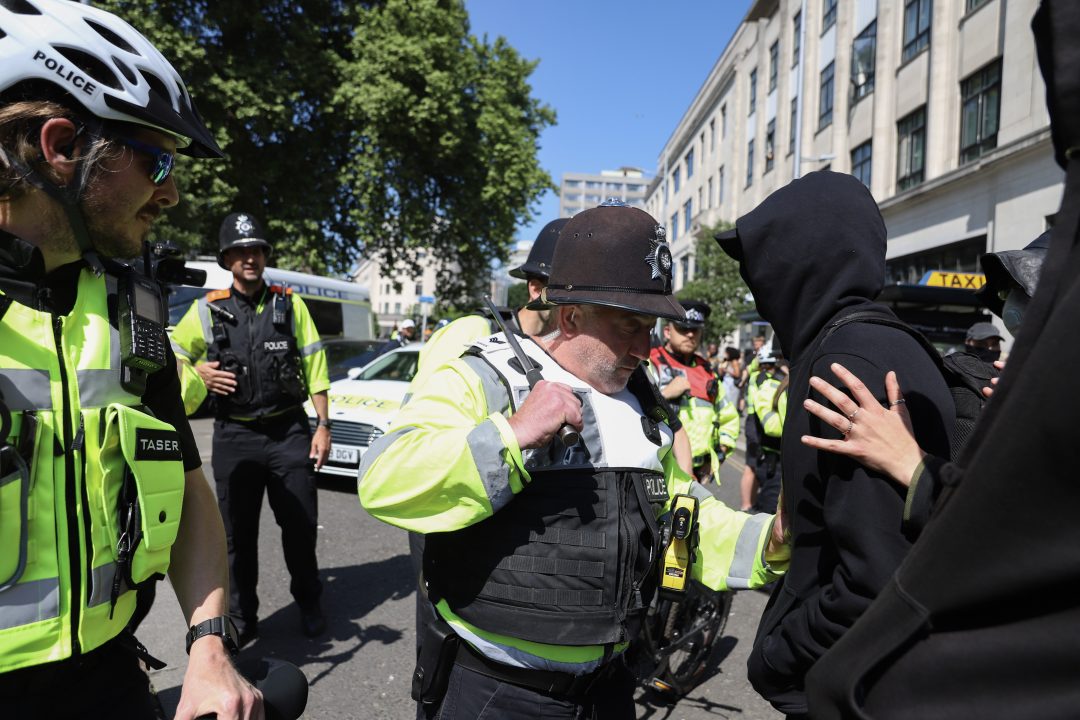
According to a post on Avon and Somerset Police’s website issued on the afternoon of 10 January, two people were arrested that day under the Public Order Act, and a third person was arrested under Section 60AA for refusing to take off a face covering.
At least a dozen people were injured, and two knocked unconscious, by police batons. One man had a tooth knocked out by an officer hitting him in the face with a baton
Bristol Defendant Solidarity
At the most recent far-right mobilisation in Bristol on 8 August, which began in Queen Square and was resisted by several hundred antifascists, a total of 10 people were arrested. This includes both supporters of Bristol Patriots and antifascists, and several of these arrests were made on suspicion of people concealing their identity.
While refusing to move a face covering had previously been an offence, following the introduction of the Crime and Sentencing Act 2026 in April, the police now also have the power to impose a 24-hour “mask-free zone” if seen as necessary.
“I’ve witnessed the police target a comrade, force them to identify themselves to the police and remove face coverings,” says Ash*, an antifascist activist who took part in a demonstration against Bristol Patriots on 7 March.
“Then later… the police shouted their full government name, doxxing them deliberately in front of fascist streamers”.
The Network for Police Monitoring (Netpol), which supports communities and social movements facing repressive and discriminatory policing, issued a briefing in February 2026 about the use of Section 60AA during protests.
“A lot of us are concerned about what this means for covid safety, for privacy, and freedom to protest,” it states. “The way the police apply the law, with intimidation and shouting, has left a lot of people in confusion about their rights.”
Antifascists as ‘extreme left wing’
The ban on face coverings comes amid a wider police crackdown on protest, particularly against antifascists and pro-Palestine activists. Netpol has argued that police operations inherently treat antifascists as potentially violent.
“Rather than treating counter demonstrations against the far right as ordinary people bravely coming out to protect their neighbours and their communities from a genuine risk of violence, the police push the idea that they alone represent the thin line between two equally dangerous sides,” says Kevin Blowe, Campaigns and Media Coordinator for Netpol.
The police often characterise antifascist organisers as ‘XLW’, meaning ‘extreme leftwing’, and thus seen as a threat to the power of the state. Policing these groups with the intention of containing the supposed threat goes back decades.
The designation ‘XLW’ was used by police against non-violent direct action movements such as Occupy London in the 2010s. More recently, police have designated environmental groups practising non-violent civil disobedience such as Extinction Rebellion (XR) as holding “extremist ideology”.
Similarly, direct action group Palestine Action was proscribed as a terrorist organisation in July 2025. This led to a wave of arrests of anyone deemed to be in support of the group, including those simply holding a placard with the group’s name.
“All antifascists are treated as an inherently violent threat that needs aggressive policing,” says Blowe. “This involves, of course, a complete disregard for the police’s legal duty to facilitate protests. But these obligations have been increasingly ignored over the last five years.”
Police kettling of protesters
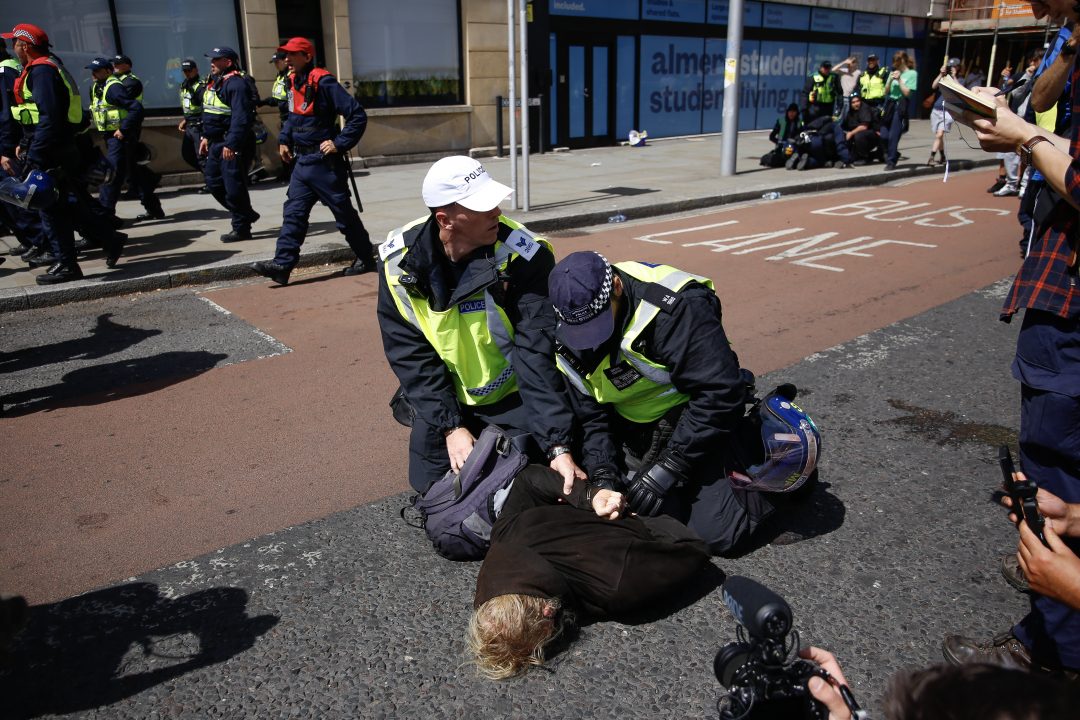
Activists have argued that the police have used particularly aggressive tactics against antifascists in Bristol. These include the use of kettling, a controversial police power in which officers surround protesters and temporarily prevent them from leaving an area in order to contain them.
One of these incidents occurred on 23 August 2025, when Bristol Patriots gathered in Castle Park. This was the first time the group had gathered under this name and came two weeks after they targeted the nearby Mercure Brigstowe on Welshback, which was housing people seeking asylum.
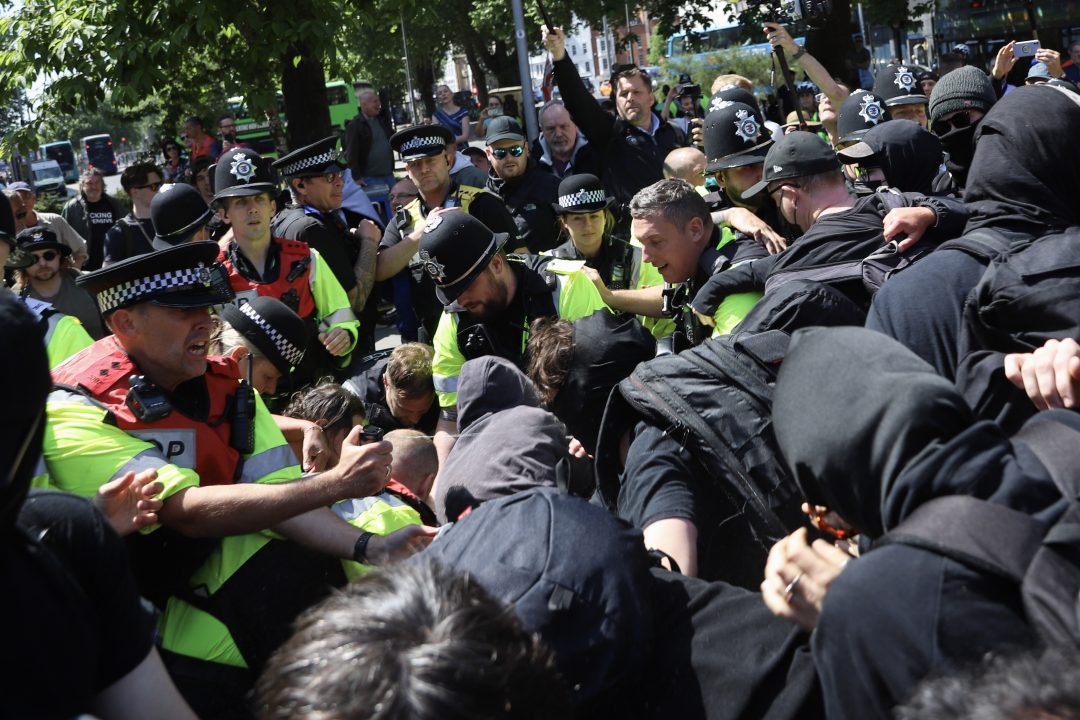
As a large crowd of antifascists came out to oppose them, the police used horses and batons against them.
The day before, Avon and Somerset Police had posted a statement saying: “Our officers will enable lawful peaceful protest, but will not tolerate criminality, disorder or hate. They will also seek to minimise disruption on other members of the public as best they can.”
They also stated that a dispersal zone had been authorised around Castle Park.
A statement from Bristol Antifascists reflecting on that day’s protests, posted on their Instagram, painted a different picture: “As they have done time and again, the police sided with the far right. Attacking antifascists with horses, batons, fists and boots, the police attempted to march the racists out of Castle Park and towards the Mercure Brigstow.
“Even in the face of such indiscriminate violence, antifascists managed to halt both the police and the far right on Wine Street, forming lines and standing firm against hours of repeated assaults by mounted and foot officers”.
Allegations of police brutality
A spokesperson for Bristol Defendant Solidarity, which supports people who have been arrested on demonstrations or following direct action, said: “There was a high level of police brutality against demonstrators and many people injured that day,” referring to last year’s events in Castle Park.
“We are supporting various people who were injured and are currently seeking to take legal action against the police.
“One woman who was knocked to the floor by police and then arrested for assaulting police had the case against her dropped. We are also supporting a man who is facing a charge of violent disorder for his part in the community self defence.”
On 15 November 2025, police again kettled antifascists who were responding to a protest held by Bristol Patriots outside the Mercure Bristol Holland House in Redcliffe, during which Nick Tenconi, head of UKIP, made a speech.
A group of several dozen antifascists were kettled on Commercial Road, which runs alongside the river near the Louisiana music venue.
“The worst police violence we have seen against antifascists took place on this day, with what can only be described as a vicious punishment beating of a group of comrades trapped by police,” said the BDS spokesperson.
“At least a dozen people were injured, and two knocked unconscious, by police batons. One man had a tooth knocked out by an officer hitting him in the face with a baton. Six of the demonstrators who endured this attack were arrested and all but one have now had charges against them dropped.”
Police measures against antifascists have also included surveillance. “Police surveillance of antifascists in Bristol has been considerable,” said the BDS spokesperson. “It ranges from evidence gathering teams and drones on the demonstrations to early morning house visits on the days of demos and car stops.”
IOPC reopens investigation
Netpol’s Kevin Blowe said: “Every counter protest against racist, anti-migrant intimidation is met with police violence, often as an excuse to gather intelligence.
My sole focus in life now is the defence of my community from fascists and the agents of the state who allow this toxic radiation to malinger onwards
Ash*, antifascist activist
“This is largely unreported, while seemingly no-one responsible for scrutiny or accountability of policing is interested in asking searching questions, until tragedies like the death of Nicholas Stone.”
Following the IOPC’s initial decision not to investigate Nick Stone’s death, in May 2026 this decision was reversed.
“After assessing the information provided by the force, we decided that an investigation was required and that it should be carried out by Avon and Somerset Police,” said an IOPC spokesperson in an email to the Cable.
“Following representations made to the IOPC, we re-assessed that decision and decided that an independent investigation was necessary.
“We are examining Mr Stone’s contact with officers including any use of force and whether that was necessary, reasonable and proportionate in the circumstances.
“Our thoughts and sympathies are with Mr Stone’s family and friends”.
Nick’s daughter Celia, and the rest of his family, continue to await the outcome of the investigation. Given that the IOPC has been criticised for being slow, poorly resourced, and often not fully independent from police, they may be in for a long wait.
While the investigation is ongoing, antifascists in Bristol are continuing their organising against the far right. For some, the impact of both confronting the far right, and being targeted by the police has taken its toll.
“I don’t make any plans for my future anymore,” says Ash. “I’ve stopped hoping to live long enough to see it. My sole focus in life now is the defence of my community from fascists and the agents of the state who allow this toxic radiation to malinger onwards.
“They are complicit and collaborating and we will not forget nor forgive this.”
*Names have been changed.
Independent. Investigative. Indispensable.
Investigative journalism strengthens democracy – it’s a necessity, not a luxury.
The Cable is Bristol’s independent, investigative newsroom. Owned and steered by more than 2,600 members, we produce award-winning journalism that digs deep into what’s happening in Bristol.
We are on a mission to become sustainable, and to do that we need more members. Will you help us get there?
Join the Cable today