The destructive juggernaut of Black Friday reminds us why we should resist the advertising industry
Today is Black Friday, as you’ve no doubt noticed. Ads are everywhere, screaming about “unmissable” discounts. (No matter that a survey by Which? found that these so-called deals are often no cheaper than at any other time of year.)
But behind the consumerist frenzy lies a far more sinister cost. Trade unions, tax justice advocates, environmentalists and anti-advertising groups are mobilising globally, including here in Bristol.
The true cost of Black Friday
Amazon imported Black Friday from the USA in 2010. What began as a post-Thanksgiving shopping spree has now ballooned into “Black Friday Week.” The fallout is extensive, and detrimental.
Black Friday produces an additional 1.5 million tonnes of waste in the UK, of which 80% ends up in landfill, incineration or poorly recycled. In the run up to the event, injuries among Amazon warehouse workers increase in the race to meet demand.
Amazon are notorious tax dodgers. They paid UK corporation tax in 2024 for the first time since 2020, yet Ethical Consumer estimates its tax avoidance still cost the UK around £575 million that year.
The company’s abuses extend beyond economics and the environment.
UN Special Rapporteur Francesca Albanese has criticised Amazon for its role in Israel’s genocide against Gaza, where Israeli military officials have credited Amazon’s software for enhanced abilities to track and kill Palestinians.
Meanwhile, Amazon dominates public space as the world’s biggest advertiser, spending $21 billion globally and £30 million on UK outdoor ads alone – bombarding our streets, our screens, TV and radio with calls to consume.
The resistance
Amazon’s march feels relentless, but it is being met with resistance.
Mass strikes, protests and walk-outs by Amazon workers have taken place today, coordinated by the global Make Amazon Pay coalition, which brings together more than 80 organisations and over 400 parliamentarians. Since 2020, Make Amazon Pay has staged escalating strikes and protests at Amazon sites every Black Friday. This year, actions are planned in 35 countries across six continents.
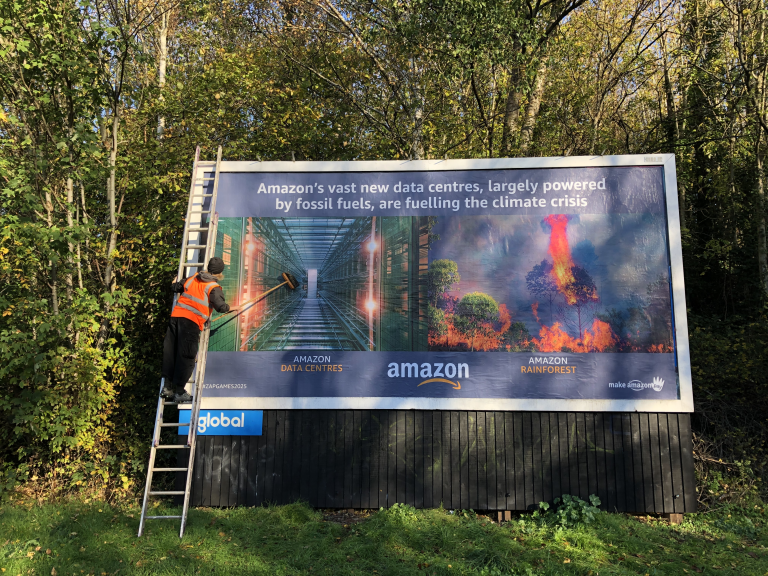
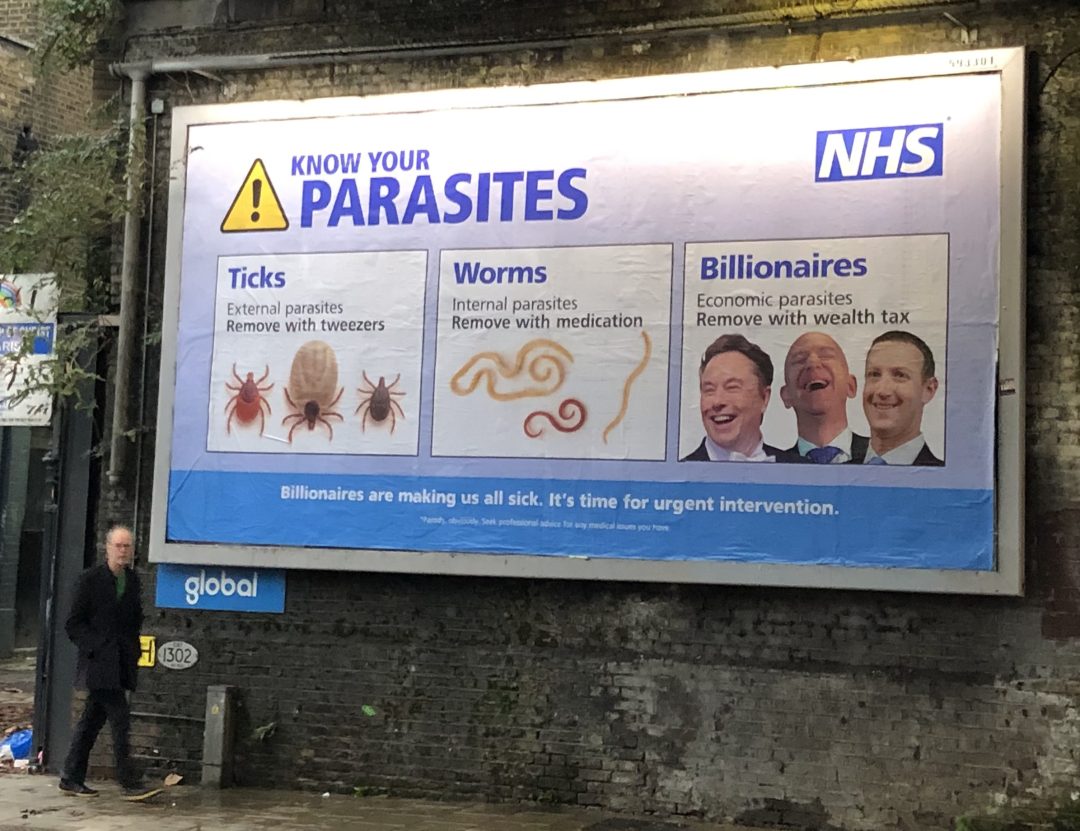
Across Europe, activists are also pushing through the ‘ZAP Games’ – two weeks of creative interventions targeting the outdoor advertising industry that saturates our streets with intrusive digital billboards. “ZAP,” short for Zone Anti-Publicité (Anti-Ad Zone), invites groups to reclaim ad spaces with art, autumn leaves, and satirical Amazon parodies.
Here in the UK, activists from the anonymous artist network Brandalism, alongside Everyone Hates Elon, have staged coordinated hacks of 100 billboard and ad spaces across London over the past two weeks, reclaiming public space and calling out the power of Big Tech.
Here in Bristol
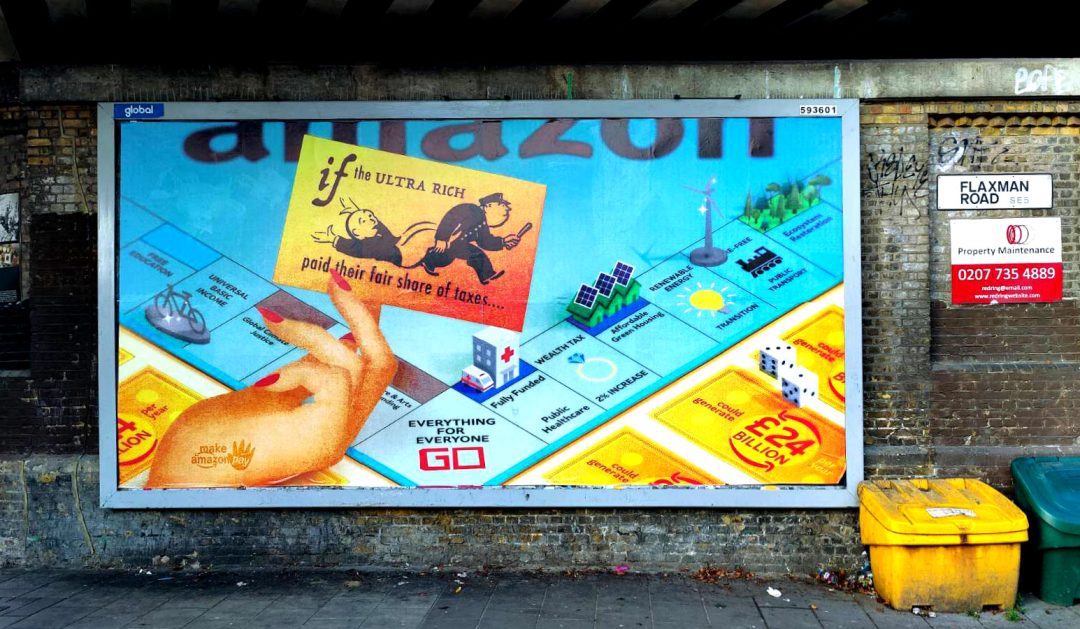
One such billboard sits in Eastgate. It shows Amazon’s energy-hungry AI data centres, which consume vast amounts of electricity and water to run and cool their servers.
As Eliza Pan from Amazon Employees for Climate Justice explains: “New data centres are directly causing utilities to build new gas plants and delay coal plants’ retirements, locking us into dirty energy for decades.”
In the UK, National Grid has already received multiple requests from data centre operators to build on-site gas plants. AI isn’t just accelerating innovation, it’s threatening to blow the energy transition off course.
To spark imagination and offer family-friendly engagement, Adblock Bristol transformed a Bedminster bus-stop ad panel into a “time machine” — inviting passersby to envision a different future.
Left unchecked, advertising shrinks our collective imagination: it dictates what we aspire to, who we become, and even our idea of the “good life”. Meanwhile, Amazon, whose fulfilment centre near Swansea is one of 31 across Britain, continues to benefit from publicly-funded transport, education and healthcare systems to fuel its growth, all while remaining world-class at avoiding the taxes that pay for those very services, moving the envelope on how we define extractivism and exploitation.
‘Advertising shits in your head’
Adblock recently ran a workshop titled “Advertising Shits in Your Head”, exploring the psychological impacts of advertising and how it shapes our desires, habits and sense of self.
Amazon is an emblematic example. The company has perfected the use of online technology, web design and behavioural psychology to keep us buying — so effectively that the US Federal Trade Commission has filed a lawsuit accusing Amazon of deploying manipulative “dark patterns” to trap customers into purchases and subscriptions.
I co-founded Adblock Bristol in 2017 to reduce the quantity of advertising in public space. We have long argued that billboards are tools for large corporations like Amazon and McDonald’s to maintain market dominance, often at the expense of smaller independent businesses.
Take for example, councillors in Newcastle who were left bemused when weak planning laws meant Amazon were able to construct their own digital billboard in the middle of the city’s main shopping street — directly drawing customers away from local shops and onto the online retailer.
Adfree Cities — the national network of anti-advertising groups, of which Adblock Bristol is a part — has now joined the global coalition challenging Amazon. The coalition’s strength lies not just in confronting Amazon’s business model, but in pushing for a reset of the labour, tax and environmental rules the UK government has so far avoided tackling.
By resisting planning applications for more digital ad screens and promoting positive alternatives like community art, Adblock Bristol aims to protect neighbourhoods from the encroachment of corporate advertising. From there, we can safeguard space for a different kind of economic imagination — one rooted not in endless consumerism, but in solidarity, community connection, ecology and equality.
Robbie Gillett is the co-founder of Adblock Bristol
Independent. Investigative. Indispensable.
Investigative journalism strengthens democracy – it’s a necessity, not a luxury.
The Cable is Bristol’s independent, investigative newsroom. Owned and steered by more than 2,600 members, we produce award-winning journalism that digs deep into what’s happening in Bristol.
We are on a mission to become sustainable, and to do that we need more members. Will you help us get there?
Join the Cable today