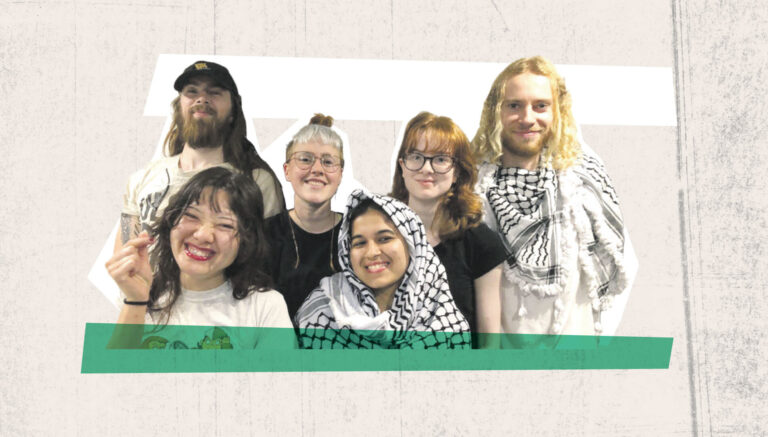
‘We wanted allies, not saviours’: Bristol’s Palestinian diaspora on allyship, isolation and enduring grief

*Names have been changed
A vigil held on 8 October last year just off College Green marked two years since Israel began its siege on Gaza. Photographs of young children with big brown eyes lit by flickering tealights on the ground, alongside a handwritten sign that read: ‘the victims of Israel’s genocide.’
A minute’s silence was punctuated with stifled cries, the air heavy with grief over atrocities too numerous to list here, and pain that long predates October 2023, the beginning of Israel’s latest onslaught, following Hamas’s co-ordinated incursions from the blockaded Gaza strip.
By that night, around 70,000 Palestinians had been killed – 20,000 of them children – and more than 169,000 had been injured. After months of relentless bombardment, much of Gaza lay in ruins, bodies still trapped beneath the rubble. Malnutrition and famine spread, while trucks carrying food, medicine and vital aid were stopped at the border and denied entry.
Physically I’m in Bristol, but mentally I’m in Gaza. I’m there on a daily basis
Of those gathered for the vigil by the steps of Bristol Central Library, the Palestinians in the crowd – around ten people from Gaza and the West Bank – carried the deepest sorrow, having watched the continued destruction of their homeland from half a world away.
“Please, don’t remember us for the broken limbs / The endless bombs / The zannaneh (constant drone noise),” read Samira*, an activist and speaker, from her poem, ‘A List to Remember’. “Remember us for the courage / For the never giving up / For the land that is more precious than our souls / For the fight to live.”
Near her stood Lina* with her father. Half-Palestinian on his side, she had grown up between Gaza and the UK. Together they lit a candle and laid flowers. Rania*, a student from Gaza whose family are still there, was also in attendance, as was Sami Al-Soos, a Palestinian from Hebron in the occupied West Bank.
By the end of the evening, these Palestinians would all leave — not just the vigil, but, they said later, the solidarity movement as a whole.
“We came away feeling devastated, shocked and angry,” Lina would tell me after. The cause of the upset came from two speakers in particular, whose addresses included prayers and calls for forgiveness to IDF soldiers.
“It’s insulting and disrespectful, this is not the time to air these views,” Lina wrote to the vigil’s organisers, Bristol Palestinian Solidarity Campaign (B-PSC).
But the vigil was only the culmination of months of mounting anguish from the Palestinians in Bristol, for whom the emotional toll of Israel’s genocide on Gaza had become compounded by exclusion and marginalisation within the very movements meant to stand in solidarity with them.
‘Mentally I’m in Gaza. I’m there every day’
“Ramadan Mubarak,” Lina says, stepping in from the rain. “I bought qatayef.”
She holds out a plate of syrup-soaked pancakes to Samira, who takes it gratefully before hurrying back to manage a noisy playdate in the living room. It is late February, the day before the start of Ramadan, and the dessert will be saved for iftar, the evening meal.
We moved into the conservatory. Rain hammers the glass. Samira’s daughter props up a phone so Rania can join us by video call.
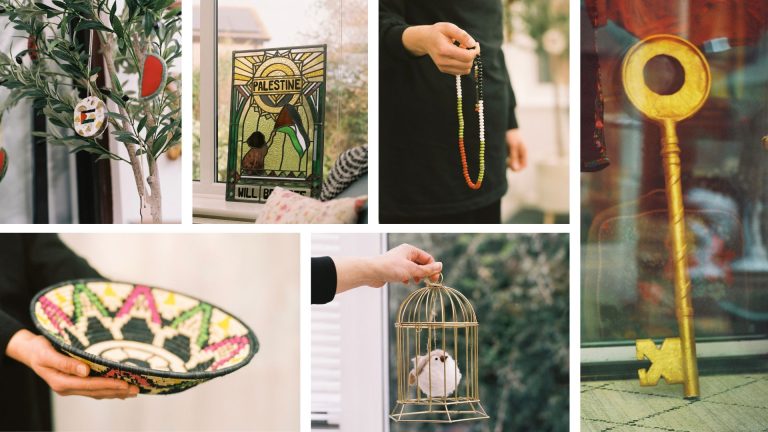
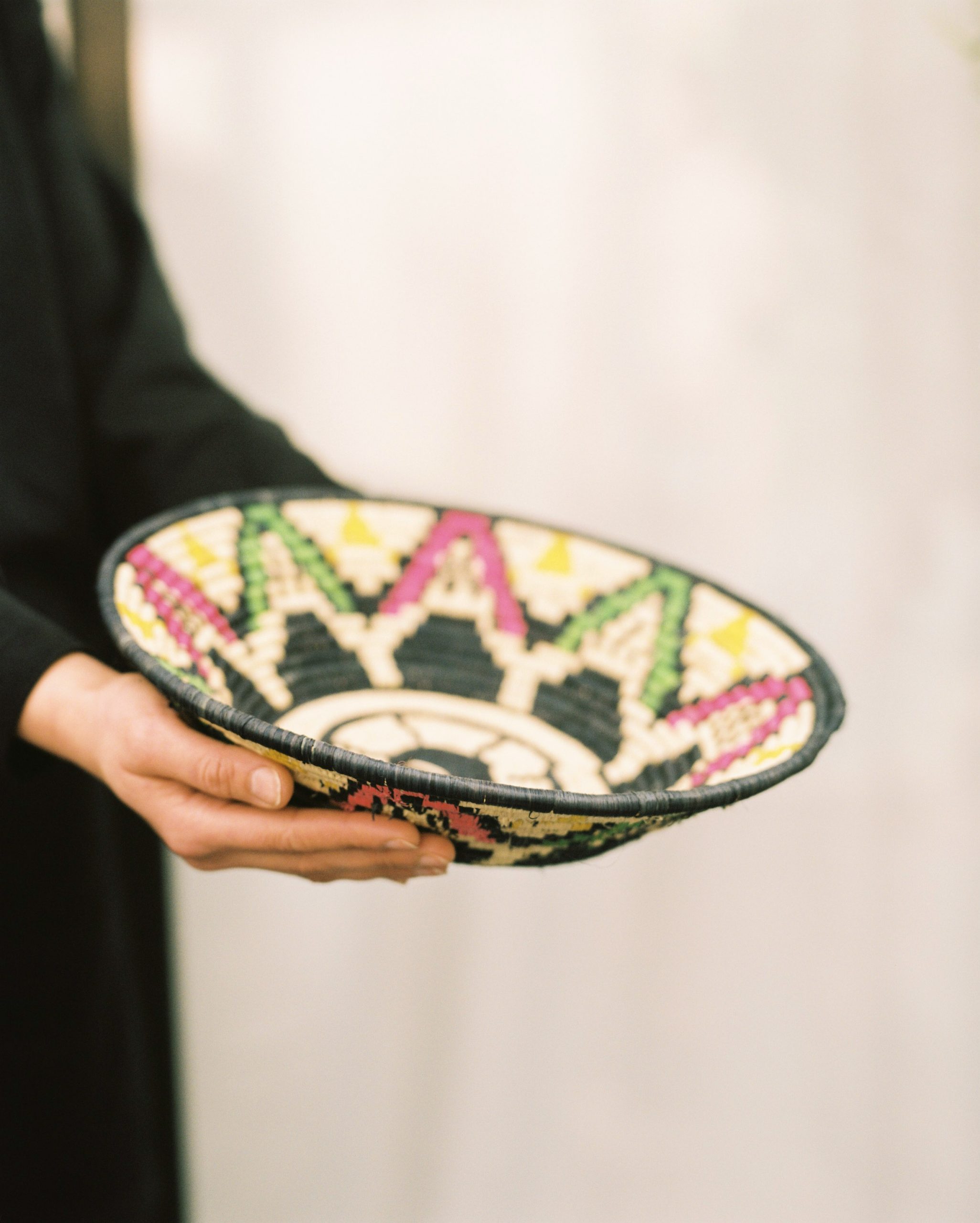
Palestine is everywhere in this room. Samira’s artwork lines the walls: maps of historic Palestine, Arabic calligraphy. A stained-glass panel reads Palestine will be free. A woven bread basket once carried by her grandmother to the bakery sits on a shelf.
A small felted bird rests inside an ornate cage. Samira placed it there symbolically. “We are a scattered people,” she says. These objects are not just keepsakes — they keep culture alive through decades of displacement.
Samira’s own life traces that diaspora: born in Kuwait to Palestinian parents who left after the 1967 war, she grew up in Jordan before eventually settling in Bristol.
During the 1948 expulsion known as the Nakba — the Arabic word for “catastrophe” — more than 700,000 Palestinians were driven from their homes by Zionist militias, their towns and villages destroyed.

My conversation with these three women at Samira’s house that February afternoon would go on for hours. We lost track of time, until the rain started hammering so hard on the glass it became impossible to hear.
But in that moment, waiting for the video call to start, there was a short silence and I readied myself to ask an impossible question: how has life been, watching a genocide unfold?
“You think it’s going to be two weeks, two months — the ‘mowing the lawn’,” says Lina. “But this time it just never ended.”
The phrase ‘mowing the lawn’ describes Israel’s strategy of periodically striking Gaza to weaken resistance groups.
Samira nods. “I was following the news obsessively. You can’t switch off. You feel it all the time.”
Both women describe the impossible balancing act of motherhood and daily life while carrying constant grief. “No one is built to take on all this tragedy and keep going,” Samira says.
For Rania, the devastation was all consuming. “Everything happened all at once. It was all over social media,” she says. “From the very beginning, I felt I had to advocate for my people. I felt a huge responsibility for my family — thinking about how to keep them safe. You go into survival mode immediately.”
“It was depressing. I couldn’t breathe,” she continues. “You feel dead inside. The place I grew up in, the hospital I was born in — destroyed. Relatives orphaned. My cousin was bulldozed to death.”
“Physically I’m in Bristol”, she says, her voice cracking. “Mentally, I’m in Gaza. I’m there every day.”
When fractures appeared
At the start of Israel’s onslaught, the women took to the streets, joining marches organised by local Palestinian groups, including the Palestine Solidarity Campaign, Stop the War and Bristol Palestine Alliance, who arranged coaches to London for national demonstrations.
“I started going out to the marches and making speeches,” Lina recalls. “The organisers wanted Palestinian voices to be heard. It was nice to scream ‘Free Palestine’, to see other people saying the same thing. It made me feel less lonely.”
But as the bombing continued, the marches began to feel hollow. “How could you have a million people marching, and it’s so disregarded? Police kicking and hitting people,” says Samira.
Lina, a long-time protestor, echoes this frustration. “[During the] first year of the genocide,” she says, “I thought with the numbers going to London, leaders would act.” She remembers standing outside Downing Street, tears streaming down her face. “I asked myself, what is this changing? I felt completely betrayed.”
It was nice to scream ‘Free Palestine,’ to see other people saying the same thing. It made me feel less lonely
Seeking a different approach, Lina suggested targeting weapons manufacturers like Elbit Systems and opposing high-profile visits from figures such as Israeli President Isaac Herzog. “I put it to the group, but no dice. No coaches, nothing. I went on my own.”
For Rania, marches were never the most effective tactic. “They could put the money to aid — starving orphans — to make sure people are warm and fed,” she says.
As the only Palestinian in the group at the time, Rania felt a deep sense of urgency and frequently proposed creative new tactics to mobilise the movement.
It was at this juncture, when approaches diverged, that fractures began to appear between them and the solidarity movement in Bristol.
‘We are all Palestinians’
Petra Mansour, a british-Palestinian arts and cinema curator, describes herself as “British with a small b,” a nod to Britain’s complicity toward her Palestinian heritage.
Her father was from Yaffa, forced to flee at the age of four to Nablus during the 1948 Nakba, later moving to the UK.
Based in Clevedon, Petra helped to establish the local branch of Friends of Palestine in 2024, hoping to create a welcoming space for solidarity. But the meetings soon became difficult. “I felt repeatedly silenced,” she says.
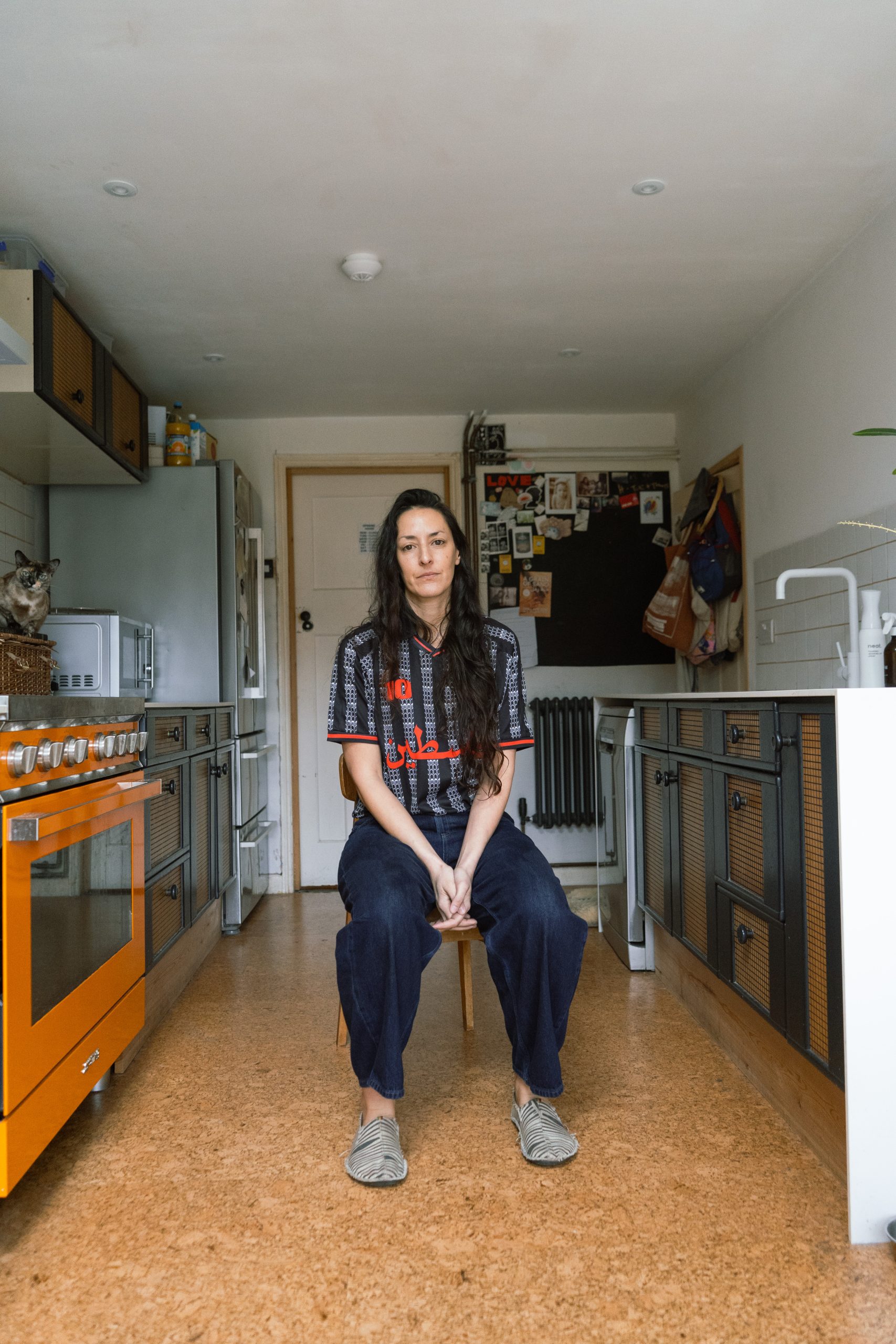
She led the first meeting, but by the second, her approach had been discarded: others had taken over chairing, imposed a new agenda, and required everyone to report on “what you’ve done for Palestine this week.”
A pattern quickly emerged — Petra’s contributions were routinely dismissed or shut down. When she suggested linking the campaign with other movements, like environmental groups concerned with land destruction, she was told the group should “just focus” and avoid intersectionality.
When she raised concerns that Palestinians’ experiences weren’t being centred, she recalls being told: “Petra, we are all Palestinians,” a literal reading of a protest slogan meant figuratively.
“It was constant,” she says. “At least every two meetings I’d be shut down.”
At one meeting, an attendee shouted at her in front of everyone for speaking without raising her hand. Moments later, a white male attendee did the same — without reprimand. No one intervened. “I was shaking,” she says. “And the meeting just carried on.”
Petra realised the group wasn’t what she thought it would be. “After a lifetime of being silenced for being Palestinian, to be silenced again in a space meant for solidarity just added more pain,” she says.
“The silence of the ‘they mean well’ people contributes to the harm,” Petra reflects. “The ‘decent’ and ‘lovely’ people that didn’t have the strength of voice, principle, or character to stand up for me. And to call yourself a ‘friend’…” She trails off, the hypocrisy too heavy to bear.
Black and White
At the 2025 Forwards Festival, tickets were allocated to Palestinian campaign groups to run stalls. Sami didn’t receive one. “I asked the groups and never got a ticket,” he says, only securing a single pass after emailing the organisers directly.
Meanwhile, Samira and Lina, invited to run a tatreez workshop — the traditional Palestinian art of hand-embroidery — arrived to find there was still no allocated workshop or art space. “We ended up on the floor,” Lina says.
For Samira, the disrespect was keenly felt. “There were dry leaves covering all my art on the ground,” she says. “I was so upset it took me two months to clean them — I couldn’t face how insignificant they made me feel.”
The festival panels, they say, were also largely unrepresentative, featuring mostly non-Palestinian speakers. “This was a big audience of festival-goers,” Lina adds. “It was a missed opportunity for Palestinians to represent Palestine because the groups prioritise themselves first.”
Sami says the movement in Bristol did not always feel this way. “Bristol was doing great at the start,” he says, pointing to the student encampment at the University of Bristol, which ran from May to July 2024 as an example of effective education and solidarity.
But other moments left him unsettled. At a 2024 protest outside the BBC about its reporting on Palestine, he recalls hearing remarks that shocked him. “One of the speakers praised an Israeli soldier in Khan Yunis for refusing to blow up a house,” he says, still incredulous.
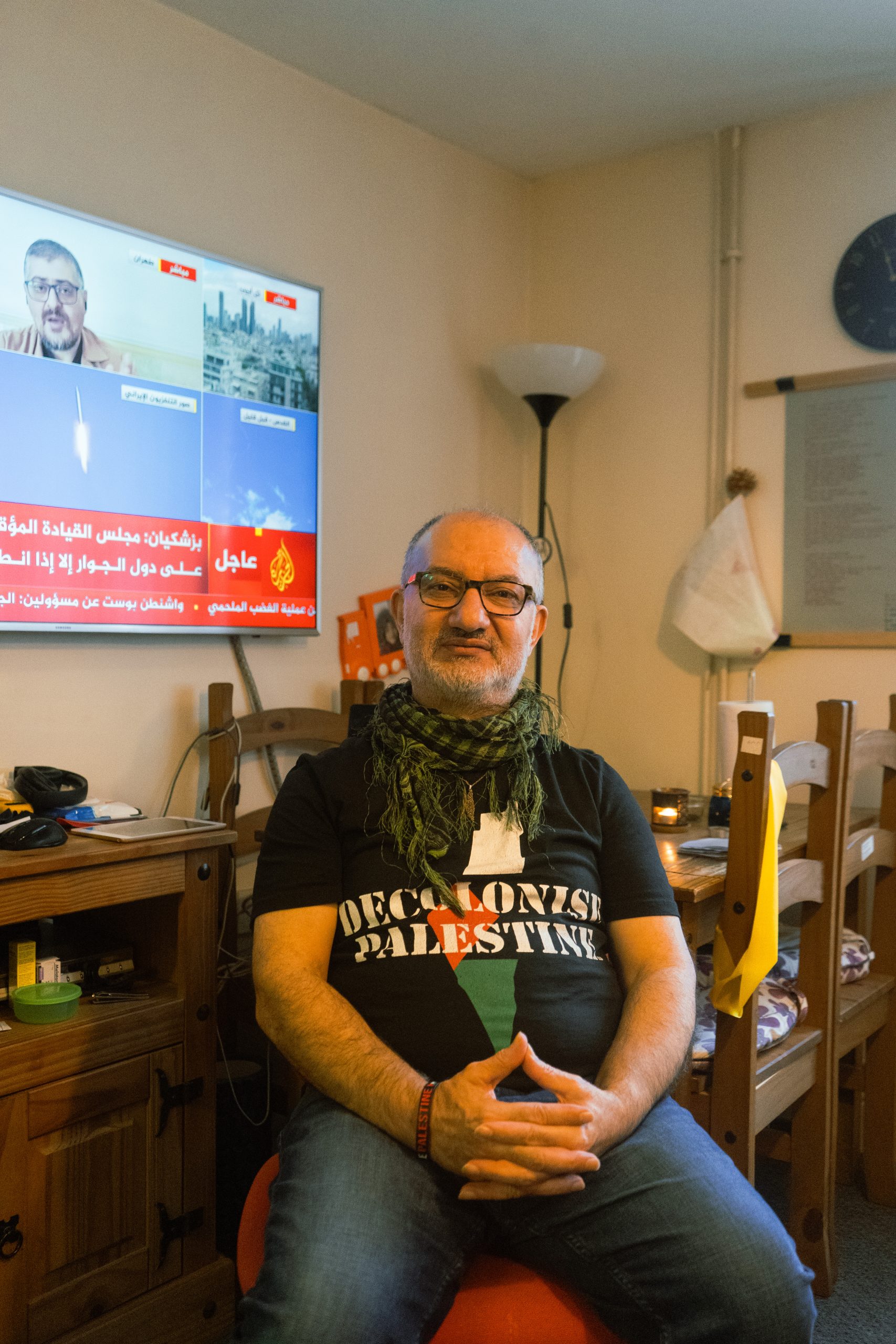
Lina describes another moment from the same gathering that angered her. “Someone told me my family had no right of return — ‘in order to build bridges’,” she says, referring to the fundamental Palestinian demand to be allowed to return to homes lost in 1948, a principle central to any discussion of justice for her people.
For many Palestinians involved in the solidarity movement, these experiences feel painfully familiar. “We have all had a lifetime of people centring Jewish or Israeli ‘liberal’ voices in the struggle for Palestinian freedom,” Petra says. “Deep down, they’ve been made to believe that listening to us would be antisemitic.” She notes that whenever Palestinian voices are ignored, the space left behind is quickly filled with misunderstanding.
Sami organises with the UK coordinator for the Freedom Flotilla Coalition (FFC) — a grassroots, people-to-people solidarity movement working to end the Israeli blockade of Gaza. He now organises with the Anti-Zionism Movement, which began in Bristol and which he describes as a grassroots, Palestinian-led initiative. The group, he says, is “unapologetically anti-Zionist, pro-armed resistance, and upholds the Thawabet.”
The Thawabet, or core Palestinian national principles, include the right of return for all Palestinians in the diaspora, recognition of Jerusalem as the capital of Palestine, understanding Palestine as the historic land of its people prior to British colonial rule, and the right to resist occupation — including through armed struggle — alongside a refusal to normalise relations with the occupier.
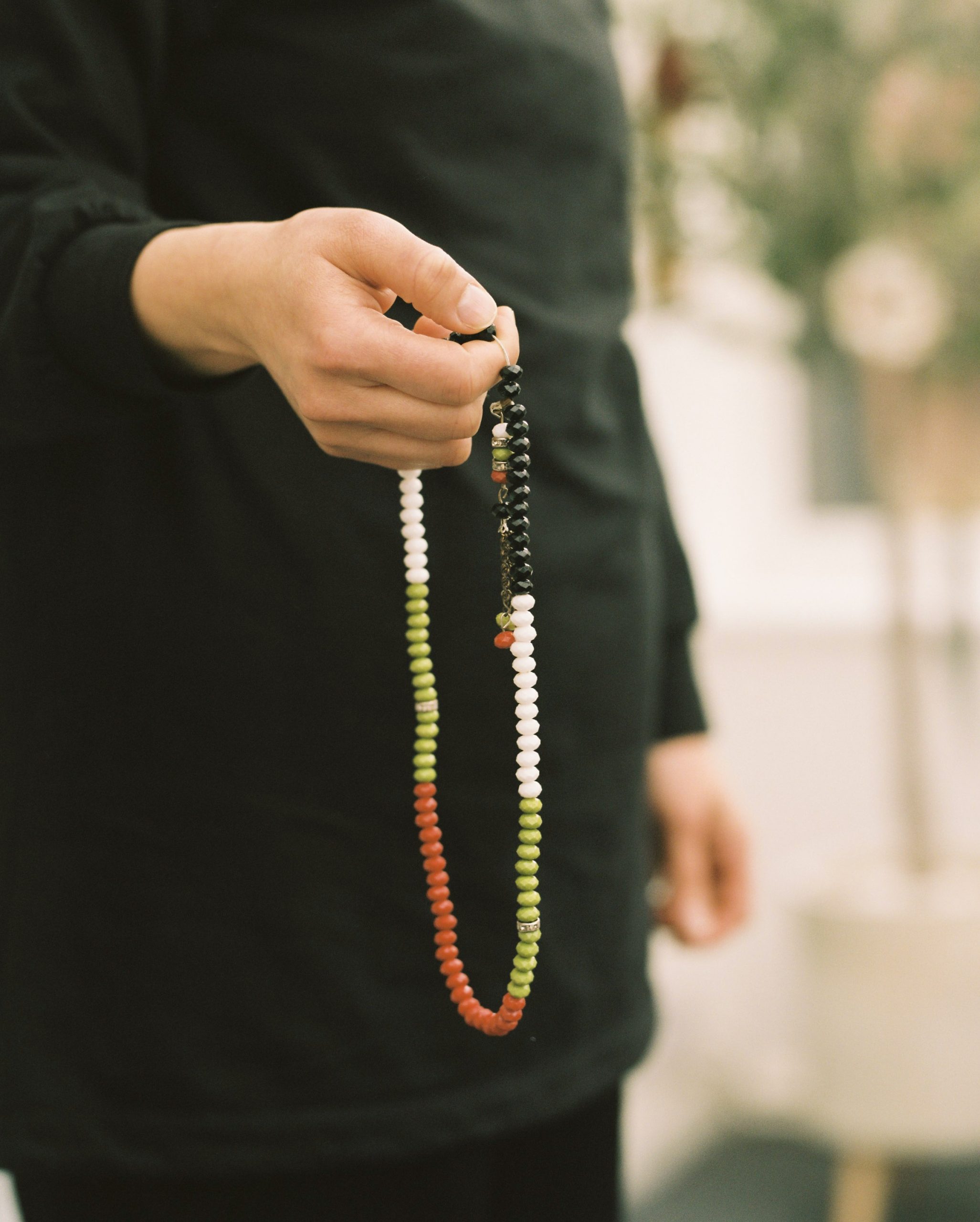
For the Palestinians I spoke to, the principles are clear — anything less renders them hollow. Samira’s second poem, Black and White, which she read at the vigil, captures this refusal to compromise, critiquing Western solidarity movements: “If you choose grey / Take off my keffiyeh / Because I am black and white / And red / Boiling angry blood / And green olive trees.”
Pushed out
Petra spent a few months trying to make things work at the Clevedon Friends of Palestine, but when things didn’t improve, she left.
Her departure was recorded in the meeting minutes: “Petra felt uncomfortable and unwelcome. As a Palestinian, her voice wasn’t heard, and her experiences — including personal, generational and familial trauma — were not taken into account or prioritised by the groups she was part of.”
After she left, the group sent her a letter. “There was no apology, no recognition of the points I raised, no acknowledgement that Palestinians should be centred,” Petra says. For Petra, the only Palestinian in the group she had helped to build, this was a cold and unfeeling end.
In a B-PSC WhatsApp group, one man called Rania “an aggressor,” while another shut her down, saying: “You know I’ve been organising since before you were born.” At another meeting, the chair challenged her directly: “Why are you in this group?” she recalls. “I said, ‘Because I’m Palestinian — and this is the Bristol Palestine Alliance.’ I was mistreated to the point I couldn’t handle it anymore for just having a different point of view.”
A narrative soon emerged that she was “too traumatised” to think clearly. “I was essentially pushed out because they wanted to do things their own way,” she says. “Shouldn’t we have a say in what we think will liberate us?”
Like all the Palestinians I spoke to, Rania struggled with the hypocrisy of being mistreated in the name of solidarity. “You want to show support for Palestinians,” she says, “but that also means standing with those in your own community who are crumbling under what’s happening.”
The weight of family and Gaza, combined with being mistreated, took a heavy toll on her mental health. “I had a nervous breakdown,” she says, her voice breaking. “We wanted allies,” Rania says angrily, “not saviours.” Burned out and isolated, Rania eventually left the movement.
Feeling spoken for but ignored, several Palestinians described a “white saviour” dynamic at play.
In comments to the Cable, Dr. Eldin Fahmy of B-PSC said concerns about “white saviourism” are legitimate and need to be taken seriously. However, they do not believe they reflect a wider pattern within the movement as a whole. Such accusations, the group said, risk amplifying right-wing narratives that seek to silence and delegitimise “social justice warriors” who speak out against injustice.
Jo Benefield, speaking on behalf of the Bristol Palestine Alliance, said the group exists “to stand in solidarity with the Palestinian people,” adding that “Palestinian voices have always been an important part of our movement.”
Benefield acknowledged that “within any broad grassroots movement there will sometimes be disagreements,” and said the organisation takes concerns raised by Palestinians seriously. She also noted that the “trauma and grief many Palestinians are experiencing” as a result of the devastation in Gaza can make activism emotionally difficult, meaning some people “step back for personal reasons.”
Activism needs decolonising. The door is not closed.
Back in the conservatory with Samira, Lina, and Rania, I sense their experience of Bristol’s activism space as another kind of displacement — pushed out of a place that should have felt like home. The solidarity they did find is with each other. “I’ve met other Palestinians from all kinds of backgrounds,” Rania says. “We all carry the grief, the trauma together… and the survivors’ guilt.”
“I can’t have a friendship with someone who doesn’t care about the issue,” she adds — a sentiment echoed by the others. Living through such a defining moment, they say, can be isolating. “You feel like no one understands your struggle.”
The protests, screenings, fundraisers, and mobilisations across the city have been powerful and important. The women are grateful to those who have organised, especially as the emotional toll of watching Gaza’s devastation leaves many Palestinians exhausted by grief and trauma.
But solidarity can feel hollow when Palestinians are not centred. “We want the actions to be centred around Palestinians,” Sanira says simply.
The frustration goes beyond individual groups or people — it reflects systemic issues. For some, it mirrors a lingering colonial mindset that has shaped Western engagement with Palestine for over a century, dating back to the 1917 Balfour Declaration, when Britain promised a “national home for the Jewish people” without consulting Palestinians.
As Petra puts it: “Palestinians have always been made to feel we should be grateful for crumbs from the table of our aggressors. Experiences like ours feel like another version of that colonial mindset. Activism in the UK needs decolonising.”
Sami stresses their criticism is aimed at the movement as a whole, not individuals. He hopes these conversations prompt reflection on how solidarity is practised — and who it centres. “We haven’t shut the door,” he says. “Come and ask us for help. We told the world what the Intifada is. We have a lot of experts.”
As the interview winds down and conversation takes over, the sense remains that this story is unfinished. “Maybe this is just the beginning,” Lina says. “How the movement responds to our collective experiences will be the real test of their solidarity.”