
“Being around these buildings,” Ryan* says as we step out of the car, “you feel like you’re witnessing a crime.”
We are not at a crime scene, but in Filton — a north Bristol suburb, six miles from the city centre. Rowan and maple trees cast faint shadows on the pavements. It’s almost peaceful.
Until, that is, Ryan gestures towards a nearby office block saying: “Every time Britain sells a plane to Saudi Arabia to go and bomb people in Yemen, somebody has to train the pilot.” He’s pointing to Ascent Flight Training, which trains pilots for the British armed forces and counts Saudi nationals among its clients.
It’s an odd feeling being here; the area feels like one big homage to its aviation heritage.
The community hub is a repurposed Spitfire hangar. On the side of an overpass, a large electronic billboard shows an army recruitment advert with the words: “You Belong Here.”
Rooftops are shaped like jet wings. Modern housing built on old airfields. Streets are named after fighter pilots from the “golden age of aviation.”
Filton has been at the heart of British aviation for over a century. It began in 1910 with the founding of the British and Colonial Aeroplane Company, transforming a small village into a hub of aircraft manufacture. During both world wars, the area’s factories produced planes for the war effort.
Famously, Concorde, the supersonic passenger jet capable of flying from London to New York in under four hours, was built here. Now Filton hosts aerospace giants including BAE Systems, Airbus, Rolls-Royce, GKN, and MBDA.
But a darker reality lies beneath. Filton’s factories, at the heart of the UK’s aerospace and defence industry, produce arms used in deadly conflicts around the world.
Unveiling this underbelly is what brought me here, on a walking tour of the area’s arms factories with activists Ryan*, Emma*, and Sally* from Bristol Against The Arms Trade (BAAT).
Stirling Dynamics Hits 600 Units
We’re in an industrial estate in nearby Stoke Gifford when Ryan stops outside a nondescript building, the kind that wouldn’t normally warrant a second glance. A new business has moved in: Stirling Dynamics.
It catches Emma’s attention. She approaches a woman on a fag break outside the reception: “Do you make anything here, or is it just offices?”
“Yeah, we do some manufacturing here,” the woman replies. Moments later, a man in a charcoal suit comes to join his colleague. “Who are you?” he asks Emma. “Just a curious passerby!” Emma replies.
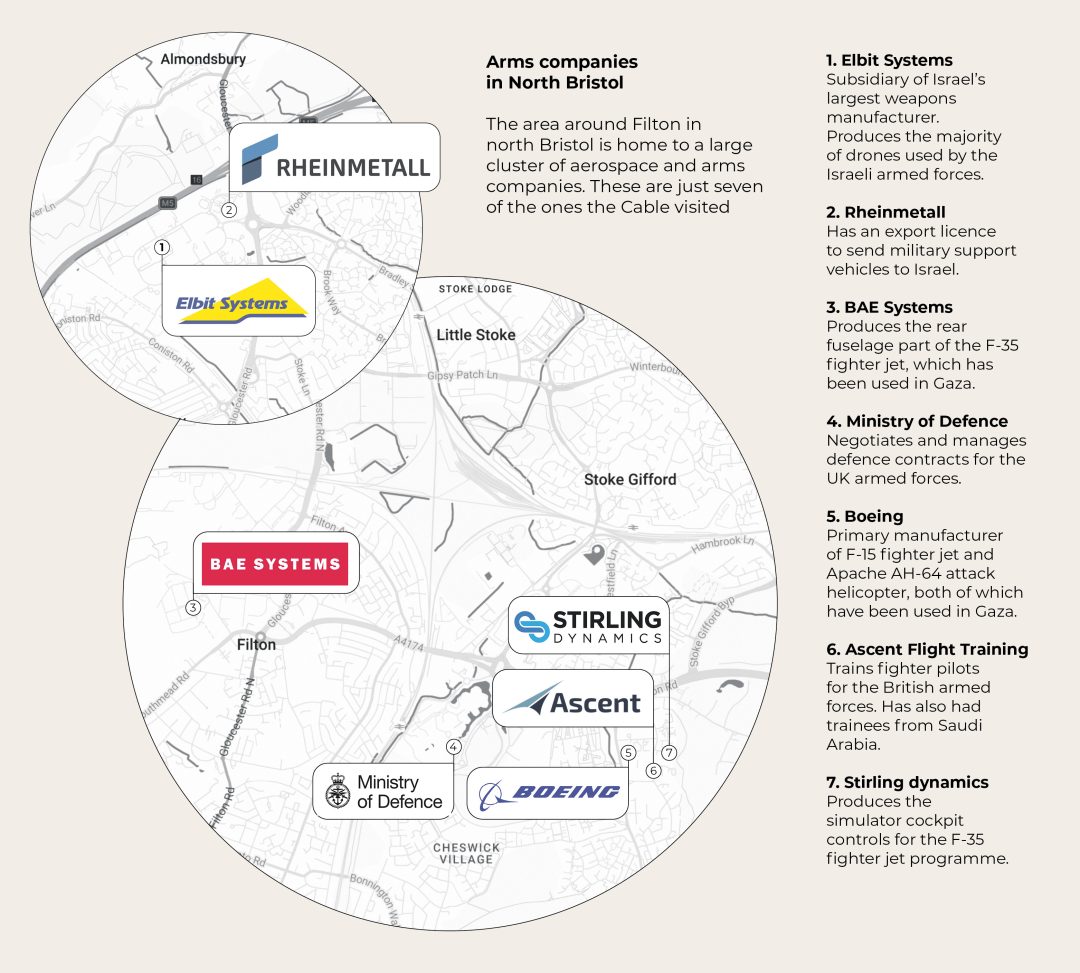
The pair stiffen, the conversation peters. Their unease may be because Stirling Dynamics is a supplier for the F-35 fighter jet programme. This site holds an open general export licence (GEL) allowing it to sell unlimited quantities of simulator cockpit controls to partner countries including the United States.
“It might mean they don’t export directly to Israel,” Ryan explains, “but their parts could still end up there.”
The company’s website proudly notes production of its ‘600th production unit’ for the F-35 programme. Seemingly unconcerned by the devastating use in ‘designated safe zones’ in Gaza and the West Bank.
“It’s murky as hell,” Ryan mutters.
Boeing not accepting CVs
Ryan checks the route on his phone, and notices an unmarked building on the map. Curious, we pull into the car park. Only a few vehicles are around, the windows are blacked out, and it’s hard to tell if anyone is inside. Through the glass, we can just about make out one word: Boeing.
Last year, Boeing — the world’s fifth largest arms manufacturer — recorded profits of $2.24bn (around £1.6bn). Its F-15 fighter jets and Apache helicopters have both been deployed in Gaza.
Ryan points to a long row of empty bike racks: “Look how eco-friendly they are,” he jokes.
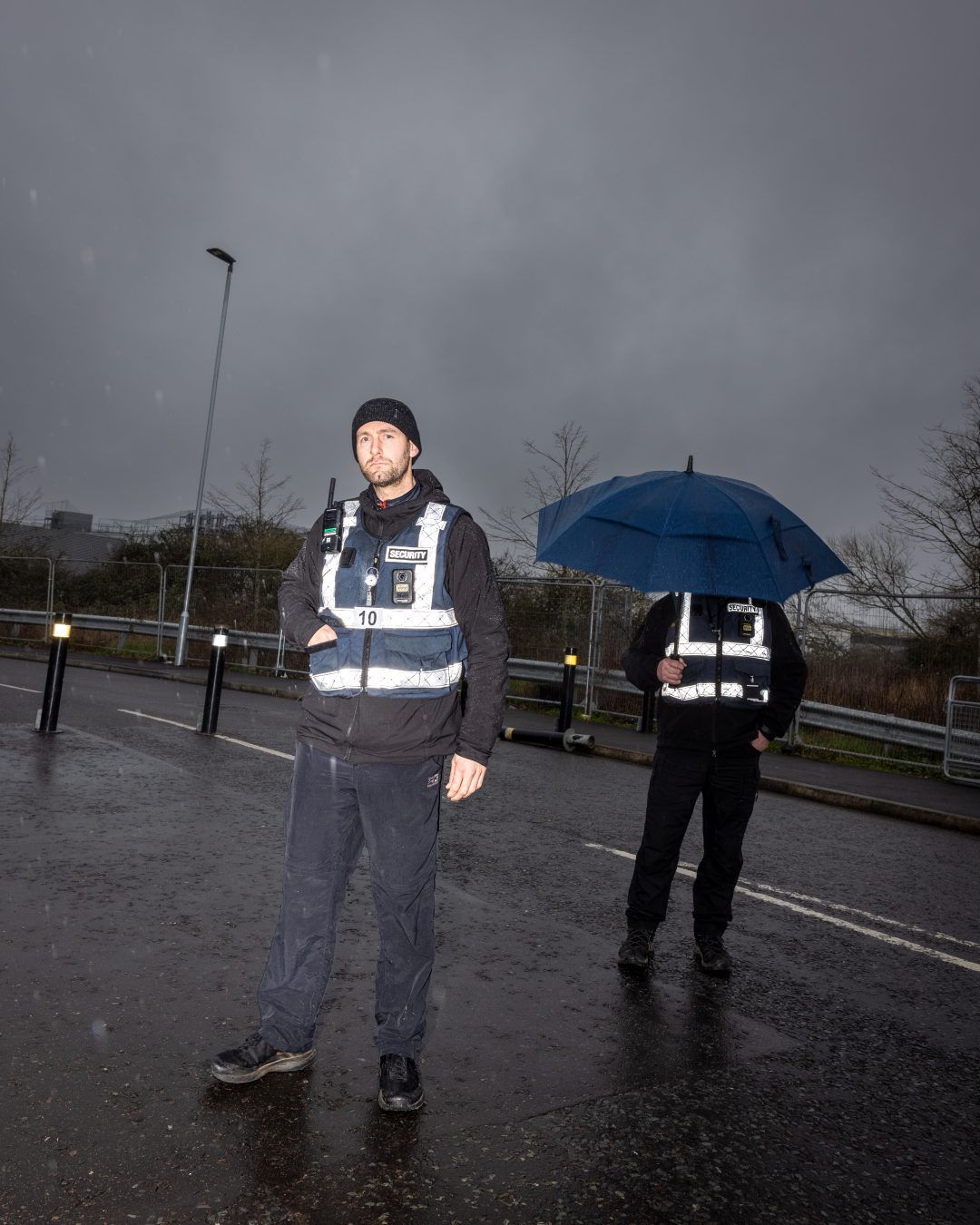
Footsteps interrupt us. “What are you doing here?” demands a large security guard. A silence falls, for what feels like an eternity. “Just wondering if I can apply for a job?” Ryan asks.
Either unconvinced, or unwilling to network, the guard ignores the request. He turns to mutter into a walkie talkie. Soon another sturdy looking bloke, nearly 2 metres tall, approaches. We take the hint and leave.
Crocodiles in the ‘UK Pentagon’?
Next is the Ministry of Defence (MOD) at Abbey Wood. At 98 acres — roughly 50 football pitches — it is Britain’s largest MoD site, earning it the nickname the “UK’s Pentagon.” Prior to the pandemic, around 8500 people worked at MOD Abbey Wood.
When it opened in 1996, rumours suggested it held missiles and even crocodiles in the lake. What is verified is that this is the MoD’s procurement arm, one of its clients is Israel.
In 2025, the MoD awarded a £10 million contract to Pearson Engineering, acquired in 2022 by Rafael, Israel’s state-owned arms company. Rafael operates under the authority of Bezalel Smotrich, Israel’s far-right finance minister, who was sanctioned by the UK government in 2025.
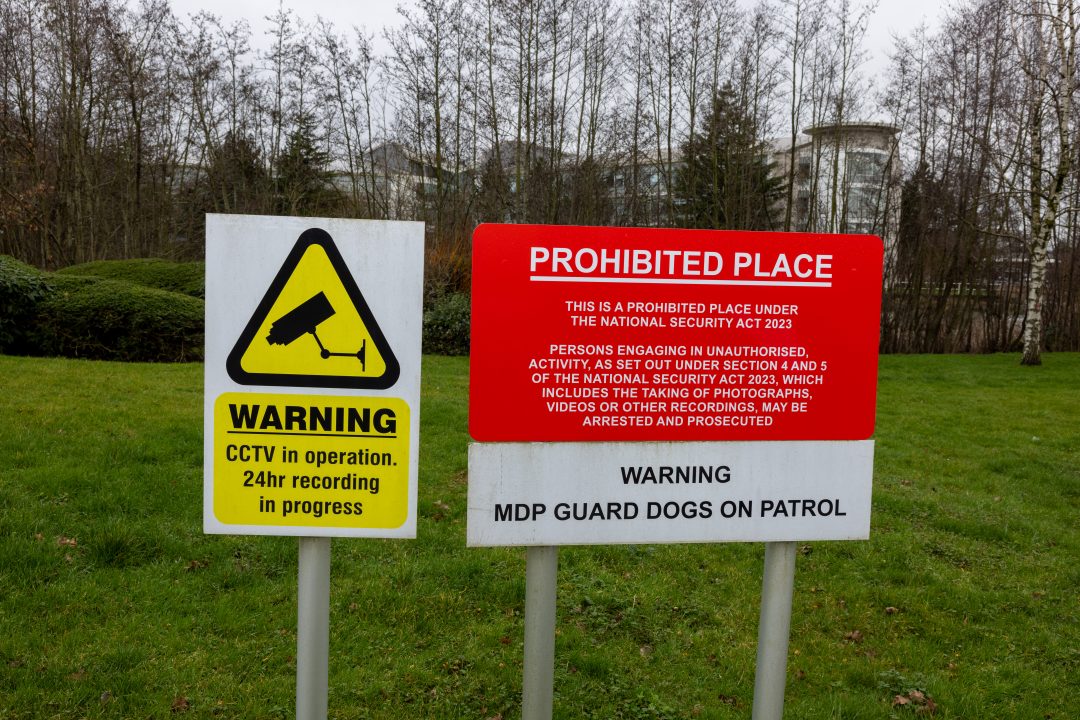
Warning signs line the perimeter, no photos, no entry. We take these as friendly suggestions rather than actual rules, and make our way to the entrance. That is, until we notice several guards at the checkpoints watching us. Not wanting to push our luck, we retreat.
As we leave, hundreds of workers begin filing out for their lunch break. I’m struck by how ordinary they look. Some are dressed in suits, a few wear military hats, but most are in hoodies and jeans.
As luck would have it, a few days later I ran into Paul, a Filton resident of over fifty years and former MoD cleaner. After a bit of probing, he admits there’s really “not very much at all” inside. No crocodiles, though the site does have its own hairdresser.
He does worry about the building being bombed, “’cos I live on that same street.”
Back on the main road, on the right hand lane of the dual carriageway, our next stop: BAE Systems, Europe’s largest arms manufacturer. Security guards patrol the perimeter, ringed by particularly sharp looking razor wire. The whirr of heavy machinery fills the air.
Near the security gate, three young men head inside. Sally asks if they know what’s being built inside. They pull up their hoods and quicken their pace.
BAE produces the rear fuselage of the F-35 fighter jet, accounting for 13–15% of the total labour required for each aircraft. It employs 2,300 people across six locations in the South West, including two in Bristol.
The site itself is already massive, but the scaffolding towers and construction lorries show it’s still expanding.
Elbit, and a slow motion standoff
Our next stop is the UK’s main operational facility of Elbit Systems, a subsidiary of Israel’s largest arms company. The building itself is unremarkable, but you can’t help feeling unnerved as you approach.
This £35 million manufacturing site made headlines when Palestine Action raided it in August 2024. The damage reportedly topped over £1 million, sparking rumours of closure.
But the site is very much active. As lorries exit the site, I can’t help but wonder what they contain.
Elbit describes their products as “propel[ing] warfare into an imaginative future” and “battle tested.” In practice, this means 85% of Israel’s killer drones and land-based military equipment are made by the company here —and then deployed with deadly effect in Gaza.
Sally notes security has been “beefed up” since their last visit. On cue, a guard tells us to stop taking photos, before taking out his own phone to film us.
The rain becomes heavy, and we decide to return to my car. Only to find two police officers waiting next to it.
“We’ve been called down here in relation to this vehicle scoping out another building,” one of them explains. “So we are just trying to work out what the craic is.”
Their car is parked in front of mine, blocking me in. Soon after, three more police cars arrive. Altogether there are eight officers and a dog unit – quite the operation.
They check my licence. A ninth officer is called to confirm that everything is above board. It’s hardly a high speed chase, but along with the rain it’s incentive enough for us to move on.
‘It doesn’t bother me’
Allow me a small interlude from the walking tour.
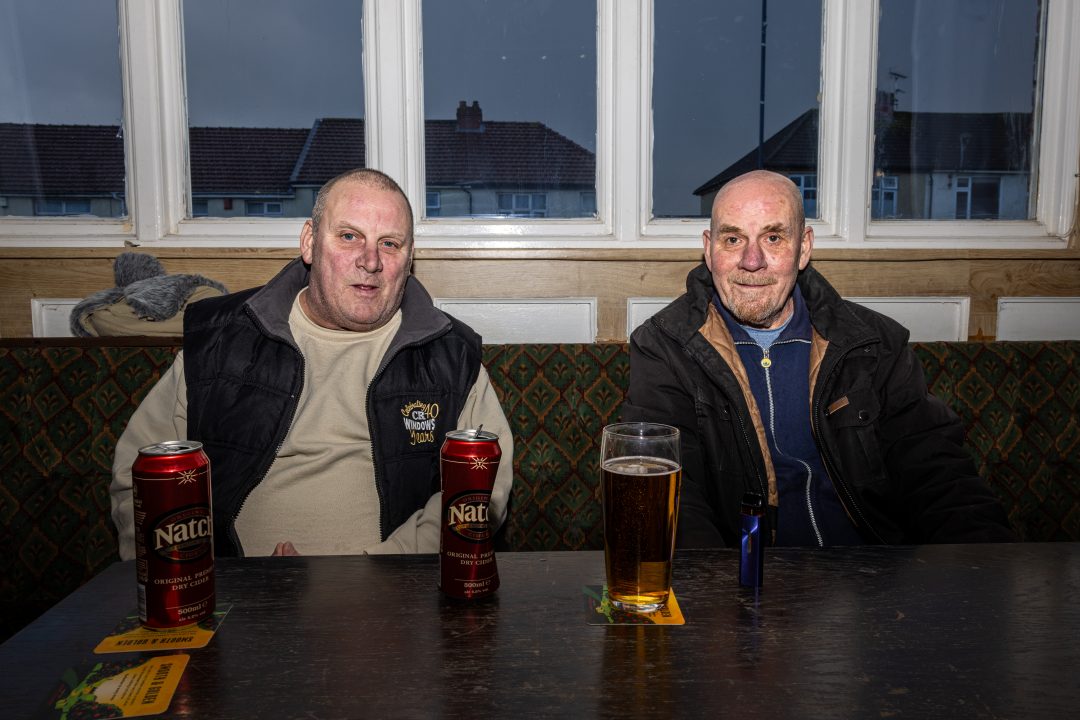
Some days later, photographer pitlad and I head to the local boozers to chat to local residents. We go to The Bull Dog, described affectionately by one Reddit commentator as: “rough as a badger’s arse.”
The pub is—of course—named after a fighter jet from the interwar period, best known for being flown by Douglas Bader, an RAF pilot who lost both legs after crashing it doing some unauthorised aerobatics. Remarkably, Bader went on to serve in the Second World War and became something of a national hero.
A painting of the jet in its former glory hanging on a wooden sign. We’re told workers from the base and nearby factories drink here.
Our welcome is suspicious, but warm enough. A small crowd is gathered round the fruit machine, while a man plays pool against himself.
We chat with Kev, a former construction worker who’s lived in Filton for 59 years. “The area hasn’t changed a great deal,” he says. But adds that the construction of the MoD site in 1996, has “brought a lot of new people here.”
“I know what some of these companies produce but it doesn’t bother me,” he adds.
Time to leave Filton
As we continue the tour, a school bus waits in the Airbus car park. I’m reminded of a previous article I wrote about arms companies courting schoolchildren under the guise of promoting STEM careers, conveniently glossing over their role in the arms trade.
Mercifully, the torrential rain has eased, and the sky is clearing as we head to our final stop: the Rheinmetall factory. Rheinmetall, a German arms company and the fifth largest in Europe, uses its Filton facility as its UK headquarters. Since 2023, the factory has held a £10 million export licence to send military support vehicles to Israel.
“Fucking hell,” Ryan exclaims. Before us looms a giant, khaki-green army truck, taking up multiple parking spaces. These factories usually keep their products out of sight—it’s strange to see such a brazen display.
As we approach the truck, not for the first time today, we have the feeling we are being watched. We turn to see a face peering from a van marked ‘private dog security firm.’ Just another reminder of the extreme lengths these businesses go to protect the military-industrial complex.
We’ve seen enough. It’s time to leave Filton.
Independent. Investigative. Indispensable.
Investigative journalism strengthens democracy – it’s a necessity, not a luxury.
The Cable is Bristol’s independent, investigative newsroom. Owned and steered by more than 2,600 members, we produce award-winning journalism that digs deep into what’s happening in Bristol.
We are on a mission to become sustainable, and to do that we need more members. Will you help us get there?
Join the Cable today