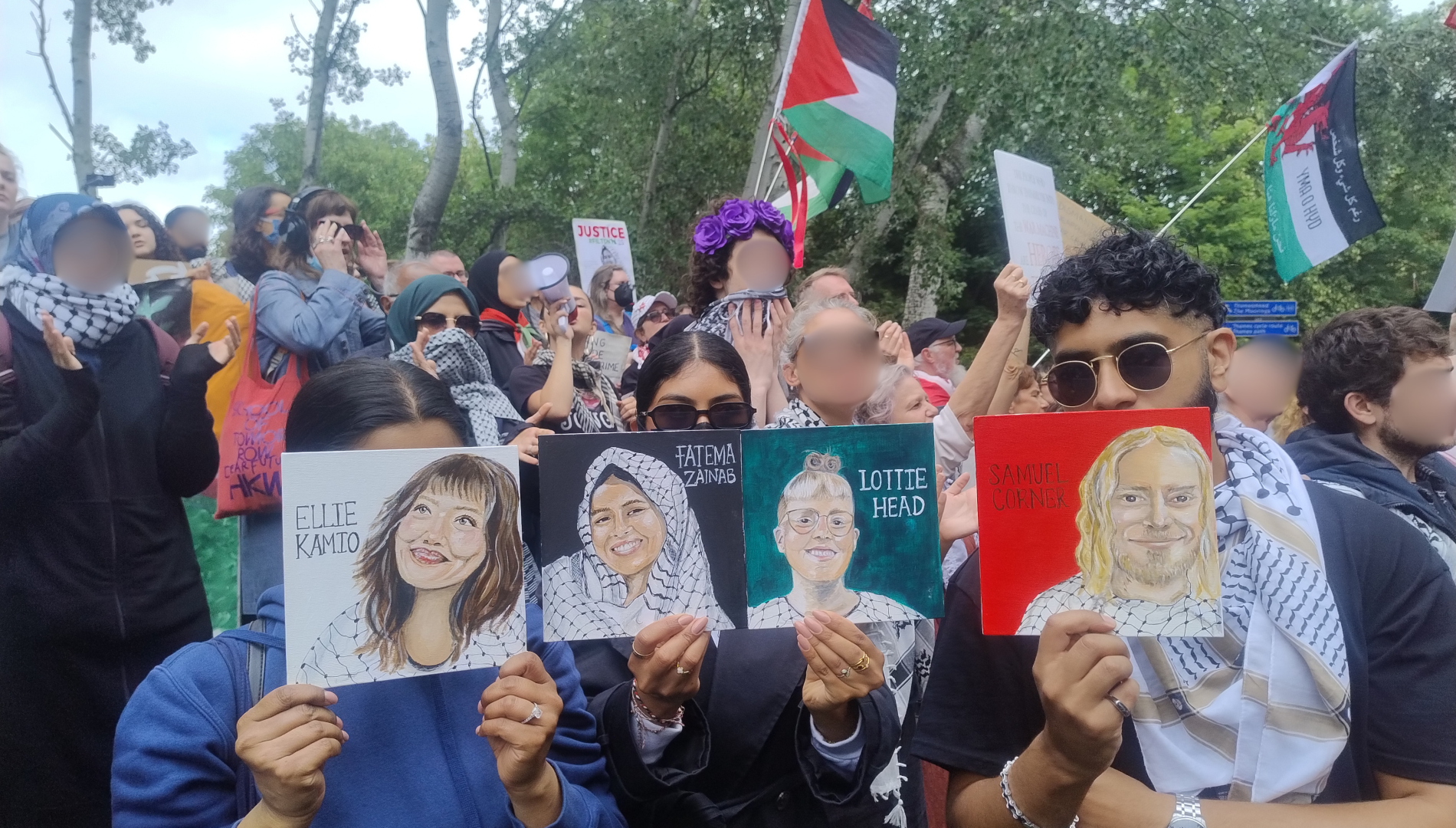

“In order to hear the birds, the drones must be silent,” called defendant Leona (Ellie) Kamio from the dock at Woolwich Crown Court as judge Jeremy Johnson delivered his sentence.
Her words echo a line from Palestinian poet Marwan Makhoul: “In order for me to write poetry that isn’t political, I must listen to the birds. And in order to hear the birds, the warplanes must be silent.”
Moments later, Kamio and three fellow activists were handed prison sentences totalling 26 years.
In an unprecedented move, Justice Johnson ruled that their offences carried a “terrorist connection“— the first known instance of a criminal damage conviction attracting a terrorist enhancement in the UK courts.
The case was over a Palestine Action action in August 2024 at the Elbit Systems factory in Filton, Bristol, where activists caused an estimated £1.2m in damage. Twenty-five people were eventually charged, with the cases split across multiple trials.
These direct actionists have done more to prevent the commission of genocide than almost all of us combined
Tim Smith, doctor
In the first trial, six defendants were acquitted of aggravated burglary, while violent disorder charges were dropped. Jurors could not reach verdicts on criminal damage, leading to a retrial.
That retrial ended in May 2026 with four activists convicted of criminal damage. A fifth defendant, Samuel Corner, was also convicted of grievous bodily harm (GBH) without intent after a police officer was injured during the action.
At the sentencing on 12 June, Fatema Zainab Rajwani, 21, received five years and eight months in prison for criminal damage. Charlotte Head, 29, and Leona (Ellie) Kamio, 30, were each sentenced to around six years for criminal damage. Corner, 23, received the longest sentence of eight years and eight months for criminal damage and inflicting grievous bodily harm on a police sergeant.
Days later, the Court of Appeal upheld the government’s decision to proscribe Palestine Action as a terrorist organisation — the first direct-action protest group to be banned under UK terrorism legislation. This marked the latest development in the ongoing state repression and the use of terrorism powers against pro-Palestinian protest.
‘Tools of genocide’
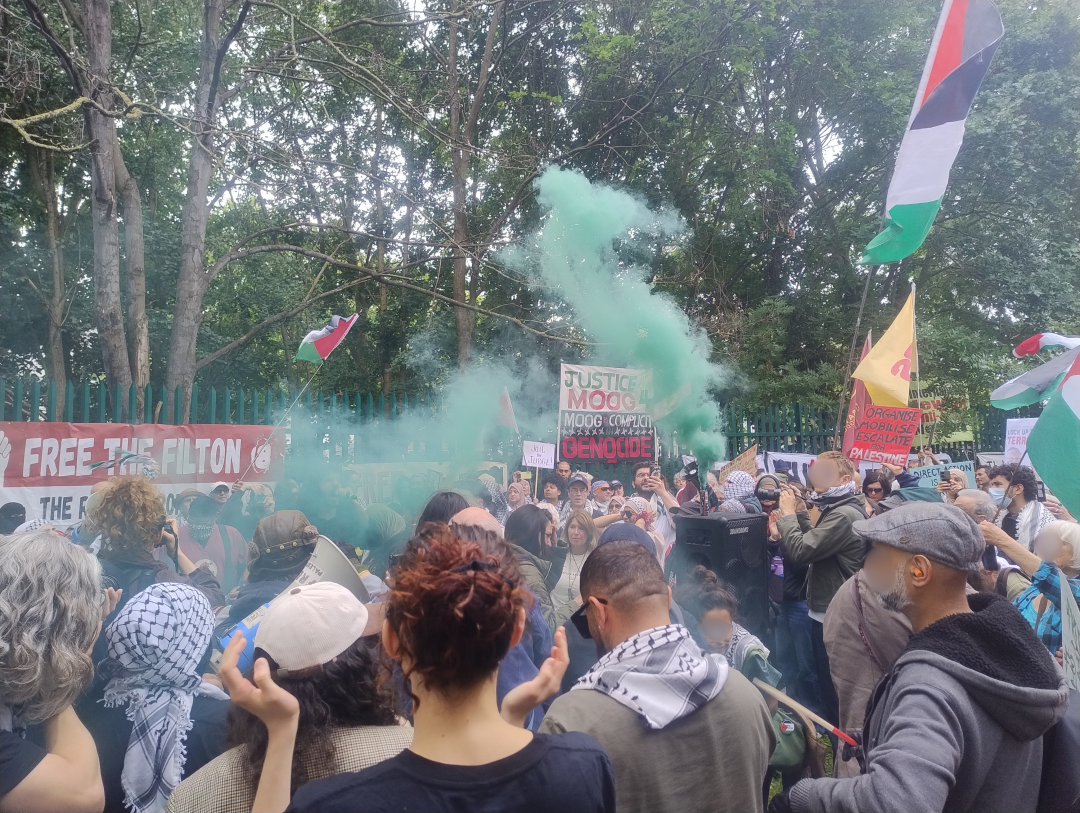
Outside the court, more than a thousand people gathered as the verdict was handed down to the first of the Filton 25 defendants. Some waved Palestinian flags, others held placards, one reading: “saving lives is not terrorism.”
Audio of the sentencing was streamed outside, crowds booed as Justice Johnson delivered his ruling. Justifying his use of the terror enhancement he said: “The action was designed to influence the UK government and also to intimidate a section of the public… and was for the purpose of advancing an ideological or political cause.”
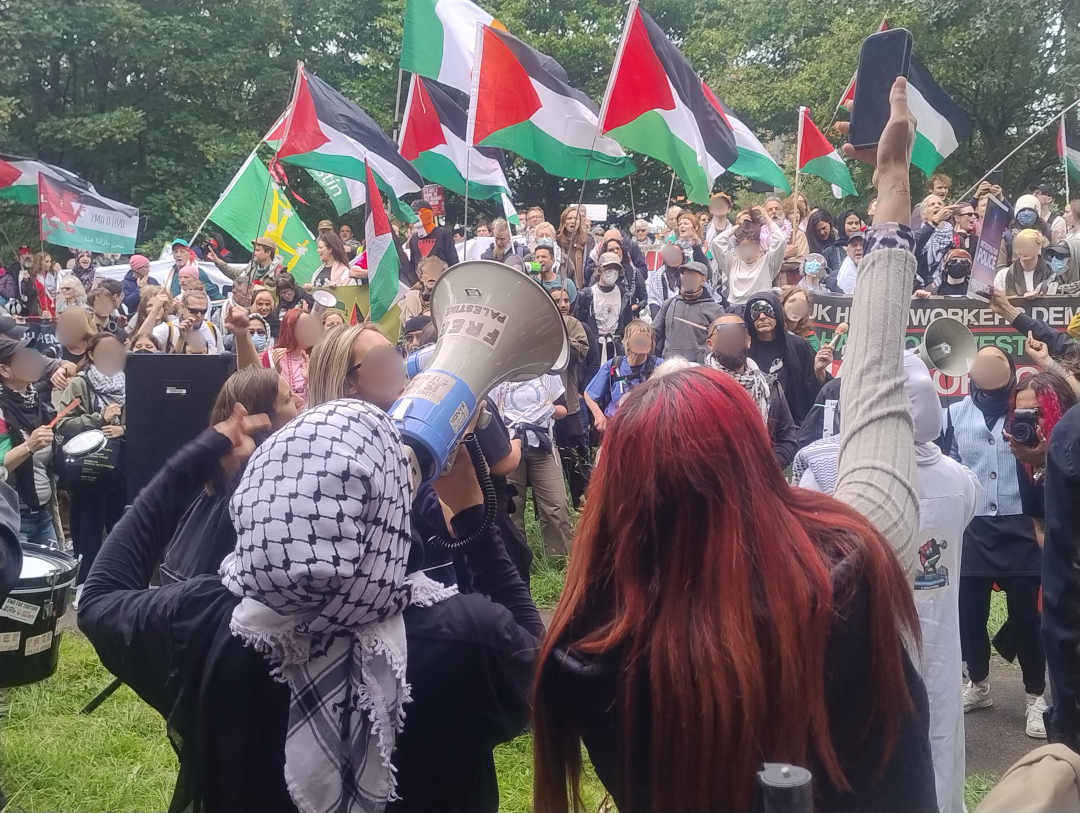
After sentencing, supporters spoke to the crowd in solidarity with the defendants. Tim Smith, a doctor who worked in Gaza during the war, described treating children in Rafah and Khan Younis, many of whom later died or suffered life-changing injuries. He said he had been deeply affected by accounts of the defendants’ actions.
“These drones were, and still are, tools of genocide,” he said, referring to the drones destroyed by the activists. “These direct actionists have done more to prevent the commission of genocide than almost all of us combined — including many of us who were in Gaza physically.”
Fatema Zainab’s mum, Sukaina Rajwani, told a crowd of supporters outside the court that her daughter’s “dissent and direct action” — “dismantling weapons used to slaughter children” — had been treated “as terrorism”.
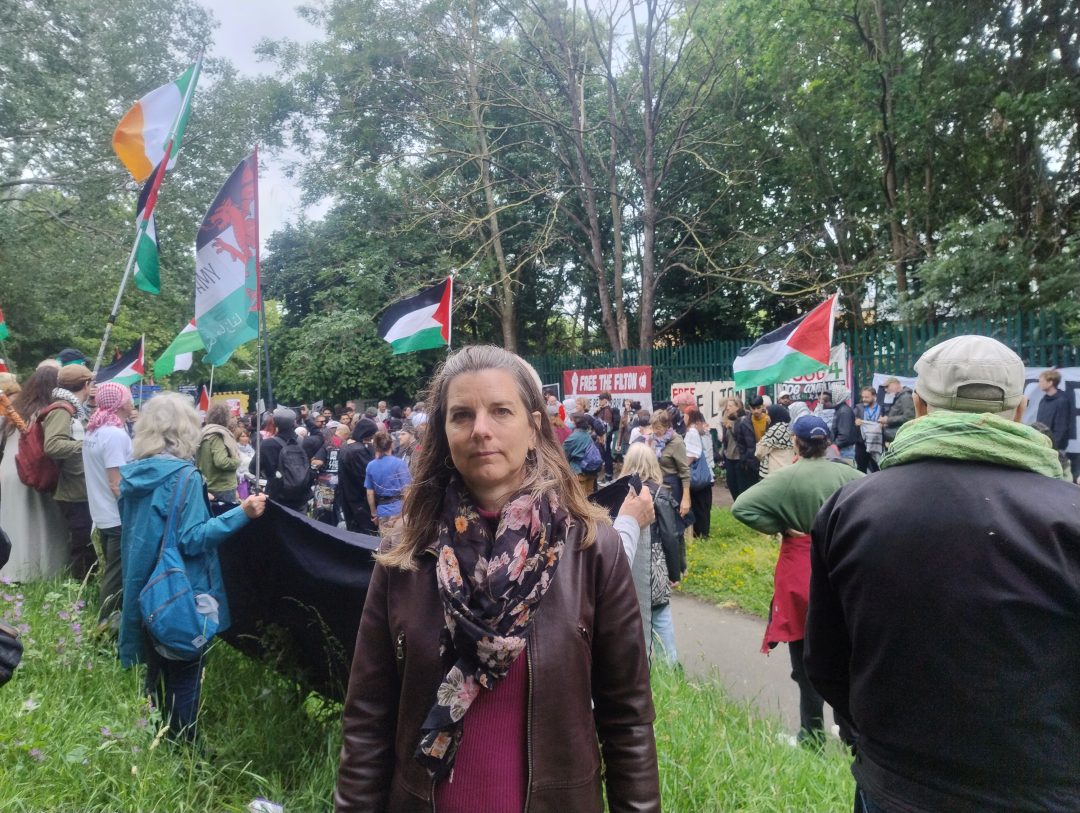
I spoke to Clare Hinchcliffe, mother of acquitted Filton 25 defendant Zoe Rogers. Clare said reporting restrictions meant there was “no transparency around the trial”. In her view, Judge Johnson created an atmosphere of fear and intimidation in the courtroom, particularly for barristers.
But the support shown outside court throughout the proceedings got her through: “I can’t express how grateful I am for people turning up outside court day after day after day. We had Parents for Palestine bringing food to the families every single lunchtime.
“The support on social media, the support on the streets, the marches have really carried us,” adds Clare.
The terror connection
The Cable covered the first trial of the Filton 25 and reported on the use of counter-terror powers used in their detention before that, including solitary confinement and repeated interrogation, despite not being charged with terrorism.
Some defendants will have spent nearly two years on remand awaiting their court date.
If they are doing this to pro-Palestine activists, they can do it to anyone… they can apply a terrorist connection to any form of dissent they don’t like. We cannot let this go unchallenged.
Clare Hinchcliffe
The jury were not told that sentencing could carry a terrorism-related enhancement: the trial itself remained subject to strict reporting restrictions until 12 May.
While within the Judges remit to do so, introducing a ‘terrorism connection’ only at sentencing has prompted concerns about transparency and due process in how protest cases are framed. Critics argue that jurors were effectively asked to determine guilt without knowing that a terrorism-related enhancement could later be applied to the defendants’ sentences.
The ruling will carry lifelong consequences. The defendants are required to serve at least two-thirds of their terms in custody, rather than a minimum of 40% many need to serve following recent changes to legislation to address overcrowding in prisons.
On release, they will also face 15 years of compulsory police reporting, and ongoing requirements which could include telling authorities about their electronic devices, finances, where they live and personal relationships.
Disputed proceedings
Inside the courtroom, Johnson ruled the defence could not argue lawful excuse or necessity — meaning they could not claim the damage to the Elbit factory was justified by the need to saving lives. He also banned them from explaining what was going on in Gaza and the wider war, as well as terms like “genocide” and “ethnic cleansing.”
As the three-week trial drew to a close, several defendants chose to dismiss their lawyers and represent themselves, saying it was the only way to speak more freely within the constraints imposed by the court.
Tensions over the judge’s conduct escalated further when he attempted to have contempt of court proceedings brought against defence barrister Rajiv Menon KC for reminding the jury in his closing statement that they had the right to acquit based on their convictions. The Bar Council described the move as “troubling”, and it was later blocked by the Court of Appeal.
“I was wrong to do that and I’m sorry about that, of course,” Judge Johnson said at the hearing on Monday 8 June.
A separate procedural dispute arose over a witness statement assessing the value of damage at the Elbit factory, submitted just eight days before sentencing. Menon KC argued it was far too late to be fairly tested, calling its admission “a gross affront to the integrity of the criminal justice system”. The judge admitted the evidence but said he would only rely on it in a limited way.
On 9 June the defence team applied for Johnson to remove himself from the case, accusing him of bias. He refused. More than 5,100 legal experts and professionals later signed a letter to the Judicial Conduct Investigations Office, raising concerns about bias and conduct during the trial.
‘A show trial’
A spokesperson for the Filton 25 Defence Campaign confirmed that an appeal has already been lodged. Campaigners will also be appealing the Court of Appeal’s ruling to the Supreme Court. Meanwhile the trial of the next batch of defendants began on 15 June at London’s Old Bailey.
Between the proscription of Palestine Action and Friday’s sentencing, the case sits within the context of a broader tightening of protest policing, with counter-terror laws increasingly deployed against dissent. Thousands have been arrested since the proscription for expressing support for the group.
Kevin Blowe from the Network for Police Monitoring told the Cable that the Filton 25 case had been “a show trial intended to punish beliefs that the government wants to silence”.
He said young campaigners were being “demonised”, with the courts encouraged to “ignore their motivations, all to protect corporate power” and the interests of the Israeli and British states.
For supporters, the implications go beyond this case. “The sentences are a turning point in British history,” said Clare.
“If they are doing this to pro-Palestine activists, they can do it to anyone… they can apply a terrorist connection to any form of dissent they don’t like. We cannot let this go unchallenged. We’ve got to make the most uproar possible.”
Independent. Investigative. Indispensable.
Investigative journalism strengthens democracy – it’s a necessity, not a luxury.
The Cable is Bristol’s independent, investigative newsroom. Owned and steered by more than 2,600 members, we produce award-winning journalism that digs deep into what’s happening in Bristol.
We are on a mission to become sustainable, and to do that we need more members. Will you help us get there?
Join the Cable today



Report a comment. Comments are moderated according to our Comment Policy.