East Bristol’s ‘liveable neighbourhood’: Is this really progress?

The East Bristol Liveable Neighbourhood (EBLN) was designed to make the area safer and encourage active travel like cycling, giving priority to pedestrians over cars to improve the environment locally. Sounds nice, right?
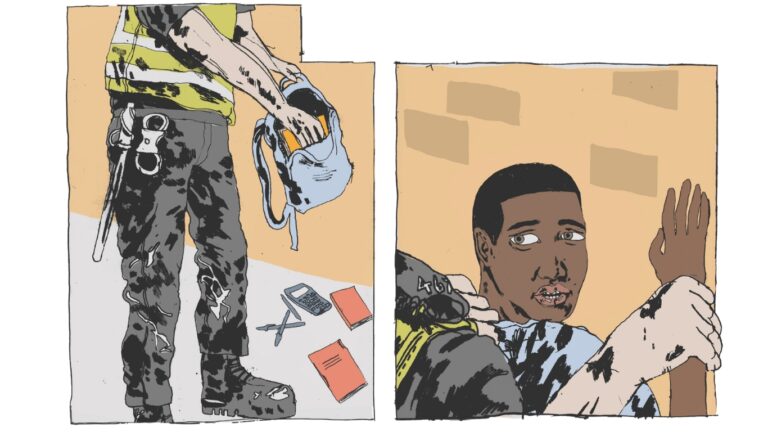
But to finish the job in March – installing planters, bus gates, etc. – the council needed the support of the police and private security. They arrived in the middle of the night to try and avoid protesters who had previously stopped work being done.
The controversy that surrounds the scheme centres on Bristol City Council’s failure to properly consult with residents of the area before making the call on what changes would be made to the streets of Barton Hill, St George and Redfield.
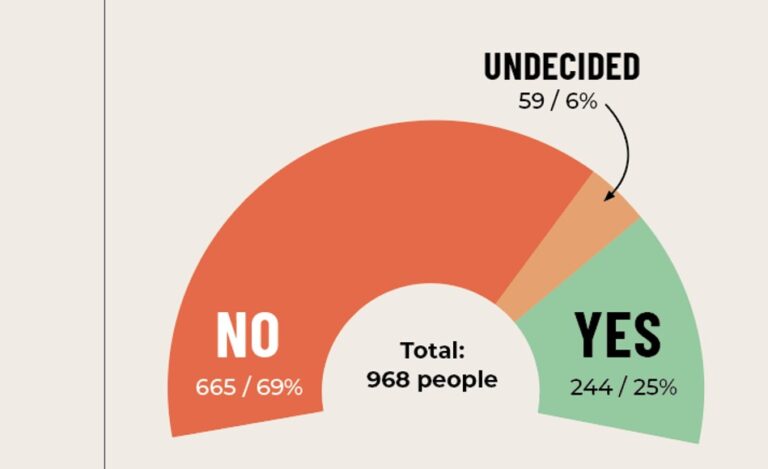
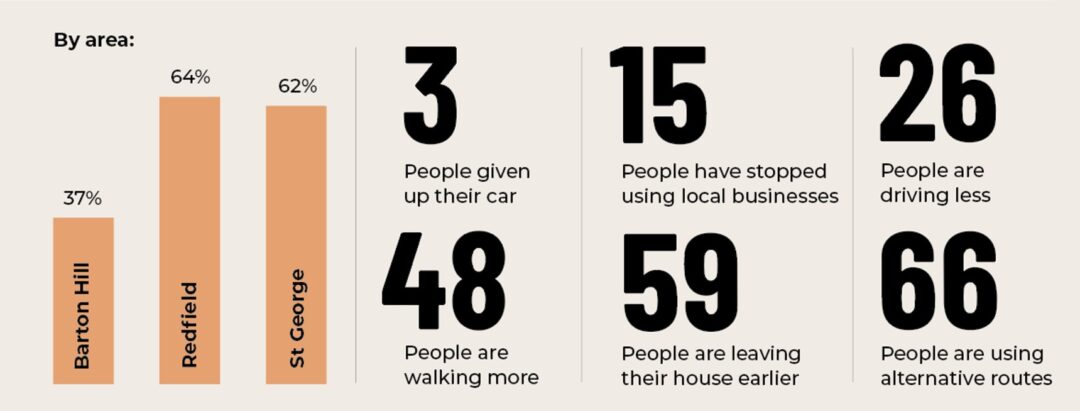
The Cable has been collecting data since November on how residents of East Bristol feel about the scheme and how it has impacted them so far – and the message is clear. Most people (69%) don’t support it, with the highest number of those opposed to the scheme living in Barton Hill, where 77% are against it.
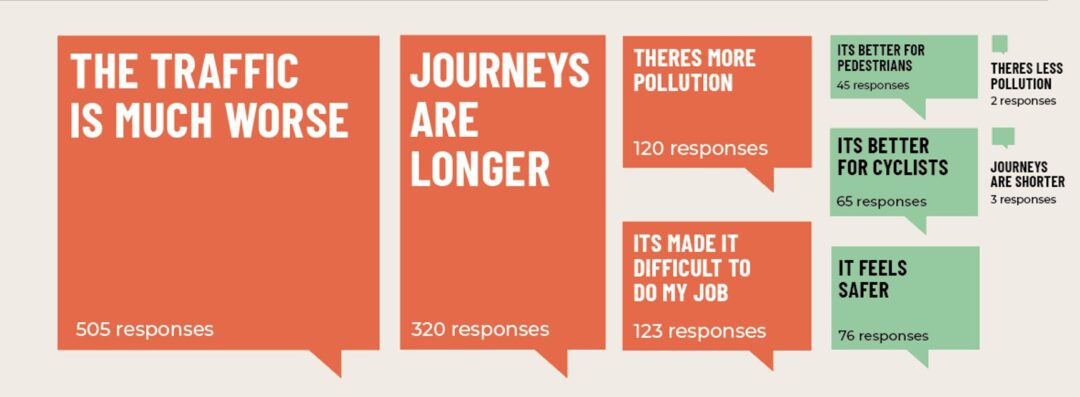
While some respondents have reported that the changes have led to improved general safety for cyclists and pedestrians, others told us that traffic and pollution has got much worse, while some say it’s impacted their ability to get to and from work or even leave their house.
Our data is the result of the Cable’s largest ever callout to readers, and it shows that the council has work to do to ensure the scheme will benefit everyone. They have the time to do that, given that it’s in a trial phase and is set to be reviewed later this year, but will they?
Bristol City Council’s leader Tony Dyer this week said there were “definitely lessons to be learned” about how the EBLN has been rolled out. And while the impacts of it are beginning to be felt, the full effects the scheme remain to be seen as not all of its infrastructure is up and running.
Sara Melasecchi, a researcher whose PhD is focused on the EBLN, says the scheme is an example of climate policies in the UK that risk being built on systems of inequality – rooted in race, class, gender and ability.
“Mobility schemes like the EBLN are often framed as solutions for public health, wellbeing, and “liveability,” she told the Cable. But their rollout, she says, is often contentious for good reason – as they can amount to climate action repacked to make cities more “competitive”, not more compassionate. Read Sara’s opinion piece here.
Below is a round-up of the responses to our call-out. Hover over the different sections of the ‘experience’ and ‘habits’ wheels to see the detailed responses, or use the dropdown menu to break down the findings by area.









Report a comment. Comments are moderated according to our Comment Policy.
I’m sorry but an online survey where you ask a self-selecting set of respondents to give you feedback is extremely poor. There’s a reason the DfT has provided guidance to councils when consulting on local transport schemes to use representative polling. Otherwise you get into exactly the situation demonstrated here.
First of all, I love them pie charts. More like doughnut charts really… although I have to add a caveat here. DO NOT be tempted by the inexpensive do’nut on offer at Greggs – cheap they maybe, cheerful they are not!
But back to the topic. Which acts as a bellwether for ecological issues in general. The general public aka The Great Unwashed, are all in favour of ‘saving the planet’ until it impacts on their own lives. Then all of a sudden, they can’t be bothered to make any sacrifices – not one! Thus I say to them, the following helpful motto: as though shall sow, so shall you reap… beep, beep!
BCC didn’t consult residents properly, but this scheme isn’t only for the residents, it has potentially far wider benefits and impacts. The residents shouldn’t have been the primary decision makers
As it was packaged as making the place more “livable”, the residents should be the primary decision makers. If it was actually about the climate, maybe they should have been more honest about this. It is also interesting that this kind of scheme is more often imposed on more deprived communities rather than on wealthier ones with more social capital/clout when it comes to making their views heard and responded to.
Before closing of roads there must be a viable alternative. Not everyone can cycle ,buses don’t go where people want to go.walking is not an option..money wasted on flower pots and cameras could have been used repairing the roads not closing the roads ..
I Work in netham road ,it takes me at least twice as long to get to work ,the lights at church road are timed wrong ,the traffic island is strangely positioned at an awful angle ,the bus gate on netham road is unnecessary for the amount of buses that go up the road ,the caravans at the bottom of the road are a greater danger than the road itself…..
The best thing do with this is put it to the vote considering that 6.600 people signed a petition in the beginning against this I think we know what the answer will be
Please come and talk to the local businesses in Barton Hill and see how they imparted them.
I have lived in this area for 35 years and I have always supported local initiatives. However, I cannot support this. It’s BCC forcing this on residents who voted when poled unanimously against it. This should be renamed East Bristol Living Nightmare. Those who are opposed to this will not back down until we reclaim our streets. The legal challenge will be forthcoming.
Surely part of the thinking behind EBLN was the impact on traffic movements wider than the area under review: mostly arterial traffic flows during rush hour, possibly other impacts as well. Most of the debate hasn’t focused on that. Nor has this enquiry. I am a great believer (and activist) in the field of local community development and empowerment, but no area should be treated as an isolated case, no claim the privileges of autonomy: we all rely on each other, esp in the greater Bristol area.
However, if the residents of EBLN are expected to ‘take one for the team’ as it were, there should be a positive package to show recognition of, and compensate for, the extra challenges they face.
This is the other side of the ‘social impact’ coin – fair exchange!