Bristol’s Kurdish community rallies for Rojava
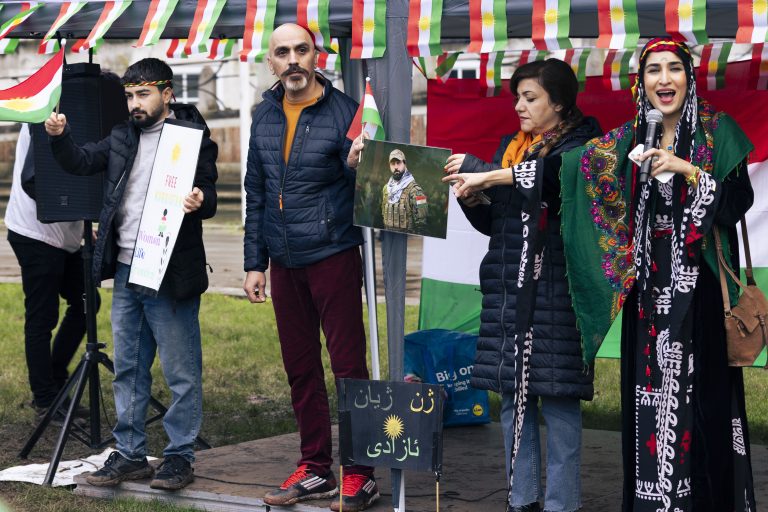
“We’re sorry about the rain,” Tanya* tells the crowd gathered on College Green for the Defend Rojava demonstration. “Our brothers are fighting in the snow and mountains of Syria and Rojhilat!” a Kurdish protester shouts in response, referring to the ongoing siege of Rojava, the autonomous region in northeastern Syria.
In early January, the Syrian Transitional Government (STG), led by president Ahmed Al-Sharaa, launched an attack on Rojava, killing thousands and displacing 175,000 people, triggering a humanitarian crisis.
Since mid-January, the STG has freed thousands of imprisoned ISIS fighters and repressed the women’s movement, with many female organisers forced into hiding and women’s centres systematically destroyed.
A fragile ceasefire has been in place since late January, but attacks continue.
Members of Bristol’s 3,000-strong Kurdish community and their supporters gathered to hear speeches, songs, and poems in English, Kurmanci, and Sorani, representing all four parts of Kurdistan.
Speakers called on the UK to speak out against the attacks and highlighted the ongoing struggle against the Iranian regime, which has claimed up to 33,000 lives, many of them Kurdish.
Meanwhile, the community has organised local fundraisers and discussions as part of a UK-wide mobilisation involving tens of thousands, united in their stand in solidarity with Rojava’s revolution.
‘We should be learning from Rojava’
After World War I, the Treaty of Sèvres promised Kurdish autonomy and the possibility of a Kurdish state, but this was never realised. A later treaty, signed in 1923 by Turkey, Britain, France and allied powers, ignored that commitment, leaving Kurdish‑populated lands divided between Turkey, Syria, Iraq, and Iran.
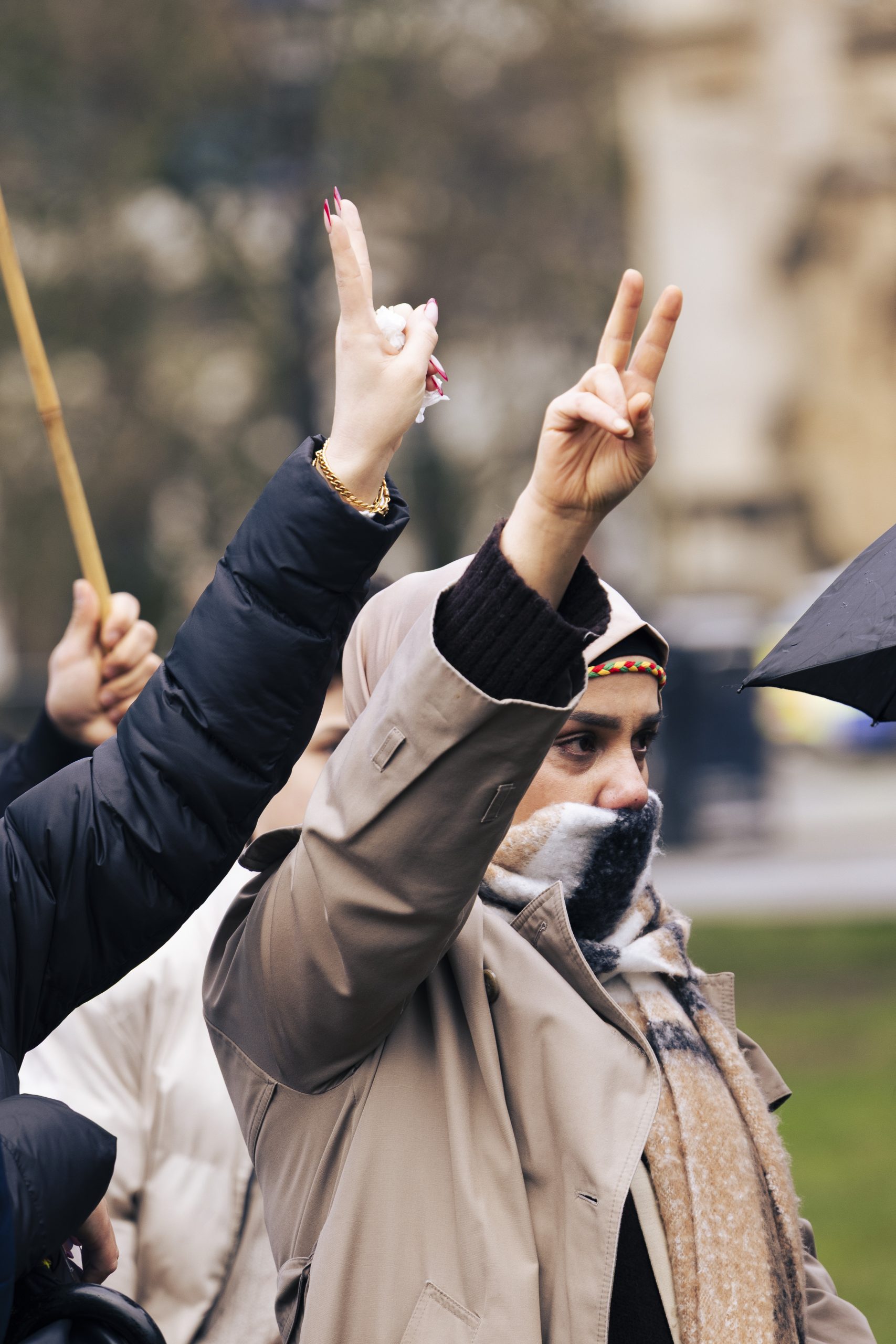
In 2012, amid Syria’s civil war, Kurds in northern and northeastern Syria established an autonomous administration in the region now known as Rojava. Here, a revolution emerged built on women’s freedom, direct people’s democracy and ecology, rallying behind the slogan Jin, Jîyan, Azadî – “Women, Life, Freedom.”
“The revolution united all Kurds,” said Tanya, a local actor and musician. “We learnt ethics from Rojava. They reminded us that we had to go back to our roots.” Tara agrees: “We should be learning from Rojava. I think the other Kurdistans can learn from their ideas and emulate them.”
Tara and Tanya are from Bashur (Iraqi Kurdistan), yet, like many in Bristol’s Kurdish community, they feel compelled to defend Rojava in Syria.
Protesters carried placards reading “2+2=1,” calling for unity across colonial borders. “You might think that doesn’t make sense. But it means that two parts of Kurdistan plus two parts of Kurdistan cannot be four Kurdistans. It’s one Kurdistan. We want a free and autonomous Kurdistan across all four regions.”
An escalating situation in Syria
Rojava’s revolutionaries defended their communities against a genocidal assault by ISIS, helping bring about the group’s territorial defeat in 2019 at the cost of around 11,000 lives.
The Turkish state – which has oppressed Kurds and other minorities within its own borders for over a century – launched full-scale invasions of North and East Syria in 2018 and 2019.
The struggle has drawn international supporters, including Bristolian Anna Campbell, who fought with the YPJ (Women’s Protection Units) and was killed by a Turkish drone strike in 2018.
Fast forward to 2026 and Rojava is facing another existential threat, this time from the STG. In 2024, Al-Sharaa’s Hayat Tahrir-Al Sham (HTS) toppled Bashar Al-Assad and took power in Damascus. Since then the STG has been trying to consolidate control over Syria. The current attacks on Rojava are part of that process, aimed at crushing Rojava’s autonomy.
‘Our calendar is decorated with the dates of betrayals’
Kate, a former Bristol resident who joined the Kurdish women’s movement, said that despite the ceasefire there is no trust in the Syrian Transitional Government (STG) and a deep sense of Western betrayal among those who have “lost their children” fighting ISIS. Tara emphasised that Rojava’s Kurds are asking only for Syria to be “a federal and democratic republic.”
For every braid you cut from our hair, we will braid a thousand more.
“Our calendar is decorated with the dates of betrayals. And memorials of deaths and genocides,” says Tara Miran. For her, the UK’s silence over Al-Sharaa’s attacks on Rojava is another “stab in the back.” She noted that Green MP Carla Denyer has signed an Early Day Motion urging the government to protect civilians and safeguard Kurdish rights, but added, “there’s more that can be done.”
Bristol’s Kurdish community and the Kurdistan Solidarity Network have continued to mobilise through protests, pickets, and public events, keeping the struggle visible locally and internationally.
‘Braiding hair is a holy act’
On College Green, many held placards bearing a braid. Others braided their hair in honour of a member of the YPJ who was killed in battle, whose braid was taken as a trophy by an STG-aligned fighter in January. The act has come to symbolise Kurdish women’s resistance to misogyny.
“Braiding hair is a holy act for us,” Tara said. “For every braid you cut from our hair, we will braid a thousand more. This is symbolic of the Kurdish resistance, of its soul”.
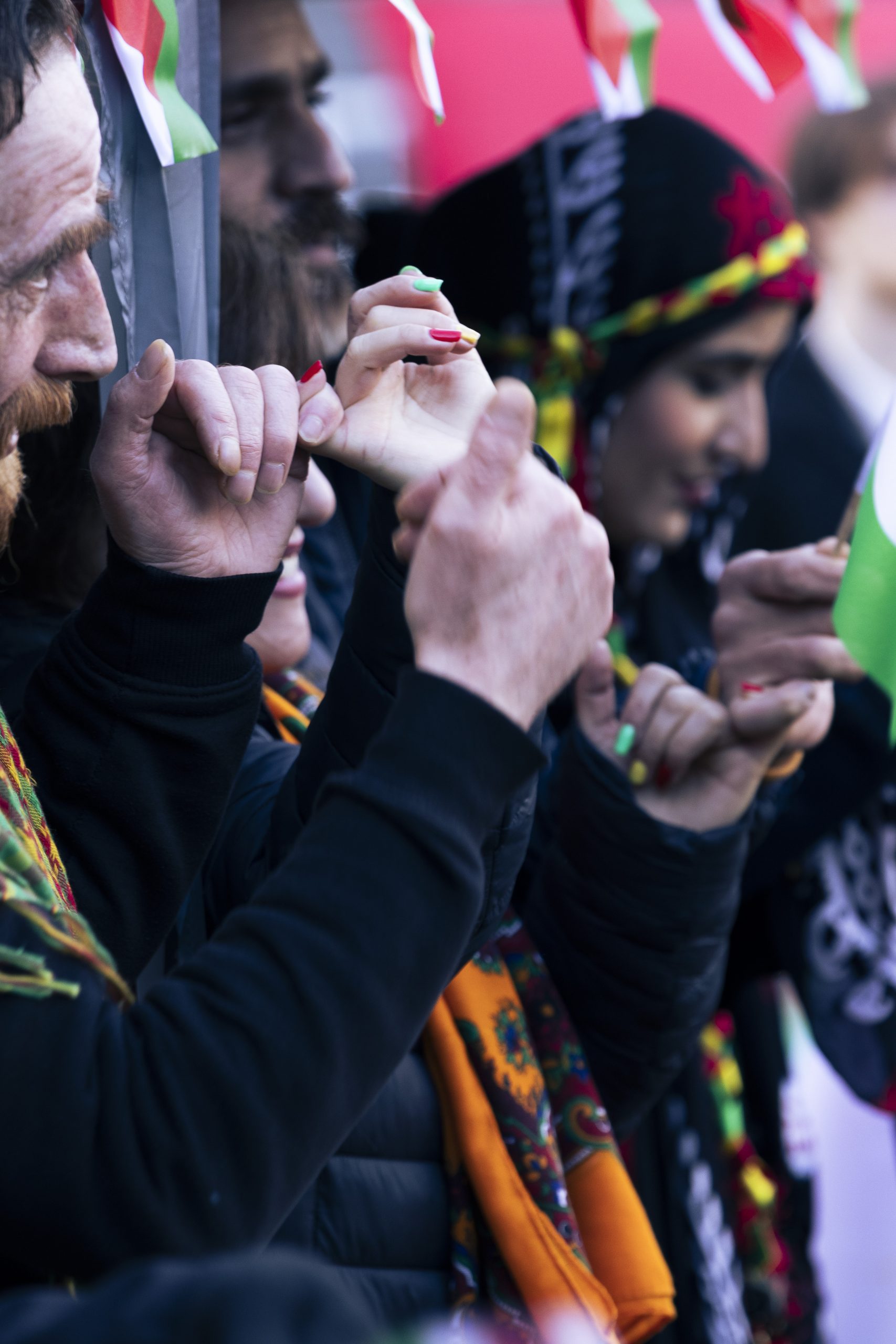
Both women stressed that Kurdish women have always been central to the struggle. The movement, Tara said, transcends national and ethnic lines — something many states perceive as a threat. “I think it is a very beautiful threat.” she said. “This promise of a bright, colourful future is… the epitome of feminism”.
“If we lose the hope again in Rojava, it’s gonna be forever… That’s it,” said Tanya.
Both women described a deep connection to Kurdish identity. Tara reflected: “My granddad could not say the word ‘Kurdistan’, or ‘I am a Kurd’ so if you ever see me at any event, don’t wonder why I wear Kurdish clothes. I’m a daughter of Kurdistan and it’s my honour to wear them. I have a very strong feeling, based on the constant resistance of Kurds, that if I don’t see a free Kurdistan in my life, it will happen in my children’s life.”
*Tanya asked for us to refer to her only by her first name.
To find out more check out Kurdani Bristol and the Kurdistan Solidarity Network.
Tom Anderson is an anarchist writer and organiser from Bristol.
Independent. Investigative. Indispensable.
Investigative journalism strengthens democracy – it’s a necessity, not a luxury.
The Cable is Bristol’s independent, investigative newsroom. Owned and steered by more than 2,600 members, we produce award-winning journalism that digs deep into what’s happening in Bristol.
We are on a mission to become sustainable, and to do that we need more members. Will you help us get there?
Join the Cable today