
The average Quaker in Britain is old enough to claim a state pension. Under-35s — known as Young Friends — made up just 6.5% of members and attenders in 2023.
Quakerism dates back to the 1650s, emerging in the aftermath of the English Civil War through the teachings of George Fox. It rejected formal clergy and hierarchy, insisting instead that anyone could encounter God directly through what Fox called the “Inner Light.”
It was a stark break with the religious and political order of the time. Early Quakers were branded radicals; they faced fines, imprisonment and exclusion from civic life.
Since then, Quaker ideas about peace, equality and stewardship have long fed into wider British social movements, from conscientious objection and the Campaign for Nuclear Disarmament to environmental activism.
Today, Quakerism in Britain is small but established, with around 13,000–15,000 members and regular attenders across roughly 400 local meetings. According to Quakers in Britain’s annual statistics, the community has been steadily ageing in recent decades.
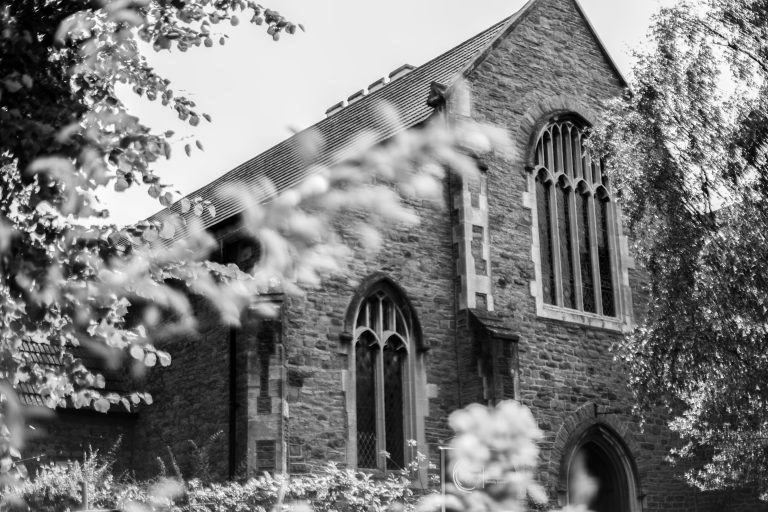
Yet outside the Redland Friends Meeting House on a Sunday, it doesn’t look that way. This week, local attenders are joined by visitors from Young Friends in Britain on a residential trip. I’m here to find out how a 400-year-old tradition is finding new relevance.
The ministry of silence
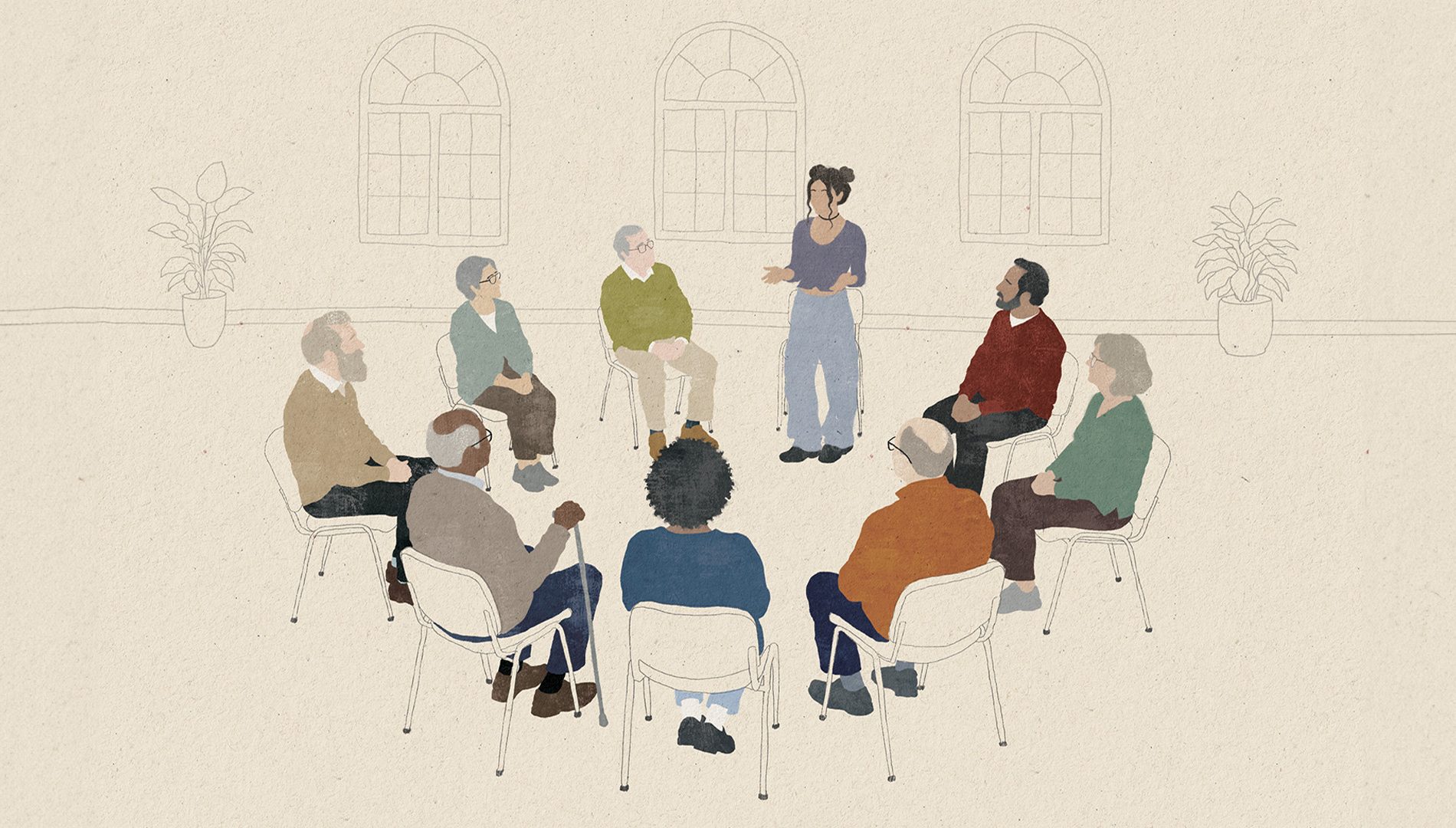
Inside, chairs are set in a circle. The meeting begins when the first person enters and ends when two Quakers shake hands.
It unfolds in near total silence. But if someone feels moved by the Holy Spirit to speak, they can stand and offer what Quakers call “vocal ministry”.
Quakers believe the stillness deepens connection — to God, self and others.
At first, I find the quiet hard to settle into. There are no clocks in the room, and I don’t have a watch. Around me, people cross their legs and close their eyes; some read, others sit in quiet reflection. Gradually, I settle into the stillness. Then, before I know it, the hour is over.
Next comes the business of the meeting. The clerk proposes an amendment to the previous week’s minutes. I’m surprised when, rather than yes or no, there’s a chorus of “I hope so”.
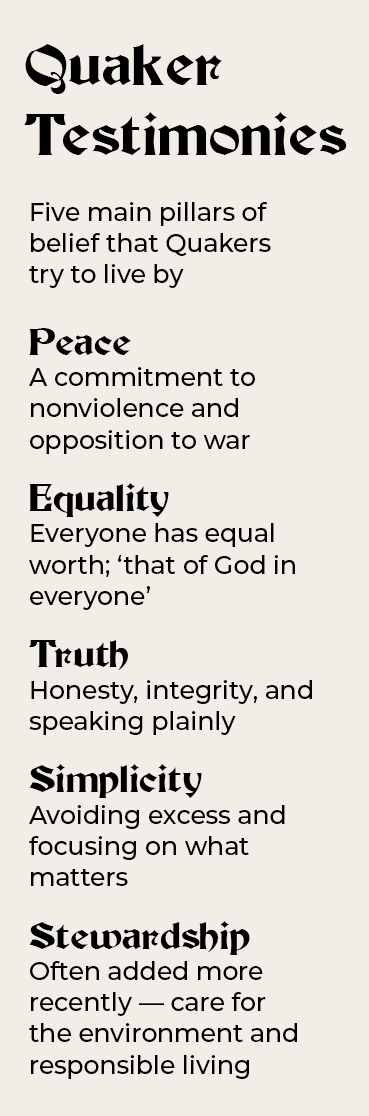
Quakers aren’t just being evasive; they’re keeping the space open for disagreement. That instinct runs through the faith. This is a tradition without clergy, hierarchy or formal liturgy. Quakers call each other “Friends”, and worship happens in “meeting houses”, not churches.
Non-members — “attenders” — are welcome to take part. Instead of priests, “elders” are elected who serve for several years, who despite the name can be any age. “I know a fifteen-year-old who acts as an elder,” one Quaker told me.
‘Here were people living in their faith’
Afterwards, I have lunch with Young Friends Daisy* and Alex*. Neither was raised Quaker. Alex grew up in an evangelical Christian household but left after becoming disillusioned with its strict dogma.
They were drawn to Quakerism by its commitment to social justice: “Here were people living in their faith,” Alex says.
At Redland House, that lived faith is visible. A poster on the door calls for disarmament. Inside, stickers read: “Quakers oppose all war.” A manifesto urging recognition of ecocide as an international crime, signed by Bristol Quakers, hangs on the wall.
Elsewhere, Friends run the Peaceful Schools Project, bringing peer mediation and peace education into primary schools to help children resolve conflict non-violently.
Bristol Quakers also don’t shy away from their own history. In November, they held a community day confronting their involvement in the transatlantic slave trade, asking what accountability looks like now.
Across the table, I speak to James*, a sixth-generation Quaker whose family were conscientious objectors in both world wars. During the Blitz, his family drove ambulances with the Friends’ Ambulance Unit, a Quaker-founded service. If a similar situation arose today, he says he would do the same.
The Young Friends are also keen to clear up a common misconception. Unprompted, several insist that Quakers do not wear, and have never worn, hats as part of their faith.
“We are not the Amish,” one says.
The myth owes something to the Quaker Oats logo. George Fox did famously refuse to remove his hat before social superiors, but the point was equality, not headwear.
A faith of doubt
Agnes Sales, a 21-year-old Philosophy and Theology student at the University of Bristol, attends Quaker meetings both at Redland House and on campus.
I like its flexibility. It’s strong and consistent in its values, but flexible in belief”
Agnes Sales
“All the social justice work I do: animal rights activism, Plant-Based Society, Palestine protests, fundraising for Bristol Refugee Rights, is directly related to my faith,” she says.
“There’s a phrase: ‘that of God in everyone.’ And while I don’t know about the God bit, the idea that there’s something significant within each person, which to me expands to all life — all plants, all animals. Veganism is just a natural extension of my beliefs.”
That idea sits comfortably within a faith that, though rooted in Christianity, does not require belief in God. In the meeting house, Christian Quakers sit alongside Pagan and non-theist Quakers alike.
There are no fixed rules on what a Quaker must believe, only “testimonies” — shared ways of trying to live in the world. “I like its flexibility,” Agnes tells me. “It’s strong and consistent in its values, but flexible in belief.”
At Friends’ “Meeting for Learning”, attenders consider how Quaker values apply to contemporary issues. Agnes appreciates that disagreement is welcomed. For her, this reflects a habit of questioning.
“We shouldn’t just be accepting things,” she says. “We should be thinking: is this belief that I have true, if I properly think about it and engage with other people?”
In conversations with young Quakers, one line from Quaker Faith & Practice keeps resurfacing: “Think it possible that you may be mistaken.” It captures a recurring theme, a willingness to hold belief lightly and leave space for doubt.
It chimes with something James* told me earlier: “Quakerism rarely takes a hard stance on things, recognising it could be wrong.”
‘A desire for genuine community’
I spoke to Reverend Ed Davis, Chaplain at the University of Bristol’s Multi Faith Chaplaincy, where he’s worked there for nearly twenty years. He says students are showing renewed curiosity about religion.
Quaker meetings, held on Wednesdays, have grown in popularity over the past few years, largely through word of mouth. “Two years ago there were just two or three students; now there are around ten to fifteen,” he says.
“What I’ve picked up from students is a real desire for genuine community, not online but in person. A multi-generational community they can be part of.”
For Agnes, that is part of the appeal: “It meant I could get more involved in my local community. I now have friends both younger and much older than me,” she says, adding that everything from 60th birthday parties to meeting friends’ babies allows for an exchange across generations.
Time will tell whether this marks a youth turn in Quakerism, but what’s striking is that it hasn’t had to remake itself for the present day — its long-held values of flexibility, doubt and social justice already resonate with younger generations.
Independent. Investigative. Indispensable.
Investigative journalism strengthens democracy – it’s a necessity, not a luxury.
The Cable is Bristol’s independent, investigative newsroom. Owned and steered by more than 2,600 members, we produce award-winning journalism that digs deep into what’s happening in Bristol.
We are on a mission to become sustainable, and to do that we need more members. Will you help us get there?
Join the Cable today