At the end of last year, 792 children and young people were in care in Bristol, up from 621 in 2020. That means 85 children in every 10,000 – well above the average of 70 across England.
Bristol’s surge in children in care has been largely driven by more teenagers entering care, fewer children now leaving the system and a rise in unaccompanied asylum-seeking children, who made up around 10% of the city’s looked-after children in May 2024.
The Covid-19 pandemic added further pressure to services already weakened by years of cuts, rising child poverty and growing mental health needs. The result is a larger, older cohort of children needing care.
Christine Townsend, Green Councillor for Southville and Chair of the Children and Young People Policy Committee, said: “With Covid-19, you have a whole generation who were in school that have only ever known services retreating – from their lives, from their parents, from their communities. We’re talking about the most vulnerable and most disadvantaged.
“We were basically knocking on doors checking if children were alive and had enough food,” she added.
Townsend considers that the current influx of children entering care in Bristol is a delayed effect of losing almost all oversight of many vulnerable children during the pandemic.
What we do is work with the most challenging young people in this country. It’s intense work. People are not prepared for that
John Stokes, foster carer
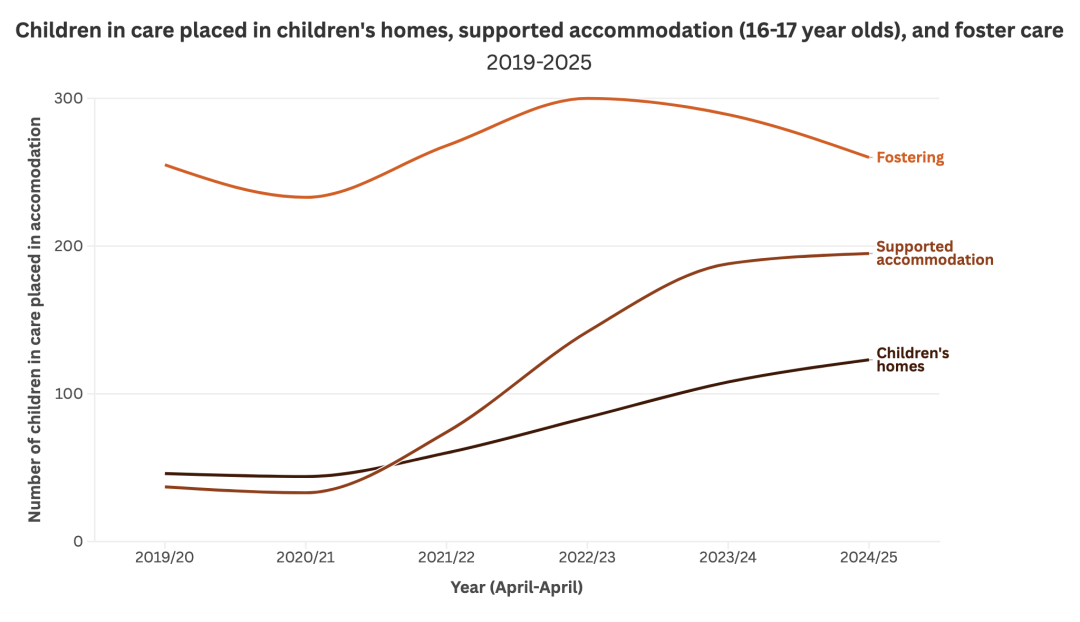
But the number of foster placements has not kept up with demand. There were 255 in 2019-20. Five years later, there were just 260.
Foster care is generally the preferred option where appropriate, offering children the stability of a family home. But with demand rising and too few foster carers, Bristol is increasingly relying on children’s homes and supported accommodation.
Children’s home placements have risen by 167% in five years, from 46 in 2019-20 to 123 in 2024-25, according to data obtained by the Cable through a Freedom of Information (FOI) request.
And when there aren’t enough suitable places in Bristol, children can be sent elsewhere, sometimes hundreds of miles from home, at significant cost to the council.
At the sharpest end of the shortage, seven children were placed in unregistered accommodation in 2024. The council said it had struggled to find registered placements for children with complex needs, prompting intervention from Ofsted.
The Cable examines what happens when more children need care than there are safe, regulated homes available – and the difficult choices that follow.
The struggle to find foster carers
John Stokes has been fostering in Bristol for 36 years. Now 73, he started in his late twenties while working in a children’s home and has since fostered more than 100 children, many of them teenagers.
“I’m giving them safety and security first and foremost. For many teenagers I take on, that’s something they’ve never had,” he says.
The Council is struggling to recruit more carers, particularly for older children and those with complex needs. Josh MacAlister MP, Minister for Children and Families, has pledged to create 10,000 new fostering placements nationally, which Stokes said was “never going to happen” without a change in approach.
John believes the way fostering is promoted doesn’t always reflect the reality of the job. “For too long there has been this ridiculous idea of, ‘If you’ve got love in your heart and a spare room, have you thought about fostering?’” he tells the Cable.
“There’s nothing wrong with that but it’s totally the wrong dynamic. What we do is work with the most challenging young people in this country. It’s intense work. People are not prepared for that.”
John believes councils should focus on the skills and experience prospective carers can bring. “A good foster carer might be a teacher living alone in a one bedroom flat. They should look for people who have the abilities but maybe not the space.”
But recruitment is only half the problem. “If you can’t retain the carers you’ve got, you’re wasting your time on recruitment,” John says.
The financial and practical demands of fostering can make it difficult for people to take on children, particularly those with additional needs.
Foster carers receive a weekly allowance from the council, depending on the child’s age and other factors. Bristol increased its fostering allowances in 2022, while the Fostering Network continues to call for higher allowances nationally.
For carers looking after children who have experienced trauma, abuse or other significant difficulties, fostering can also make full-time employment difficult or impossible.
John has cared for children who have experienced trauma and abuse, as well as helping young asylum seekers navigate legal proceedings and appeals. He describes the work as rewarding, but also as “full-on frontline work”.
“I love the kids and I love doing the job. But I’ve been single for all of my fostering career. I don’t have a job, I don’t have any other income.”
“We work in the shadows but it’s vital what we do. That’s why I want to see more foster carers,” says John.
Rise in private care homes
When there isn’t a suitable foster home available, children can instead be placed in residential children’s homes or supported accommodation.
“It’s the world we live in. We are desperately trying to get children out of children’s homes,” says Annette Solomon, who works on foster carer recruitment for the South West Fostering Hub, which includes Bristol.
But that is becoming harder as Bristol’s care population gets older. Around 70% of children in care in Bristol are aged over 10, while 30% are over 16. The council says this is partly because more children are entering care at older ages, while fewer are leaving the care system.
Supported accommodation for 16- and 17-year-olds has risen even more sharply, increasing by 427% over the same period.
As demand has grown, Bristol City Council has increasingly relied on private providers to fill the gap. In 2024-25, 86% of children’s homes and supported accommodation in Bristol were privately run, a proportion broadly in line with the national picture.
The growth of private provision has become a contentious issue nationally, with councils facing high costs as they compete for a limited number of places. In Bristol, the council spent almost £33m on children’s home placements in 2024-25, nearly twice the £17m it had budgeted. The budget has more than tripled since 2019.
Townsend says the problem is not that private provision is inherently poor. Some private homes provide good-quality, specialised care for children with complex needs.
“It’s the profit-making private element that needs to be taken out,” she says. “As opposed to saying you’re private, you’re the problem. That isn’t always the case.”
The council is trying to increase the amount of care it provides, but expanding residential care is not straightforward. A surge in applications to register new children’s homes has created a backlog at Ofsted, slowing the process of getting new homes approved.
And when there isn’t a suitable place in Bristol, the search gets wider.
Sending children out of Bristol
The shortage of suitable placements is increasingly pushing Bristol children beyond the city.
For the first time last year, more than half of Bristol’s children in care were placed outside the city, due to a lack of available accommodation locally.
The problem is partly regional. The South West has the fewest children’s homes and care places of any region in England.
As a result, children from Bristol have been placed hundreds of miles from home, including as far away as Scotland, Cumbria and Merseyside in the north, and Cornwall, Kent, Essex and Suffolk in the south.
We are desperately trying to get children out of children’s homes
Annette Solomon, South West Fostering Hub
For a child in care, being sent away can mean being separated from family, friends, school and other support networks. For teenagers who may already have experienced significant disruption, another move can mean losing yet more of the familiar people and places around them.
There are important exceptions. Some children need to be placed outside Bristol for safeguarding reasons, while others may technically be outside the city but only just over the boundary, such as in neighbouring Gloucestershire.
But the council is actively trying to bring children placed outside Bristol back closer to home. It now offers enhanced fees to foster carers who take children who have previously been placed outside the city.
Townsend says there was also a particular dynamic for older teenagers. At 16, some young people can choose whether to remain with a foster family in the area where they have been placed or return to Bristol and live more independently in supported accommodation.
Many choose to come back to the city, she says.
That is one reason Bristol has particularly high rates of supported accommodation: some young people who have been placed away from the city return at 16, but no longer need or want a traditional foster placement.
The result is a care system increasingly trying to balance three things at once: finding somewhere safe for a child to live, keeping them close to the people and places that matter to them, and finding a placement the council can actually afford.
Unregistered children’s homes
At the most extreme end of the shortage are children placed in homes that are not registered with Ofsted.
In 2024, Bristol City Council admitted that seven vulnerable children had been placed in unregistered homes. The council said at the time that it had struggled to find registered placements for children with complex needs, prompting intervention from Ofsted.
Operating a children’s home without Ofsted registration is a criminal offence. Registered homes are subject to Ofsted inspection and regulation. Yet unregistered homes do not receive those routine checks.
Bristol is not alone. A Public Accounts Committee report found that nearly 800 children were placed in illegal accommodation across England in 2024, with children staying there for an average of six months.
An investigation by the Bureau of Investigative Journalism has since revealed the scale of the problem. It found that more than 480 private companies had operated unregistered children’s homes over the past two years, receiving around £250m from councils for 1,800 placements.
The Bureau said the true figure is likely to be higher because almost half of councils did not respond to its Freedom of Information requests.
The investigation found that some of these placements were made because councils could not find legal provision for children with complex or high-risk needs. Without registration, however, there is no routine Ofsted inspection to provide an independent check on the quality and safety of the home.
For Bristol, the seven children placed in unregistered homes in 2024 show how a shortage of suitable placements can push the system beyond the regulated care it is supposed to provide.
And it brings the consequences of the shortage into sharp focus: when there isn’t a foster carer, the council looks for a children’s home. When there isn’t one in Bristol, it looks further afield. And when there isn’t a suitable registered home at all, the choices become far more difficult.
Trying to build a way out
Bristol City Council is now trying to increase its own capacity, both by opening more residential homes and by making it easier for people to become foster carers.
The council is expanding its residential provision from 14 beds in 2025 to 32 beds, with the new homes intended to provide more local places for children with complex needs and reduce reliance on private providers and placements further from Bristol.
It has also committed more than £3m to help existing and potential foster carers adapt or extend their homes. The scheme is expected to create around 22 additional foster placements, mostly by enabling existing foster carers to take on more children.
The aim is not simply to find people with a spare bedroom, but to make fostering possible for a wider range of households whose homes might otherwise be unsuitable.
The council has also introduced the Mockingbird fostering model, which brings foster carers together into local support networks, or “constellations”, led by an experienced foster carer. The model is designed to give carers greater support and help them sustain fostering over the longer term.
But the scale of these measures has to be seen against the size of the problem. Bristol now has 792 children and young people in care, while the number of foster placements has barely changed over the past five years.
For the council, building more residential homes and supporting more foster carers could help close that gap. But Bristol is still operating within a wider shortage of suitable placements, while more children are entering care at older ages and fewer are leaving.
Ultimately, the aim is not simply to find more beds. It is to give children a safe, stable home that is as close as possible to their families, schools and communities.
Independent. Investigative. Indispensable.
Investigative journalism strengthens democracy – it’s a necessity, not a luxury.
The Cable is Bristol’s independent, investigative newsroom. Owned and steered by more than 2,600 members, we produce award-winning journalism that digs deep into what’s happening in Bristol.
We are on a mission to become sustainable, and to do that we need more members. Will you help us get there?
Join the Cable today