It’s a hot May afternoon in St Paul’s, the tail end of a heatwave. A dancehall tune pumps from a van across the square. Behind an unassuming shopfront on Grosvenor Road sits the Rastafari Cultural Centre, a fixture in the area for more than three decades.
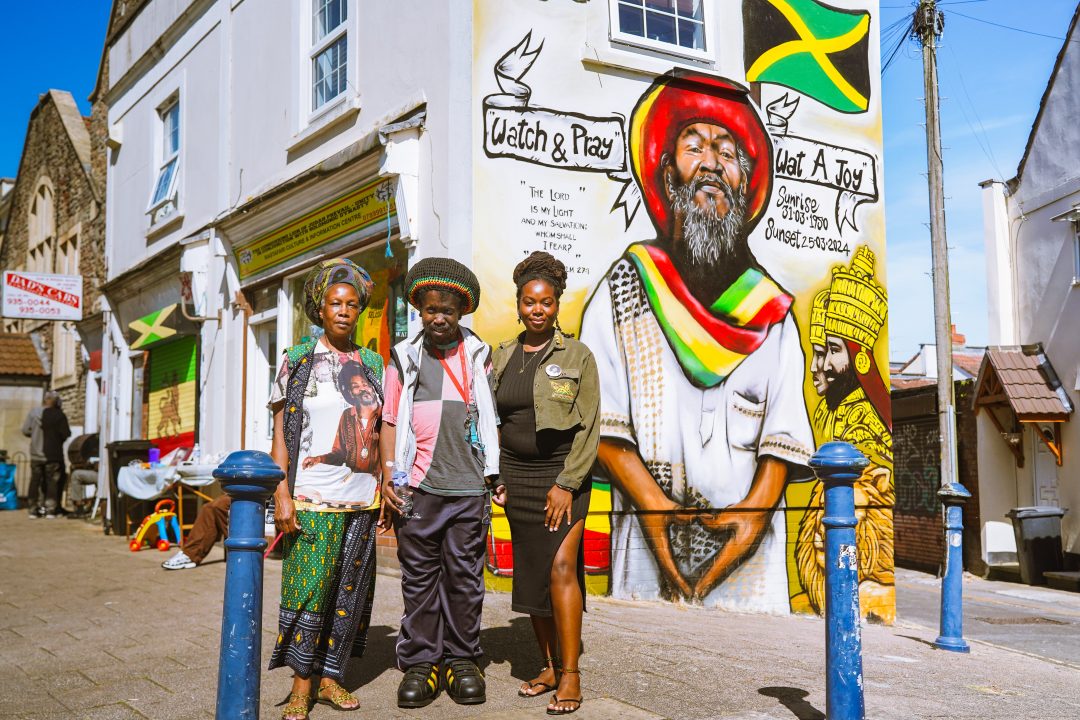
It was founded by Ras Bandele Selassie, whose passing in March 2024 was deeply felt across the community. A mural of him now covers the wall outside, unveiled this year — his life and values envisioned in Rastafari colours of red, gold and green.
At its centre is the face of Ras Bandele Selassie I. Above him runs a banner: “Lion of Judah Prevail – Unity” — the organisation he founded in 1986 to promote Rastafari teaching and community practice in Bristol.
Morowa (left) and Yeshawa (right) with a family member by the mural of Ras Bandele. Credit: Keyane Allman
The imagery around him traces core Rastafari ideas. The flags of Ethiopia and Jamaica sit side by side: Jamaica as the movement’s birthplace, Ethiopia as its spiritual centre.
On the right of the mural, A regal profile of Emperor Haile Selassie I, regarded as a divinely appointed figure for Rastafari. Beneath him is the Lion of Judah, drawn from Ethiopian imperial symbolism and the Book of Revelation, representing strength and defiance.
A Psalm 27:1 quote sits to one side: “The Lord is my light and my salvation; whom shall I fear?” Rastafari draws deeply on the Bible, especially the King James Version, but reads it through a lens shaped by African history and liberation.
Since its founding, the centre has served as a vital community hub, surviving funding pressures and threats of closure. But with Ras Bandele’s passing, a question looms: how do you carry a tradition forward without the generation that built it?
‘He left a constitution’
I’m welcomed in by Yeshawa, who manages the centre. Alongside her is her mother, Empress Sis Morowa, Ras Bandele’s widow, a softly spoken, calming presence.
Inside, the space sits somewhere between a living room, a shop, and a classroom. Records and posters line the walls, alongside clothing for sale and framed photographs of Emperor Haile Selassie. Djembes are stacked in a corner; a piano sits against one wall, a sofa against another.
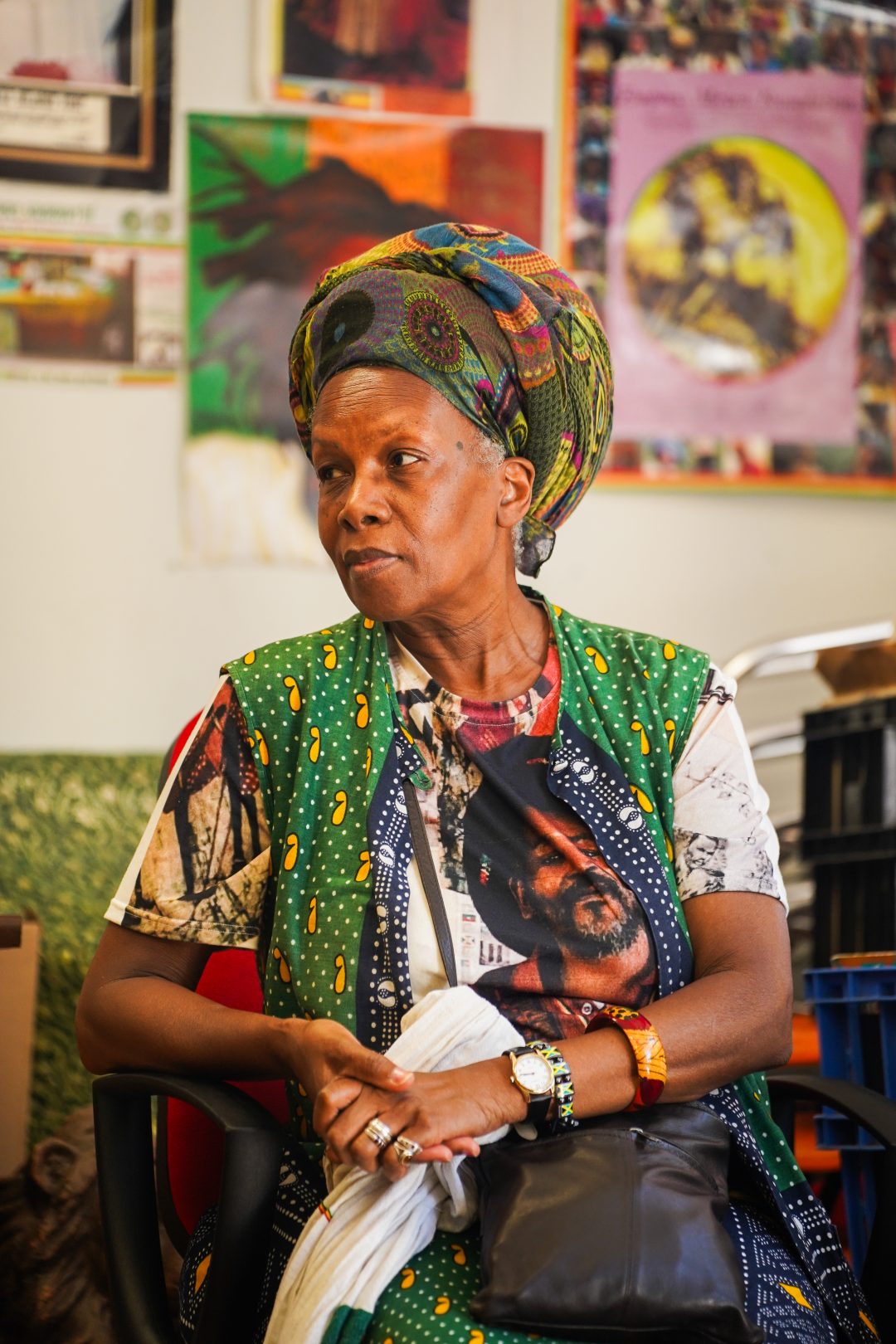
Morowa inside the centre. Credit: Keyane Allman
People drift in and out. Some stop to talk, others just lean through the doorway to say hello. “It’s always operated as a drop-in — a space where you can meet people, same mind or different mind, and just tussle things around,” says Morowa. “If you want to pop round, play the piano, sit and chat, you’re always welcome.”
The building’s role as a community space dates back to 1994, after the attack on Black teenager Marlon Thomas on Durdham Down. The council handed the Grosvenor Road site to the Justice for Marlon Thomas campaign, who invited Ras Bandele Selassie in. He lived upstairs and transformed the ground floor into a Rastafari centre for St Paul’s, first offering counselling to a traumatised community.
Over time, it became a Black cultural hub. A place of calm in crisis, a first stop for people leaving prison and a steady presence for young people.
He offered spiritual counsel, historical grounding, and “reasoning” sessions — informal Rastafari gatherings built on discussion, listening and reflection.
“It was like an invisible magnet,” says Morowa of her late husband’s presence. “He had this rapport. He’d listen, deal with a lot of issues, and give people space.”
“He left a constitution,” adds Yeshawa, a way of holding the space that still guides how it’s run today.
But Morowa says the landscape around them has shifted. “The community has changed. A lot of the elders are no longer here,” she notes with a sigh. “We’ve got a new batch of people with different ideas — not specifically Rastafari.”
Rastafari had the answers
Ras Bandele Selassie was born in Jamaica, he moved to the UK in 1964, first to the Wiltshire town of Trowbridge, later settling in Bristol. He first encountered the teachings of Rastafari at Inkwerks on Hepburn Road, a Rasta centre that later became Kuumba.
To understand how Rastafari took root in Britain, I speak to Professor Shawn Sobers of UWE — a follower of Rastafari and the Ethiopian Orthodox Church.
Sobers grew up in Bath, where Haile Selassie lived in exile at Fairfield House between 1936 and 1940. It is now both a community space and a place of pilgrimage. Ras Bandele himself was closely connected to Fairfield House.
For Sobers, the political climate of the 1970s and 80s shaped why many young Black Britons gravitated towards Rastafari, with its promise of cultural grounding and a spiritual return to Africa.
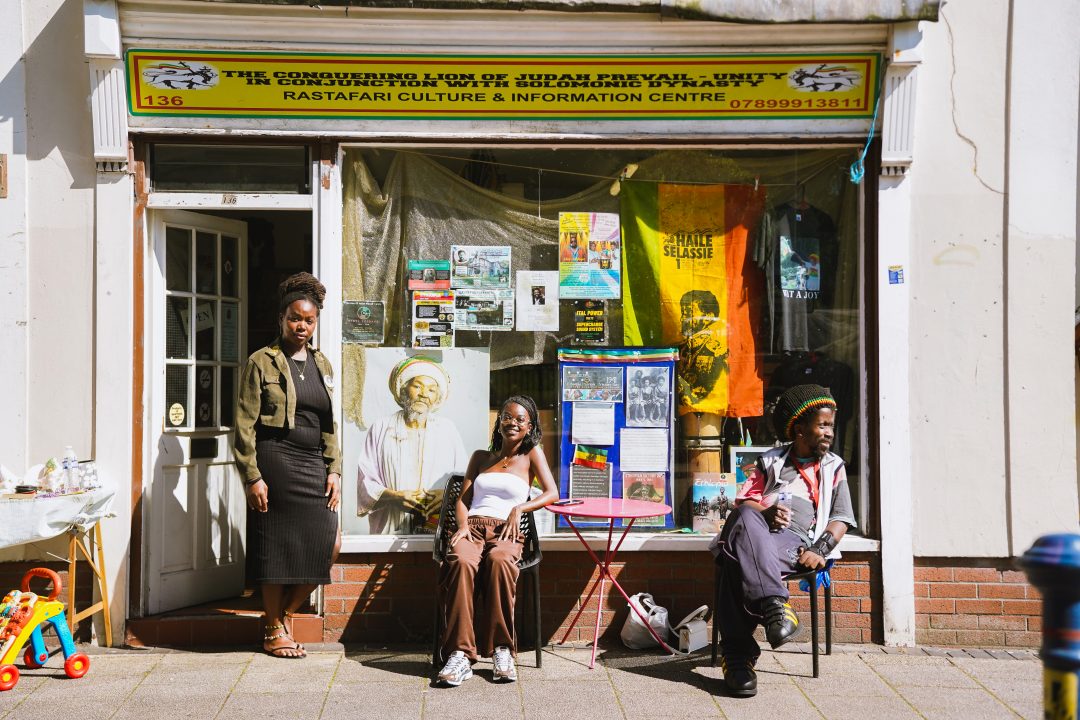
Yeshawa (left) outside the Rastafari Culture Centre, Grosvenor Road. Credit: Keyane Allman
“There was definitely heightened tension in the air — the SUS laws, the police,” he says, referring to police stop and search powers disproportionately used against Black communities. Their use resulted in major civil unrest across British cities, including Bristol, in the early 1980s.
For second-generation Britons of Caribbean descent, Rastafari offered a new language and cultural expression. “It was about fighting for your rights and standing up to the oppressors. Rastafari had a lot of answers for that,” says Sobers.
Sobers first encountered it in St Paul’s as a teenager, meeting Ras Bandele and other elders at the centre when it was still on St Nicholas Road. “It was an old social services building, somewhere Ras ‘captured’,” says Morowa with a wry smile.
For Sobers, the appeal was having an informal space to talk things through. “It’s called ‘reasoning’,” he says. “You sit down and talk about the Bible, history or politics, whatever it might be, and just help make sense of things.”
Fellowship and community
In 2020, Bristol City Council attempted to sell off the building, accepting a developer’s bid to convert it into flats. The move sparked a community backlash, with the Afrikan Caribbean Assembly leading a campaign that gathered more than 5,000 signatures.
Under pressure, the council backed down and blocked the sale. A final £20,000 crowdfunder secured the space, placing it under permanent community ownership.
But the pressures on Rastafari in Bristol extend beyond bricks and mortar. In England and Wales, the number of people identifying with Rastafari fell from 7,906 in 2011 to just under 6,000 in the 2021 census.
For Sobers, it’s not about the numbers: “It was never about counting heads… it’s more about how you are with other people in the world, defending justice, promoting peace,” he says.
For Sobers, spaces like the Rastafari Culture Centre still offer something increasingly rare: fellowship. “One of the powerful functions of religion in society is that idea of fellowship and support, being there for one another.”
He adds: “The HQ that Yeshawa and Morowa run on Grosvenor Road still plays that purpose — a place where you can come and find a listening ear, or just be. Listen to music, read the Bible, with little expectation.”
Independent. Investigative. Indispensable.
Investigative journalism strengthens democracy – it’s a necessity, not a luxury.
The Cable is Bristol’s independent, investigative newsroom. Owned and steered by more than 2,600 members, we produce award-winning journalism that digs deep into what’s happening in Bristol.
We are on a mission to become sustainable, and to do that we need more members. Will you help us get there?
After coming across a far-right YouTuber trying to provoke people for content, Nikesh asks: is it better to engage or ignore? And how do we have hard conversations with those closest to us?
Humanism in Bristol, where faith no longer defines the majority
More than half of Bristolians say they have no religion — but what do people believe instead? Bristol Humanists show how non-religious ethics find a place in public life
Listen: Bristol Unpacked with Paul Smith on spending £20m and ensuring Hartcliffe doesn’t get betrayed again
The housing chief and former councillor on helping residents of the neighbourhood where he grew up decide how to spend a decade-long government grant – and making sure that actually benefits locals.