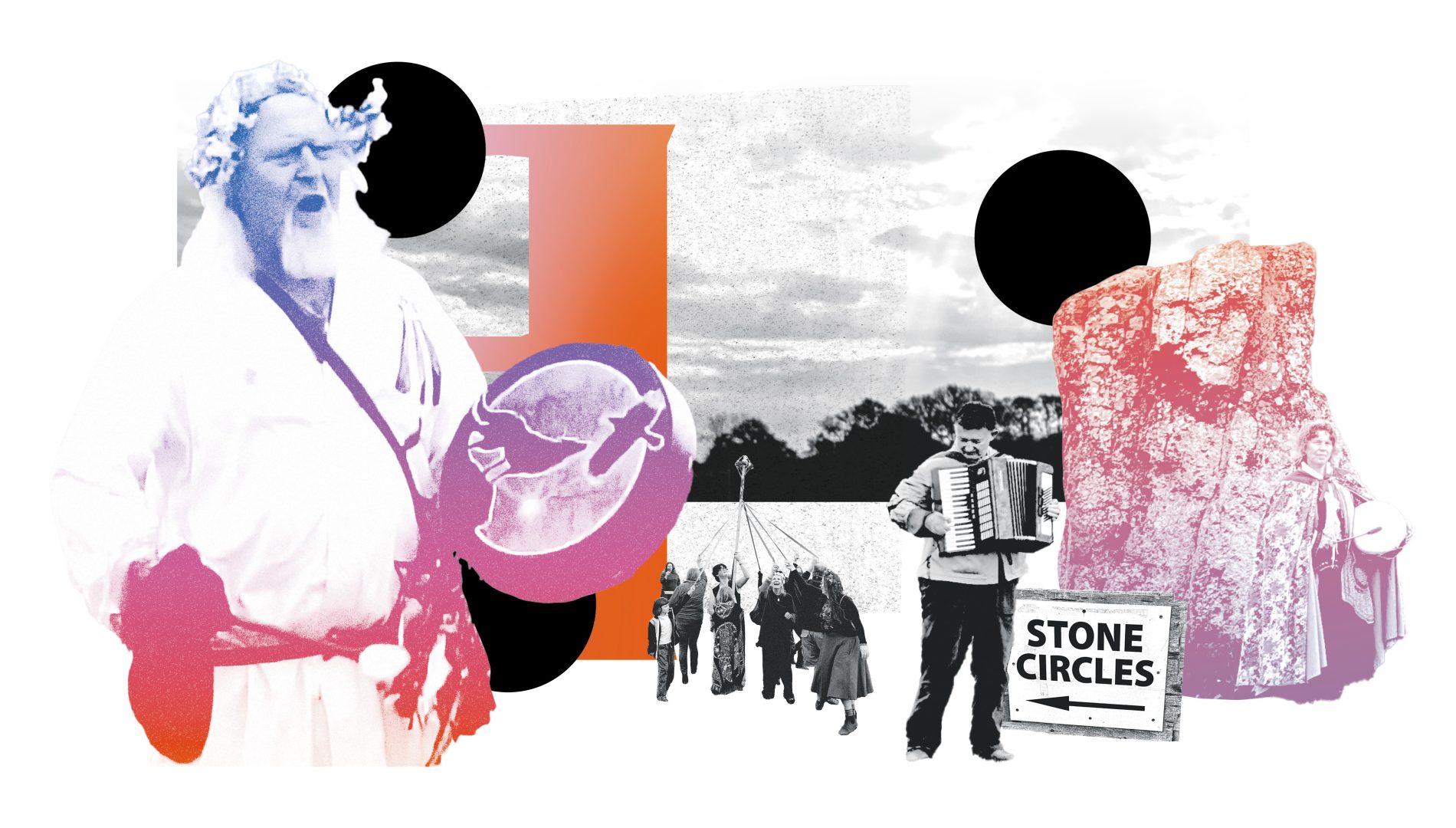

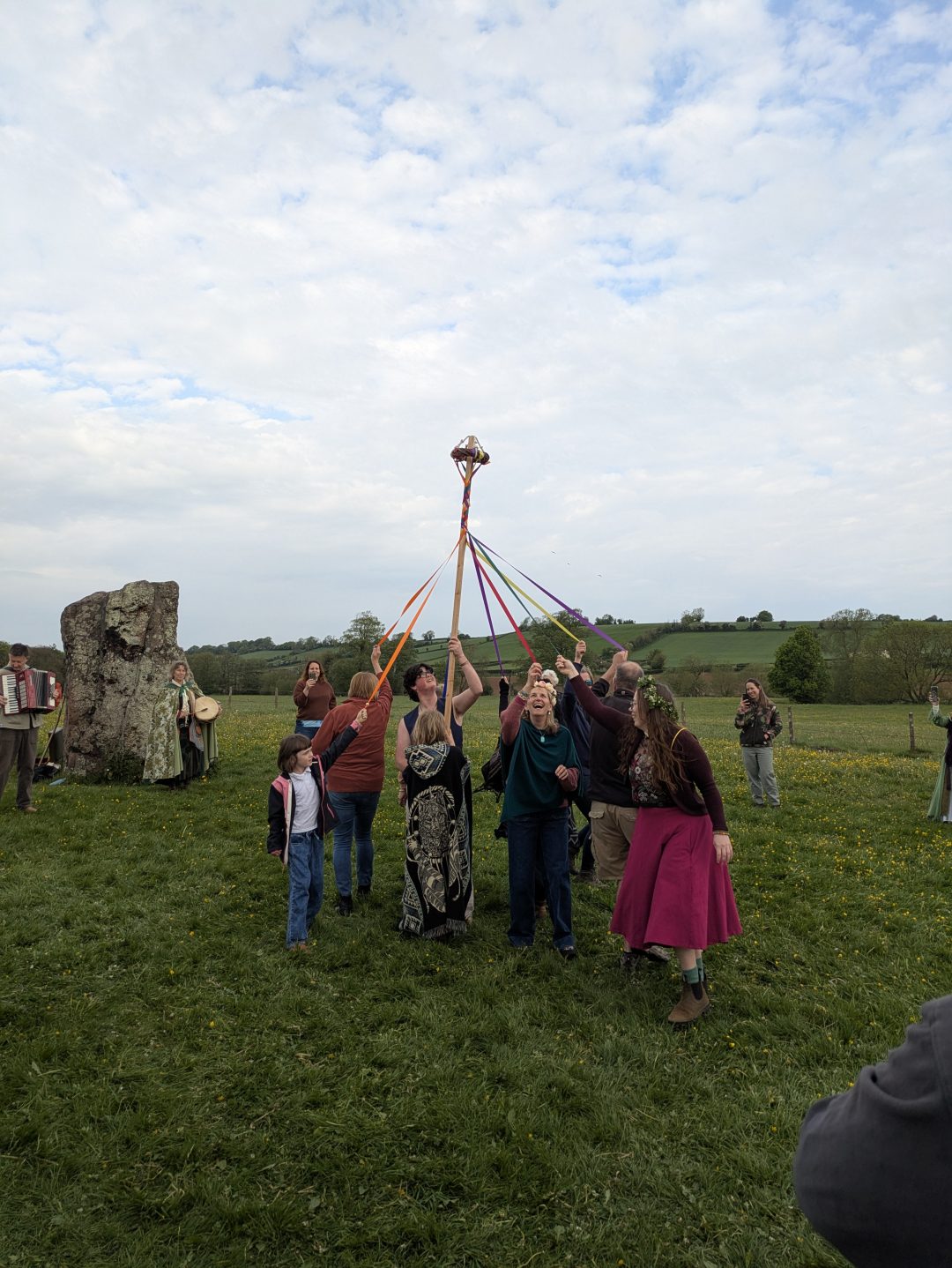
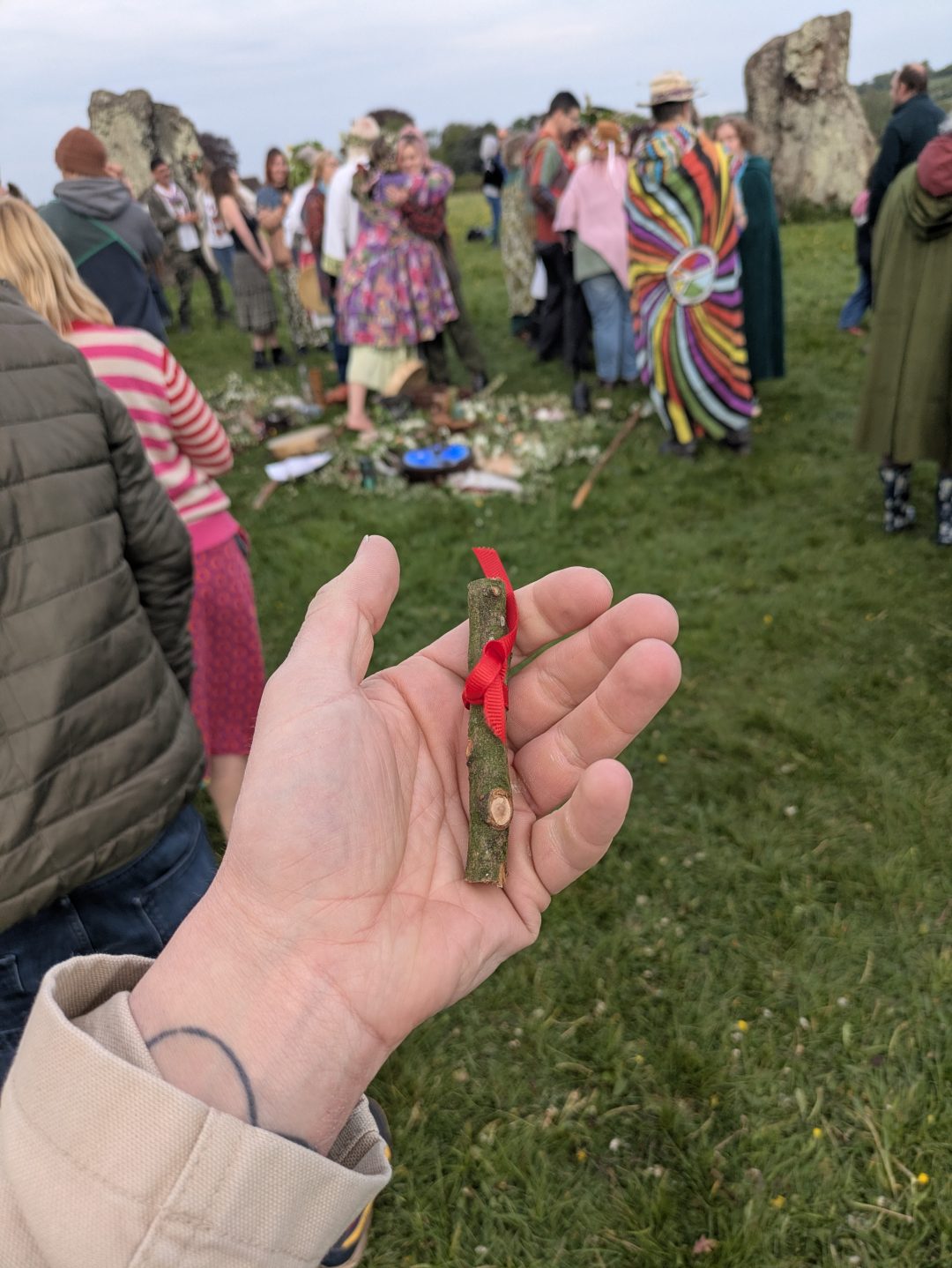
Men and women draped in robes beat an accelerating rhythm on drums. I’m holding hands with two strangers. Around a hundred of us swirled in concentric circles around a 5,000-year-old stone monument. It is barely 8am.
“Round and round we turn, we hold each other’s hands, and weave our lives in a circle…” we chant together. I have abandoned any journalistic detachment.
This was not the chemically altered last gasp of a rave, but Beltane: a pagan festival celebrating the arrival of summer.
I’ve long been fascinated by people who practise ritual magic; not David Blaine-style illusionists, but spiritual seekers who believe willpower and ritual can alter consciousness and perhaps even the world around them.
Modern Druidry is one of a number of alternative spiritual traditions on the rise as participation in organised religion declines. According to the latest census, more than 100,000 people in England and Wales identify as Pagan, Wiccan or Druid.
It is this curiosity that leads me to wake in the early hours and travel to Stanton Drew, just south of Bristol, to join members of the Order of Bards, Ovates and Druids (OBOD) and meet the modern Druids who live among us.
Magic, mirth, merriment
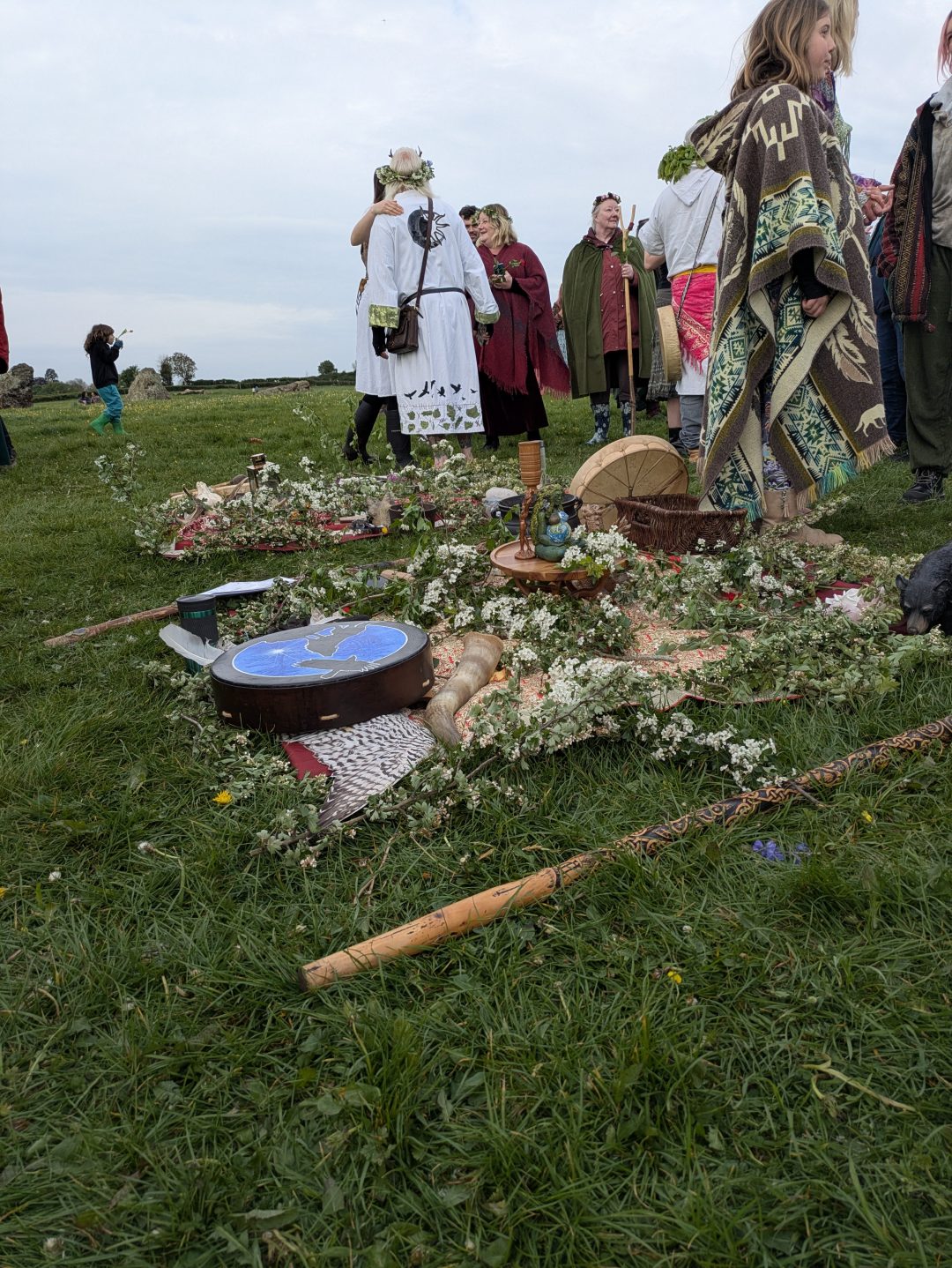
By the time I arrive, around a hundred people are already standing hand-in-hand in meditation. When it ends, Druids carrying symbols of the four elements move through the crowd. Earth is distributed. Air arrives in the form of a bird’s wing gently brushed over participants. Mistletoe dipped in water is sprinkled onto outstretched hands.
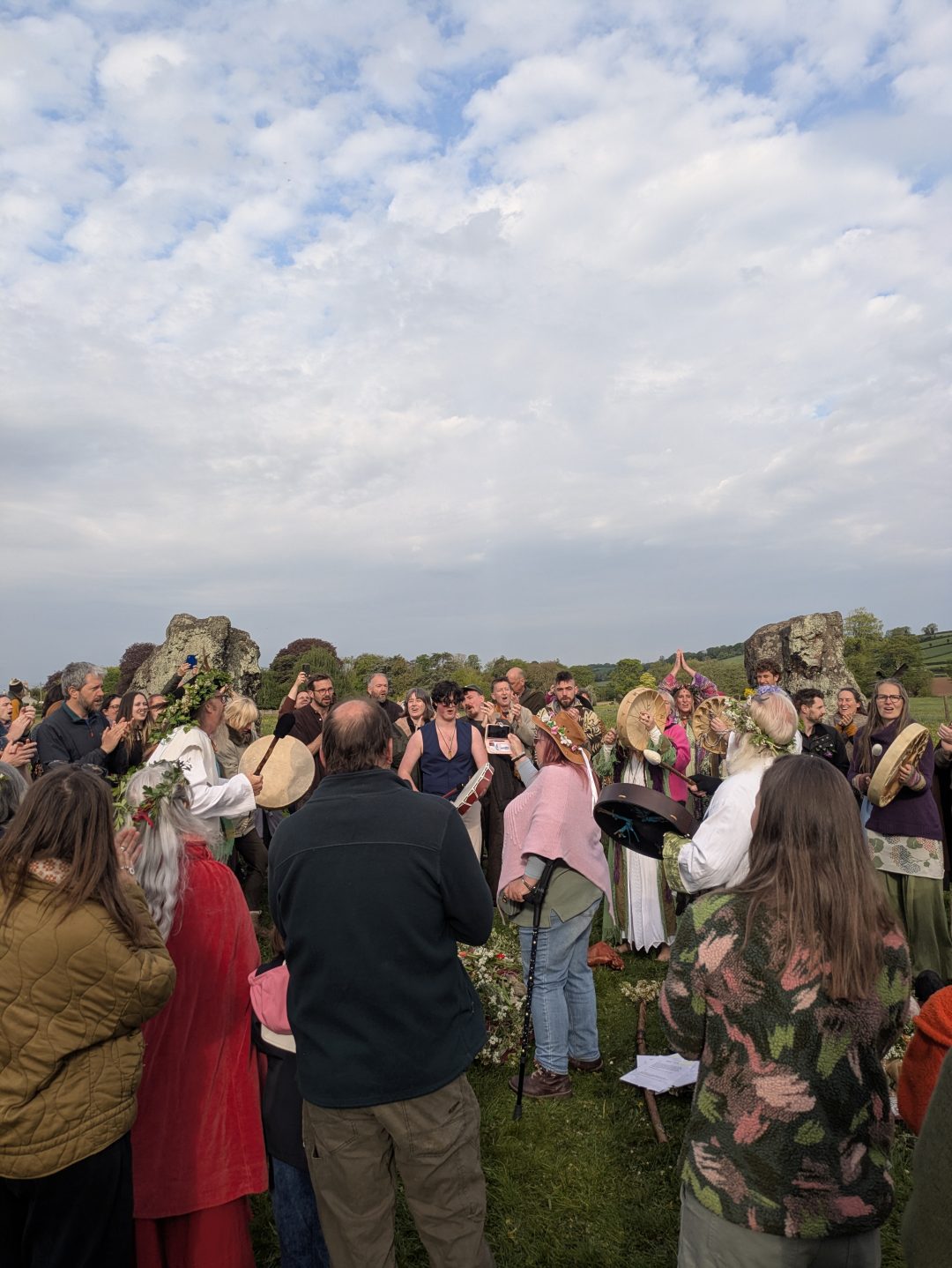
Truth be told, I missed the water bit entirely because I was checking my phone. Lesson learned: if I am going to report on the ritual properly, I need to commit to the experience.
There is more chanting, more hand-holding, and eventually the “Sacred Fire”. Except the landowner no longer permits Beltane bonfires, so one Druid runs through the circle brandishing a lighter instead.
“Magic, mirth and merriment are vital to any ritual,” one Druid later tells me.
The lighter ignites herbs smouldering in decorated pots at the centre of the circle. Participants are instructed to imagine leaping through a roaring bonfire.
The drumming started again, and the chant: “Fire, sacred fire, burning through the night…”
One by one, we form a slightly awkward queue and prepare to leap through the imagined flames before beginning the circle dance.
“I’ve been told if you do something three years in a row, it becomes a tradition,” the ceremony leader tells us. Druidry, it seems, is flexible enough to adapt even the most ancient rituals to modern-day health and safety constraints.
‘A coming home‘
A few days after the ceremony, I sat down with OBOD elder Adrian Rooke. He looks much as you might expect a Druid to: long white hair, a braided beard threaded with a metal ring, colourful tattoos.
His home in south Bristol follows suit: a garden overflowing with flowers, Green Men and pagan artwork. It even contains its own stone circle. One stone, he tells me proudly, nearly killed him while he dragged it 2.5 miles along a beach. “It adds to the magic,” he laughs.
“Magic,” as he defines it, is “accessing different levels of existence — planes of possibility that are always around us, but most people are asleep to. Ritual is about opening gateways to those possibilities.”
His thick Bristolian accent quickly dispels my preconception that modern Druidry is simply public-school enthusiasts playing at Celtic mysticism.
Adrian’s path began after a near-death experience in his early twenties, following complications from dental surgery. During the operation, he recalls an out-of-body moment: “I just watched myself on the operating table. I felt free of the shackles of the human body.” Then, he says, he heard a voice: “Adrian, it’s not your time. You have stuff to do.”
Disillusioned with Christianity, he spent years exploring alternative traditions — from Spiritualist churches to Buddhist chanting groups and Native American-inspired sweat lodges — before repeatedly circling back to one idea: a spirituality rooted in the landscape he grew up in.
“I’m Bristol born,” he says. “I’ve got the limestone of the Dundry Hills in my body.”
As a child, he watched Druids marching at Stonehenge on television and wondered whether they still existed. Years later, he found them through a small advert in an astrology magazine that had fallen open on his desk, inviting readers interested in “ancient British spirituality” to contact the Order of Bards, Ovates and Druids (OBOD), named after its three Masonic-style initiatory grades.
The folklore and mythology captivated him, but so did the organisation’s attitude. New members are told they can leave “with our love and blessings”.
“Not all traditions are like that,” he says. “They tend to get a bit cross when you leave.”
Modern Druidry, he acknowledges, takes a flexible approach to history. Sources on the original Druids are remarkably thin, and much of the modern movement draws on the work of the 18th-century Welsh poet Iolo Morganwg, whom Adrian describes as “an inspired fantasist… but a little flexible with the truth.”
Inspired by the French Revolution and opium, Morganwg produced elaborate forgeries of supposedly ancient texts that helped spark a Druid revival. But that’s by the by for Adrian: “My take is: if something works, and it’s beautiful, and it’s relevant, I don’t care if it was invented yesterday.”
For Adrian, who struggled with addiction, it also helped him stay sober. “I realised I needed to take responsibility for my own life and happiness rather than relying on going down the pub.”
His friends took the piss. His ex-wife thought it was bizarre. But that didn’t stop him. “Once I’d discovered Druidry for myself, it was a coming home,” he says. “It was what I’d been looking for.”
‘We live in a very bizarre world’
Standing among Druids dancing around a five-thousand-year-old stone circle before breakfast, it is impossible to say whether I am experiencing magic.
Once I push past embarrassment or cynicism, the scene is undeniably beautiful. The morning sun breaks through the clouds. Bird calls from the surrounding trees feel newly charged with meaning. A hundred strangers stand hand-in-hand among stones that have watched generations come and go for millennia.
What is clear, though, is the joy people take in sharing meaning, ritual and community.
“We live in a very bizarre world,” Adrian says. “People are tired of being anxious about the next crisis, the next thing that’s supposed to terrify them. They want something that gives them a sense of awe. Something they can connect to. Something simple that they can love and be loved.”
I suspect that is the key to Stanton Drew, where OBOD members and their fellow travellers gather eight times a year for the solstices, equinoxes and seasonal festivals.
Throughout our conversation, Adrian repeatedly returns to one idea: community. “What kept me coming back was the quality of the people I came across,” he tells me. “I’ve never come across such a forward-thinking, inclusive, kind, talented, conscientious bunch of people.”
Whatever you make of ritual magic, ancient wisdom or invisible energies, it is clear they have built something many struggle to find elsewhere: a community that genuinely cares for one another.
Independent. Investigative. Indispensable.
Investigative journalism strengthens democracy – it’s a necessity, not a luxury.
The Cable is Bristol’s independent, investigative newsroom. Owned and steered by more than 2,600 members, we produce award-winning journalism that digs deep into what’s happening in Bristol.
We are on a mission to become sustainable, and to do that we need more members. Will you help us get there?
Join the Cable today
Report a comment. Comments are moderated according to our Comment Policy.
Very informative post. I learned several new things from this post. Please continue posting content like this.