‘I feel like I can do anything’: breaking the ‘survival sex’ cycle
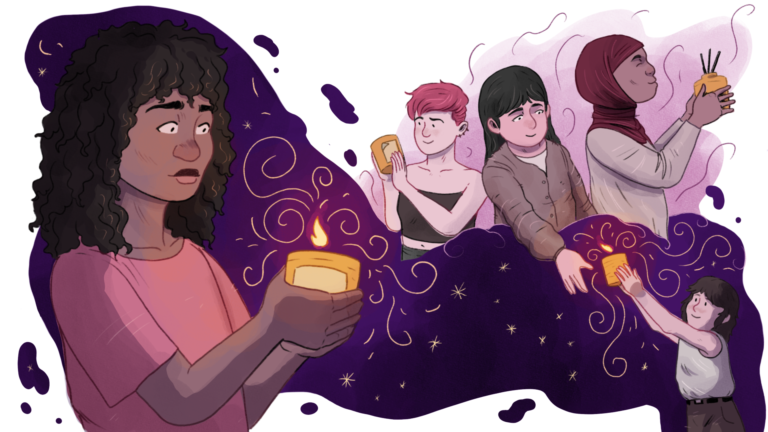
Illustration: Louis Wood
Janet* is lost in her own world in a small office in St Paul’s Learning Centre, making candles by hand. “It’s like a therapy for me,” she tells me.
When Janet first started at LoveWell, a community interest company (CIC) and charity, she was an asylum seeker and lived off government vouchers as she was not allowed to work.
Now she’s production lead and training facilitator and a support worker elsewhere. “I always call this my fun job,” she explains as we sit surrounded by the smell of lavender.
LoveWell was founded in 2017 to work with women looking to leave massage parlour jobs. They make and sell luxury products like candles, and run training and mentoring programmes to give women new skills and support them into employment.
LoveWell is the first job Janet has had in the UK and it’s given her a new sense of confidence. “Because I never used to work like a normal work before. But Lovewell is like a normal work that I had.”
“The vision for Lovewell came from women’s lived experience working in massage parlours in Bristol,” says Claire Dormand, chief executive and co-founder. She is quick to point out that not everyone wants to leave that industry: “We’re here for women who have ended up in parlour work and don’t want to be.”
LoveWell has links with charity Beloved, which offers support to women working in the indoor sex work industry who often fall into a pattern of trying to leave.
“Sometimes women were exiting [sex work] and two years later they were back in the parlours,” Claire explains. The cycle of women leaving exploitative sex work situations for low-paid jobs only to return “when difficulty hits” is not an unfamiliar one to support organisations. Beyond the Streets, another charity affiliated with Beloved, labels this pattern ‘survival sex’.
I ask Claire how LoveWell helps women break this cycle. “We can’t guarantee that,” she replies.
But she adds that 18 months of “quite intensive support” helps fill the trainees’ toolboxes and make it easier to find work. The feedback from the majority of participants is that “it’s the building of their confidence that changes things for them the most.”
‘If I can do it, then they can do it’
The company started out as a simple operation. Initially, LoveWell received a small grant for research and pilot workshops over 18 months, and what they needed for their first small production run of 250 products in 2018.
It has since received funding to run its six-month programmes and women are referred from refugee organisations, through the public justice system, or they self-refer.
For up to a year after the programme, each woman has an “accountability partner” who offers moral support and makes sure they apply for jobs.
All this aims to ease the drop-off in the often daunting search for employment after the programme. “That’s a really key time,” says Claire.
Around 60% of the programme’s participants are now employed. “When you look at the group of women that we’re working with and how far from the employment market they are when they start with us, that’s a really high statistic and something that we’re really proud of,” says Claire.
But organisations like this are under risk. According to research, 32% of charities anticipate a worsening financial situation this autumn.
Claire says that it’s “heartbreaking” to be “in an industry where we know that there are women who aren’t going to be picked up on.”
Giving back
Janet was on LoveWell’s first programme. On finishing, she became production assistant, and now she’s production lead as well as a programme facilitator.
She signed the contract the day after she was granted refugee status, remembers Claire. “She is really inspiring because she’s saying: ‘Actually this is where I was, this is my life story, this is my experience – and look where I am now.’”
Janet’s confidence has grown hugely. “I feel like I can do anything,” she says. “My session is the best!” she adds modestly. “The girls love me.”
She is determined for women in difficult situations to feel the same. “When you’re in a certain position, you feel, like, ‘that’s all of me’. You think you can’t do more than that. But you’ll be shocked if you come out to see what you can discover about yourself.”
This is the message Janet leaves for women who fear their ability is defined by their circumstances.
*Name has been changed
Independent. Investigative. Indispensable.
Investigative journalism strengthens democracy – it’s a necessity, not a luxury.
The Cable is Bristol’s independent, investigative newsroom. Owned and steered by more than 2,600 members, we produce award-winning journalism that digs deep into what’s happening in Bristol.
We are on a mission to become sustainable, and to do that we need more members. Will you help us get there?
Join the Cable today