
Content warning: this article contains references to suicide.
“Going out is a lot scarier than it used to be.”
Sarah* is a trans woman. She used to be able to go to the supermarket in pyjamas, but now she puts on a full face of makeup before leaving the house. “It feels much more imperative that I pass, or at least that I don’t look conspicuous.” ‘
Last April, the Supreme Court ruled that the words ‘sex’, ‘woman’ and ‘man’ in the Equality Act 2010 referred to a person’s sex assigned at birth, excluding trans women from the protected characteristic of women.
Then, just nine days later, the Equalities and and Human Rights Commission (EHRC) published ‘interim guidance’ on what it called the “practical implications” of the ruling. It advised that trans women should not be allowed in women’s facilities in public spaces (including workplaces, venues, gyms and hospitals) or in women-only services like rape crisis centres and homelessness centres.
It was later withdrawn after criticism and legal challenges, but they’ve been working on a redraft and on 21 May published an updated draft code of practice, stating that single-sex toilets and changing rooms must exclude trans women from women’s facilities and trans men from men’s. MPs have 40 days to consider it before it comes into force.
“Do you know what the funny thing is? I’ve never actually been challenged,” says Sarah. “Nobody’s ever yelled at me in the toilet for using it, not even [since the ruling]. But it’s the fear, it’s the hypervigilance. It’s the fact that people have license to do that now. That’s the scary thing.”
‘This will cause serious harm’
The government’s equality impact assessment released alongside the draft code has suggested that trans people can use ‘third-spaces’, like gender-neutral toilets, where available. And, for businesses without gender-neutral toilets, they can use accessible toilets, as suggested by Conservative leader Kemi Badenoch last year.
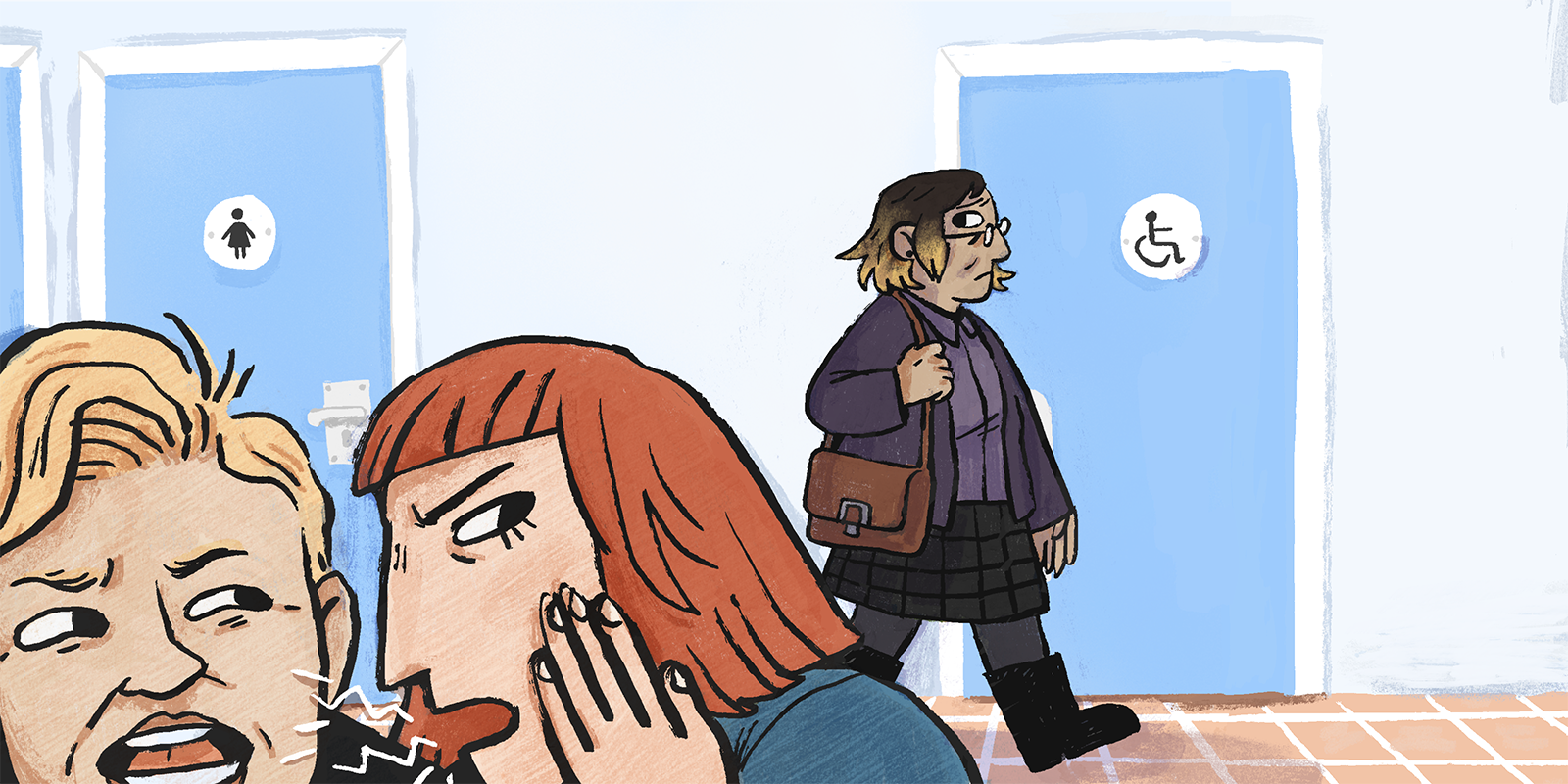
Natasha does this. She started transitioning in her 40s and is still waiting on her first appointment with the gender clinic over eight years later. She was already self-conscious using the women’s toilets before the ruling and now exclusively uses gender-neutral or accessible toilets. She says she’d hate to be the cause of someone feeling less safe in a toilet. “It’s tricky, because it’s quite clear that I’m trans”.
“I used to feel a little bit bad, using a space designed for people with disabilities, but I’ve never come out and found anyone else waiting to go in, so I’ve never felt like I’m holding anyone else up.”
‘I can’t just not pee when I’m out and about, I’m going to need to wee at some point.’
But forcing trans people into third spaces creates stigma, segregates trans people, and risks outing them. Graeme*, who transitioned in 2012, says he would feel deeply uncomfortable suddenly switching toilets.
“I don’t want to go to trans loos,” he tells me. Most people don’t know he’s trans, so switching toilets would likely out him. But he tells me that even if he’s alone in a building, he wouldn’t want to use the gender-neutral toilet.
“I just want to go to the loo like everyone else. It’s definitely more comfortable going to the trans loos than it would be going to the women’s, but not by a huge amount.”
Non-profit The Good Law Project wrote about the draft code: “A trans woman who goes to the pub with the rest of her female friend group would have to explain why she cannot go into the women’s toilets with them. In practice, third services or spaces are often insufficient – denying trans people access to vital services and pushing them out of public life. This will cause serious harm.”
Disability advocacy charities also have expressed concern about the suggestion that trans people should start using their toilets, when there already aren’t enough.
Even before the ruling, Tegan, a care worker, used the disabled toilet when out with the children she supported, because “what happens if I’m out with a kid and somebody yells at me?” But now she only uses the ladies. “I refuse to use the disabled toilet now. Because screw ‘em, you will not force me to do something.” But it means she’s always braced for conflict, which she hates. “I’m a bleeding daoist!” she blurts, exasperated.
She usually calls ahead before going out. “Checking a restaurant is safe for trans people is the first thing you do when considering going out. The first thing you check if you’re a trans person, [are the toilets] sex segregated? Are people going to kick off?”
Bankrolled by a billionaire
The ruling and guidance haven’t gone unchallenged. The Good Law Project contested the EHRC’s guidance in July, resulting in the High Court ruling this February that trans women are allowed into women’s facilities (and trans men into men’s), but not in their workplaces.
But it’s not a level playing field. Super-rich lobbyists, like children’s author-turned-anti-trans activist JK Rowling, are directly impacting the law by donating huge sums of money to anti-trans groups. “We’ve got the Good Law Project, and that’s all we got,” says Tegan. “We’re trying to raise money, but JK Rowling literally raises that money in her sleep”.
Billionaire Rowling has funnelled a lot of money into the anti-trans movement. She reportedly donated £70,000 to For Women Scotland in 2024, who were bringing the challenge in the Supreme Court. She celebrated the ruling by tweeting a photo of herself on her £100m super-yacht, smoking a cigar, with the words: ‘I love it when a plan comes together’.
‘If I can’t use the toilet in public, I can’t be in public, that’s the end of it. I can’t make my bladder bigger.’
Shortly afterwards, she announced a new fund dedicated to financing court cases against trans women. The JK Rowling Women’s Fund (JKRWF) prioritises cases that will make legal precedents.
But, “Rowling is a drop in the ocean compared to the rest of it,” says Chay Brown, health director for advocacy organisation, TransActual. A 2020 openDemocracy report revealed that several US right-wing evangelical groups had spent over $280m on campaigns against women and LGBT+ rights in Europe.
In stark contrast, many trans people are struggling to make ends meet, typically earning less than cis people, and also trying to raise the thousands required for private surgery, because the alternative is waiting a decade to go through the NHS.
Funding a court case is simply out of reach for most trans people. Lexi, a bar manager, says it’s “very rare” that she meets trans people with the resources to take on a court challenge. “I’ve got a friend who’s like: ‘let them come for me, I will take them to court.’ I love that she is in a position to do that. I am not.”
Panic attacks and losing jobs
Chair of the EHRC, Dr Mary-Ann Stephenson and Secretary of State for Work and Pensions, Pat McFaddon have both assured that there would be no toilet policing. But that’s not how it’s played out. Research by TransActual conducted in late 2025 found that public challenges in toilets “increased markedly” following the guidance, particularly in pubs and leisure venues – to cis, as well as trans women. “It was already happening before the Supreme Court. It’s been happening for years,” says Brown. But it’s worse now, he says. People are being stopped and challenged more than ever before.
“There is definitely a small group of people that feel that they’d have to do some policing […] it gives them an excuse to be the thugs that they really are,” says Natasha.
Sarah’s workplace changed their trans and non-binary policy in September and suddenly she was expected to stop using the ladies and use the gender neutral toilet. She works in an open-plan office on a floor full of cis women, most of whom don’t know she’s trans.
Sarah had a panic attack in the car on her way to work when she found out about the policy change. She had to park up and wait for it to pass, and then she turned around and went back home. She’s been off sick since.
When I first spoke to Tegan, she was working in child care. A 15-year-old girl she was caring for asked her to start taking her swimming. “Luckily, in Bristol, the [changing rooms for the] swimming pools aren’t sex segregated, they’re just cubicles,” she says. But she was still certain that someone would have something to say about a trans woman accompanying a teen girl swimming.
“I have no voice training, you know, and I’ve got this adams apple […] So I don’t send out all the gender signals I would like to automatically click it into people’s brains”.
Tegan had a panic attack and received a disciplinary for not being fit to do her job. She eventually found a workaround: she doubled up with a colleague, joking that it was to make sure she wouldn’t drown, because she hadn’t gone swimming in ages.
When the Supreme Court ruling came out, days later, she was still under review for the panic attack. She was signed off sick with suicidal thoughts. On her return, she was told she’d taken too many days off and they’d have to review her attendance. She’s since been placed under medical suspension and tells me she’ll soon be deemed not fit to work.
‘I don’t want to go back. I have my life’
Lexi is one of the 26% of trans people considering leaving the UK since the Supreme Court ruling.
“If the toilet ban happens, that is it for me. I can’t stick around, that’s not an option. If I can’t use the toilet in public, I can’t be in public, that’s the end of it. I can’t make my bladder bigger.”
TransActual’s The Gendered Spaces Report 2025, found that the ruling and interim guidance have made many trans people more cautious about which venues they go to. Some even drink less water and avoid going to the toilet when going out.
“I just want to go for a wee and get out again,” says Brown. “But going in there worried — is someone going to say something? — it’s not nice, and that’s why a lot of people have changed their behaviour”.
It took Lexi ages to be confident enough to transition. “I think the reason it took me so long to come out as trans was because I didn’t think I could get away with it, as if it’s a crime.
“I thought, if I try to be a woman, I won’t be pretty enough, and I won’t fit in enough, and I won’t pass enough, and I’ll fail, and everyone will laugh at me, and I’ll have a horrible time. And, right now, at least I’m getting by, even if I’m not having a good time.”
It took her a long time to work up the courage to use the ladies. “Every single time I use the women’s changing rooms I’m like ‘shit is this going to be the day someone makes an issue with me?’ I just dash in there, keep my head down and get out of there.”
For Lexi, the ladies is a huge part of her new life living openly as a woman. “I don’t want to go back. I have my life”. There are nights out where she spends most of the night in the women’s loos “chatting complete shit with other drunk girls”.
“You’ll be in there and someone will say ‘oh I love your coat, and you’ll say ‘I love your hat,’ and you’ll have a great time, you’ll chat-chat-chat,” she says.
“I don’t want to give that up, not now that I’ve had that. I don’t take a second of my life as a woman for granted because I know what it was like before. It wasn’t fun.”
It’s not all fun now, though. She tells me about a man yelling “scum” at her for going into the ladies in a shopping centre. “I mean, I’m just peeing,” Lexi says, laughing. I comment on her gallows humour and she answers: “I just wish the gallows wasn’t for me”.
*Some names have been changed.
Trans Solidarity Alliance is holding a mass lobby on 25 June and encouraging people to write to their MP before they vote on the EHRC Code.
Independent. Investigative. Indispensable.
Investigative journalism strengthens democracy – it’s a necessity, not a luxury.
The Cable is Bristol’s independent, investigative newsroom. Owned and steered by more than 2,600 members, we produce award-winning journalism that digs deep into what’s happening in Bristol.
We are on a mission to become sustainable, and to do that we need more members. Will you help us get there?
Join the Cable today