
“This stuff around bathrooms is awful but it’s just another thing to add to the pile, hundreds of papercuts that paralyse you and stop you living your life”.
Emma is a young trans woman who moved to Bristol four years ago. “I’m quite lucky in that I pass relatively well,” she says. “Right at the start [of transitioning]… I didn’t feel safe in bathrooms, but it’s been a couple years, and now I do feel pretty safe.”
In April 2025, the Supreme Court ruled that the words ‘sex’, ‘woman’ and ‘man’ in the Equality Act 2010 referred to a person’s sex assigned at birth, excluding trans women from the protected characteristic of women. In late May the Equalities and Human Rights Commission (EHRC) published a draft code of practice excluding trans women from single-sex facilities.
“It’s a really blatant attack on a vulnerable group,” Emma says, of last year’s ruling. She went to her GP for help with her mental health. “I said, I’m struggling the most I have in my life. I’m struggling to get to work. I’m so worried about this stuff.” Her GP gave her a list of counselling groups she could refer herself to, but that was all.
“I’ve struggled with my mental health all my life and figuring out I’m trans in the last five years has not made that easier. It feels like absolutely every step of the process is made as difficult as possible in this country.”
Life for trans people is already stressful, expensive, and difficult. Long waiting lists for a first appointment at the gender identity clinic, rising transphobia and obsessive media coverage, all combine to make an extremely hostile atmosphere for trans people.
“On top of that, you’re then told you can’t even go to the bathroom. It’s not that it’s the worst thing to ever happen to trans people. It’s just yet another thing that makes daily life more difficult,” says Emma.
‘A completely broken system’
It currently takes at least eight years to get a first appointment at a gender identity clinic (GIC). There are only a few of these in the UK, and the only one in the South West is in Exeter. All the while you’re living in a body that feels wrong.
Many trans people resort to crowdfunding surgeries and DIY hormone therapy. This involves buying hormones off the internet, without blood tests and regular checkups. It’s expensive and risky.
“It’s a completely broken system,” says Natasha. She was in her forties when she came out as trans and approached her GP to start the years-long process of getting gender-affirming care. “It was a real struggle just to get the words out, saying: ‘I’m suffering with gender dysphoria’”.
There’s always been transphobia but it’s been ramping up. People have taken a real interest in transphobia as a hobby
Lexi
That was over eight years ago. She still hasn’t had her first appointment. “No one will tell me where I am on the waiting list.” She initially got medication from abroad, spending around £250 a month doing this privately before she managed to get shared care, where GPs share the prescribing and monitoring of specialist medicine. “It’s been a lot of trial and tribulation and risk”.
A lot of trans people go private with their healthcare, or choose to crowdfund if they can’t afford the cost. Lexi, a bar manager, is fundraising £4,000 for surgery, but will eventually spend £20,000 if she gets everything she wants to get done privately.
Even if you wait for NHS treatment, it’s still costly. Graeme*, who transitioned in 2012, was finally called up for surgery late last year. Waiting lists for surgery are more than five years long, and this is after the initial years-long wait for the first appointment at the GIC. You have to be within an hour’s travel from the hospital for the week after your surgery and the only two hospitals for bottom surgery in the UK are in London.
It cost Graeme around £1,000 in Airbnbs, lost earnings and dogsitting, and a week of annual leave for his partner. In the end, his surgery was cancelled the day before and he had to pay it all again when surgery came round again four months later.
“The actual surgical team themselves are brilliant,” he says. “Really kind, open, proactive people.” But, to get to them you have to wait several years, travel to London, and spend a lot of money. “Unless you can get hold of a grand or so, it’s not an option.”
Rising transphobia
Transphobia has been steadily growing in the UK over recent years. A recent survey by advocacy group TransActual of 4,000 trans people, the largest in-depth survey of trans people in the UK to date, found that the rise in discrimination and prejudice is having a “profound effect on the wellbeing and daily lives of trans people”. It was conducted before last year’s ruling.
I’ve had to get a thick skin… Otherwise it would do my head in
Natasha
Almost all respondents said that media coverage had affected their mental health or made their gender dysphoria worse. The majority of respondents also said they believe media coverage has affected the behaviour of strangers, family members, colleagues, and friends. 99% also said they’d heard politicians saying transphobic things.
“We’re all feeling like, how long before this constant ramping up of the transphobic rhetoric… turns into a situation where we just can’t live here any more?” says Lexi, who’s been considering leaving the UK since the ruling.
“I can’t go online at this point without seeing an insane amount of trans stuff. People have taken a real interest in transphobia as a hobby”.
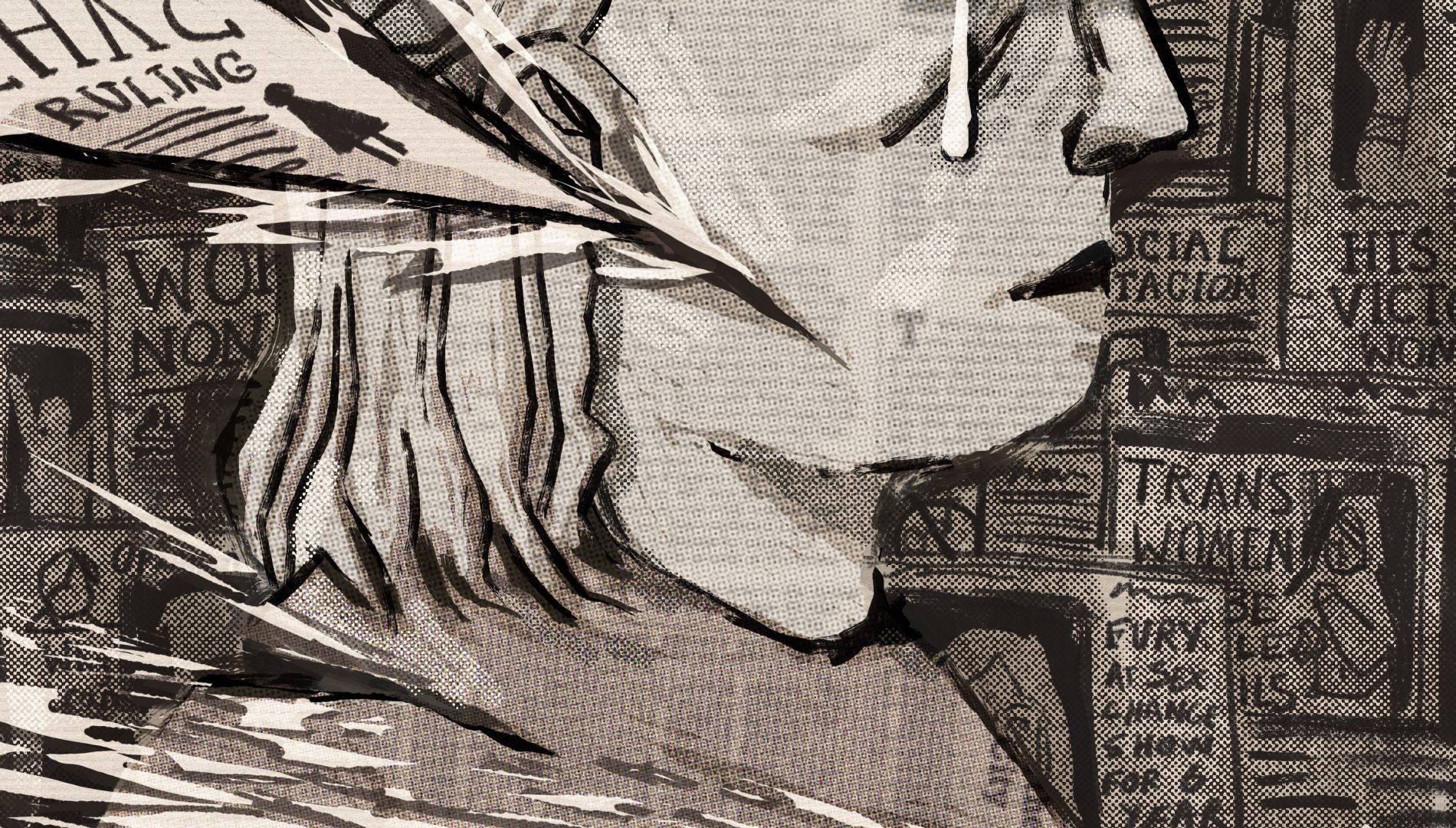
This rising transphobia is being fuelled by an increase in negative media attention. “The Telegraph are obsessed with us,” says Chay Brown, director of healthcare at TransActual. “In the past five to ten years, the increased number of pieces about trans people [in the media] is unbelievable.”
In 2018-19 the British press published around 3.5 times as many articles on trans people as they had done in 2012, and the coverage was overwhelmingly negative.
People are “being fed a diet of lies,” about trans people, says Chay.
‘Socially acceptable to be transphobic’
Nathasha feels that transphobia is “definitely worse” since the Supreme Court ruling. “I think that’s the big difference with trans communities [compared with] other minorities,” she says. “At the moment it feels socially acceptable to be transphobic, whereas it’s pretty socially unacceptable to be racist or ableist. Though that’s changed a bit over the last year.”
“People are more emboldened to be abusive to trans people,” says Chay. “The same way as they’re more emboldened to be racist. It’s linked to the general rise of far right politics”.
Natasha regularly gets abuse from strangers in the street. Sometimes it’s groups of men just staring at her as she passes. Sometimes people make comments, and instead of intervening, others often join in.
“It might not be vocally joining in, but it’ll be a smile or a laugh.” She recounts all this calmly. “It’s quite scary that when I think back all of these years, not once has anybody stood up.
“Whenever I go out, there’s a lot of people doing double takes or sideways stares or just simply staring for far too long. I suppose I’ve had to get a thick skin… Otherwise it would do my head in.”
She’s found that since the Supreme Court ruling, it’s often older men giving her abuse. Recently though, it was schoolchildren. Walking her dog in the centre, Natasha saw two children of around 15 laughing, pointing, and taking photos of her. She challenged them, “perhaps naively”.
“Immediately one of them said, ‘oh you’re a paedo. Why has a grown man come over and spoken to us?’ I was really taken aback.” No one around said anything.
“That’s just quite sad, because I’ve always said every generation gets slightly better and more accepting, and that seems to have taken a different turn.”
Mental health struggles
The long waiting lists, widespread discrimination and abuse, and uptick in media attention have, unsurprisingly, have led to trans people having much worse mental health than cis people. Trans people are five times more likely to have a mental health condition like anxiety or depression than cis people.
“So many things need to happen that are fundamental to trans people surviving. It’s a scary position we’re in and I want to be hopeful, but it’s really hard to feel that,” says Emma. She says that enshrining the rights of trans people in law and making trans healthcare take less than a decade to begin would be a good start.
“I’m scared, not only for myself, and not only for trans people, but for people of colour, people who are disabled, so many other groups of people. Because when fascist governments hurt trans people, everyone else is next to be targeted”.
Independent. Investigative. Indispensable.
Investigative journalism strengthens democracy – it’s a necessity, not a luxury.
The Cable is Bristol’s independent, investigative newsroom. Owned and steered by more than 2,600 members, we produce award-winning journalism that digs deep into what’s happening in Bristol.
We are on a mission to become sustainable, and to do that we need more members. Will you help us get there?
Join the Cable today