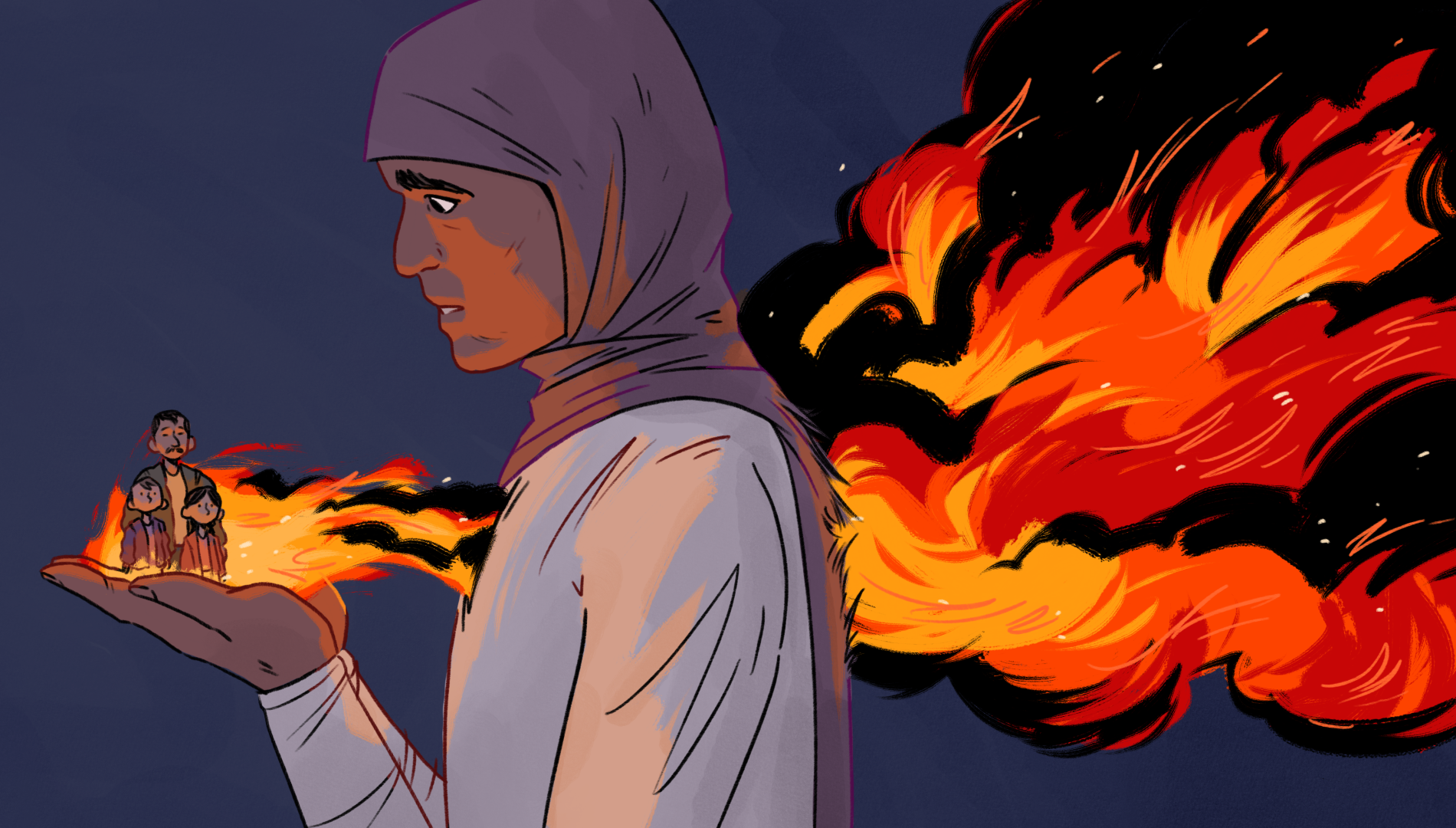

“My home doesn’t exist anymore,” says Randa* quietly. “It was destroyed by shelling in the first months of the war.”
I sit beside her on a bench atop Troopers Hill, looking out over the city sprawled below. It’s a grey January afternoon, and the sky is already darkening.
When Randa came to Bristol in August 2023 to start a PhD, she believed her husband and two children would follow shortly. More than two years later, she is still waiting.
She opens her phone to show me a photo of her house in Khan Younis, southern Gaza. Tumbling pots of maramieh, mint, and za’atar sit on the porch. Her 13-year-old son Bilal grins at the camera, taking a selfie in front of their home, family lined up behind him.
“Every time my phone buzzes, my heart stops. I am desperate to hear from my family, and at the same time terrified that it will be bad news.”
“This is where my family lives now,” she says, scrolling to a video: a makeshift tent, her husband Omar standing outside, his smile tired. The camera pans across to dozens of similar tents, sinking into muddy, stagnant water — the aftermath of recent storms in the devastated Gaza Strip.
Another photo shows her daughter Rayan and other girls in colourful dresses, holding bright pink balloons against a grey backdrop of bombed-out buildings. “This was my daughter’s 10th birthday party. Can you imagine how it feels to miss these moments?”
Our gaze falls to a nearby bench, where a toddler trips and starts to cry. His mother scoops him into her arms to comfort him.
“Before I left Gaza, I had not been separated from my daughter for more than one night,” Randa says. “Now I have had to watch her grow up from afar, amidst a war.”
Separation has hollowed her life, making it difficult to focus on her research or feel present in Bristol. “Every time my phone buzzes, my heart stops. I am desperate to hear from my family, and at the same time terrified that it will be bad news.”
Randa’s situation mirrors that of many people who have managed to escape from Gaza. But while people fleeing other war zones often receive more lenience, Palestinians like her face suspicion, legal hurdles, and prolonged uncertainty.
The situation in Gaza
When Randa received her scholarship, her husband and children were eligible to come as dependents under UK immigration law. A delay in their application meant she had to come to the UK alone to avoid losing her place.
Just two weeks after her arrival, on 7 October 2023, Hamas carried out a surprise attack in southern Israel. Israel responded with an assault on Gaza days later. At that point, the UK’s Visa Application Centre (VAC) in Gaza closed, citing the conflict. This has left Randa, and many others like her, in years of limbo.
The UK requires most visa applicants to provide fingerprints and a facial image at a VAC. “When the VAC in Gaza closed, we were told my family should travel to the West Bank, Egypt, or Jordan to give their biometrics,” Randa explains. “But when we asked how they were supposed to leave Gaza to get there, we got no real answer.”
Israel controls Gaza’s airspace, waters and most of its land crossings. The Rafah crossing into Egypt operates under shifting arrangements, but Israel has the power to close it or veto individuals from leaving. Egypt and Jordan are reluctant to allow Palestinians to enter without assurance of onward travel to the UK.
Exit is typically limited to medical evacuations, dual nationals or those on approved lists. For ordinary families, leaving is nearly impossible without significant money or foreign intervention.
So Randa’s family is trapped: the Home Office requires biometrics for a visa, but there is no safe way to provide them.
Safe and legal routes to the UK
This problem is not unique to Gaza. VACs have also been closed in other conflict zones, including Ukraine, Afghanistan and Sudan.
The Home Office does have the power to grant biometric waivers to facilitate the safe exit of people from a war zone. After Russia’s invasion of Ukraine, ministers introduced bespoke visa schemes allowing applicants to verify their identity remotely with an ID-checking app, or provide biometrics after arrival in the UK.
Yet very few waivers have been granted to non-Ukrainians — just 15 between May 2023 and February 2024 — prompting charities to accuse the government of ‘blocking’ people stuck in other war zones.
For Randa, the contrast is difficult to ignore. “When there is political will,” she says, “solutions appear.” “I am not asking for special treatment,” she adds. “Only for the UK to allow my family to join me.”
A Palestinian family from Gaza recently challenged the UK government to grant them a biometric waiver. In response, Rory Dunlop, a former lawyer for the Attorney General, stated in a written submission that allowing the family into the UK without biometric checks would be a “step too far” and risk national security.
“What is distinctive in the Gaza context,” Elizabeth Little of Law for Change explains, “is that there has been no bespoke, large-scale route for Palestinians… and key protections for Gazan families have often depended on case-by-case court challenges.”
“I am not asking for special treatment,” she adds. “Only for the UK to allow my family to join me.”
Law for Change, a charity funding strategic legal actions, recently supported a law firm to successfully challenge the British government. The challenge centred on the government’s refusal to evacuate the Palestinian family of a student who, like Randa, had been sponsored to do a fully-funded PhD in the UK.
Little explains that the case changed UK policy on dependent eligibility. The government now commits to evacuate dependents of certain fully-funded scholarships from Gaza without requiring prior biometric checks.
The updated guidance offers some hope to students, universities, and NGOs advocating for evacuations. Students who traveled alone can now apply to bring their dependents under the clarified criteria. According to Little, the policy recognises that “education and family life must be protected together, rather than traded off against each other.”
Whilst this updated policy means that more students and their families have arrived in the UK from Gaza, delays, poor communication and uncertainty remain. Randa still has no timeline or assurance about when – or if – her family will be evacuated.
‘The violence never really stopped’
Israel’s most recent war in Gaza has been its deadliest escalation in recent years, but violence against Palestinians is longstanding.
“My father Hamoudi was born in 1938 in Jaffa, during the Great Palestinian Rebellion (1936–1939),” Randa told me. “In 1948, during the Nakba, Israel declared independence, and my father’s family was forced to flee to Jabalia refugee camp in Gaza. He was ten years old.”
She traces the line forward. “My son Bilal, born in 2012, had already lived through two wars by age three. No matter what they say about this ceasefire, the violence never really stopped.”
Since the US-brokered ceasefire in October 2025, the UN Office for the Coordination of Humanitarian Affairs (OCHA) reports that the Israeli military has killed 1,591 Palestinians and wounded over 1,500. Restrictions on food, medicine, building materials, and freedom of movement continue to leave many in desperate situations.
As we leave Troopers Hill, the wind picks up. Randa checks her phone and shows me a message from her husband:
“There is more than one type of death. People who don’t know war forget this. There is the death we all know. And there is a death where your soul dies, but your body stays alive.”
She looks out over the city, the glow from her phone lighting one side of her face, and casting the other in shadow.
“This,” her husband writes, “is the death that we are living.”
The Home Office did not respond to our request for comment.
*Names have been changed.
Independent. Investigative. Indispensable.
Investigative journalism strengthens democracy – it’s a necessity, not a luxury.
The Cable is Bristol’s independent, investigative newsroom. Owned and steered by more than 2,600 members, we produce award-winning journalism that digs deep into what’s happening in Bristol.
We are on a mission to become sustainable, and to do that we need more members. Will you help us get there?
Join the Cable today