University of Bristol paid private security firm to ‘spy’ on pro-Palestine protesters
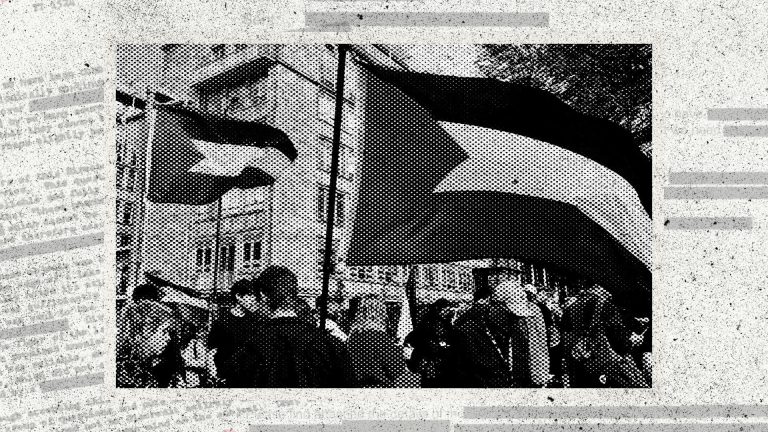

It’s late May 2024. Students have been camped for weeks in the University of Bristol’s Royal Fort Gardens, demanding the institution cut ties with companies linked to Israel’s genocide on Gaza.
What they don’t know is that the university is monitoring their protest, with the help of a private security firm run by former military intelligence officials. The company, Horus Security Consultancy Limited, is sending senior staff regular insight reports.
“Last one today, honest. Could you also add [redacted] to the circulation for Bristol,” a University of Bristol employee writes to the Horus Insight team, in correspondence released under freedom of information laws and seen by the Cable. They sign off the email with: “Our senior team are delighted with the briefing.”
The University of Bristol is one of at least 12 British universities to have paid Horus Security to monitor campus protest activity, some since 2022, an investigation by Al Jazeera English and Liberty Investigates has found. The firm compiles intelligence reports for universities, drawing on student social media activity and conducting what it describes as “counter-terror” threat assessments.
In the US, universities have worked hand-in-hand with the state to surveil and deport students. That happening here is not an impossibility
Since 2022, Horus has received at least £440,000 from universities. At Bristol, the university paid at least £8,700 between 2024 and 2025. Internal emails seen by the Cable show that the university requested and paid for a “bespoke” alert service covering “anything related to proposed student protest… encompassing all protest activity across the city.”
The director of the firm’s parent company, Horus Global, has previously called for non-British protesters who “misbehave” to be deported.
The revelations are unsurprising to student protesters and university union reps. To them, this kind of surveillance is a worrying sign that British universities might be willing to engage in the kind of repression against international students happening in the US, where pro-Palestine protesters are facing deportation.
‘Part of the imperialist war machine’
Internal emails between the university and the security firm show that between October 2024 and March 2025, Horus sent Bristol 21 weekly “Insight” briefings. The university even provided the firm with a list of student protest groups it wanted the firm to monitor, including pro-Palestinian and animal rights activists groups.
One email sent by University of Bristol staff to Horus in October 2024, with the subject line ‘pro-Palestine protests’, requested monitoring of: Camp Beagle, Free the MBR Beagles, MBR Suppliers, Vivisection exposed, Liberate or Die, and Animal Rising, all campaigning against controversial animal testing and breeding practices in the UK.
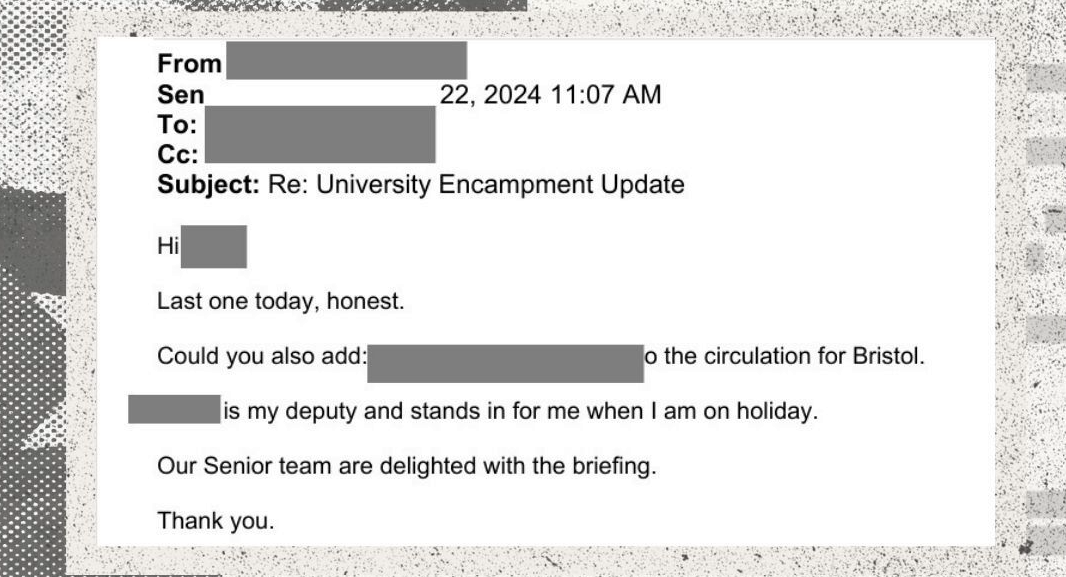
In May and June 2024, Bristol received ‘encampment updates’ from the security firm tracking students involved in an encampment organised by Bristol Occupy for Palestine. Earlier that year, eight students also occupied the university’s Victoria Rooms before moving to 5 Tyndall Avenue – a building used by the institution’s senior management team.
The actions came amid a global wave of pro-Palestinian protests on university campuses that began in late 2023, with students demanding their institutions divest from companies complicit in Israel’s genocide on Gaza.
The Cable put the revelations to a protester involved in University of Bristol campus actions at the time. Rainbow, a student organiser and speaker at pro-Palestine rallies in Bristol, told the Cable: “It’s very on brand for the uni to do this kind of thing. I’m not surprised at all.”
“Not only does [the university] not face its complicity in the arms trade and genocide, it’s trying to stop students, 18 and 19 year olds, from confronting it. Bristol is part of the imperialist war machine,” she added, pointing to the university’s investments in arms companies linked to Israel.
She also highlighted the university’s use of a controversial check-in attendance app. A group known as the Bristol Leftist Collective ran a campaign in early 2025 calling for Bristol’s students to boycott the app, which was developed by Ex Libris Group, an Israeli company headquartered in al-Maliha, Jerusalem. The collective said use of it was a “manifestation of UOB’s complicity in the genocide and occupation of Palestine”.
Harvesting sources online
Horus Security was launched in 2006 as a project within the University of Oxford’s security team by former Lieutenant-Colonel Jonathan Whiteley. In a post on the company’s website, he boasts of a “23-year career running security, intelligence and counter-intelligence operations all over the world”.
In 2020, Colonel Tim Collins became director of Horus’s parent company. Collins is known for his role in the Iraq War and in particular a famous speech he gave to British troops on the eve of the US-led invasion. More recently, he blamed the rising number and size of pro-Palestine demonstrations in Western countries on a “Russian-Iranian orchestrated media campaign” and has called for non-British protesters who “misbehave” to be deported.
The company offers a service called “Insight”, providing clients with open-source intelligence reports compiled using a tool it has developed to “harvest a vast range of sources on the internet”. It has been integrating AI into its operations since 2022.
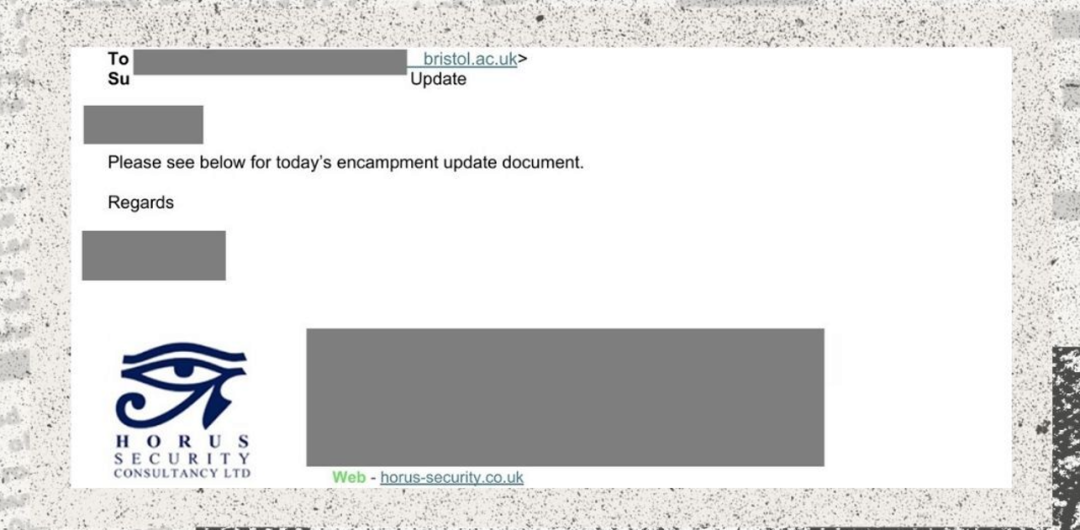
Among those the firm monitored for British universities since 2022 were a Palestinian academic invited to a guest lecture at Manchester Metropolitan University and a pro-Palestine PhD student at the London School of Economics, the Al Jazeera-Liberty investigation found. Other universities to pay the firm include the University of Oxford, Imperial College London, University College London, King’s College London, the University of Sheffield and the University of Nottingham.
Responding to the Cable, the University of Bristol said the information Horus gathers is “publicly available”. A spokesperson added that the insights are on “any protest activity by any group in the city that could potentially affect the safety of our university community… It helps us to make informed decisions on where our security staff may be needed to provide support and if information needs to be conveyed to students and staff. We support the right to freedom of expression and to engage in lawful, peaceful protest.”
Horus did not respond to questions about allegations raised in this investigation. On its website, Horus states that it adheres to “the strongest ethics in whatever we do, and are fully transparent and legally compliant in whatever territory we operate in.”
‘That whole decolonial effort, there’s no substance to it’
There is nothing to suggest that this activity is illegal, nor that individual protesters were monitored by the security firm on behalf of the University of Bristol. But the decision by British universities to do so has been criticised by branch members of the institution’s branch of the University and College Union (UCU).
Max de Bono, UCU postgraduate rep, says surveillance of students in this way is a worrying revelation of what could lay ahead: “In the US, universities have worked hand-in-hand with the state to surveil and deport students. That happening here is not an impossibility, with [the possibility of] a Reform government. What would the university do in that situation? Would it comply, would it actively help? In light of this, it seems clear which direction they would head in”.
The US government is actively cracking down on pro-Palestinian campus activism and targeting international students for deportation, with the collaboration of university administration monitoring. The crack down involves the revoking of visas for protesters whose actions the Trump administration argues support ‘terrorism’.
Max points to the university’s assertion that it wants to reckon with its colonial past: “When the university says it is trying to decolonialise, or in some way make amends for its colonial past, for its money in slavery, it’s impossible to have that conversation without thinking critically about the historic role [the university] has played in British imperialism through the arms trade. If you can’t have these conversations now, then that whole decolonial effort: there’s no substance to it.”
Read the full investigation by Al Jazeera English and Liberty Investigates here.
If you’re a student activist worried about what personal information your university holds on you, a good way of trying to find out is by submitting a subject access request. You can find a helpful guide from the Campus Accountability Mapping Project (CAMP), here.
Independent. Investigative. Indispensable.
Investigative journalism strengthens democracy – it’s a necessity, not a luxury.
The Cable is Bristol’s independent, investigative newsroom. Owned and steered by more than 2,600 members, we produce award-winning journalism that digs deep into what’s happening in Bristol.
We are on a mission to become sustainable, and to do that we need more members. Will you help us get there?
Join the Cable today





Report a comment. Comments are moderated according to our Comment Policy.