

The Avon Pension Fund, which manages pensions for 135,000 public‑sector workers, has long been on The Bristol Cable’s radar. We’ve reported before on its big investments in oil and gas, and how to square that with our city’s climate commitments.
Now, a new dilemma has come into focus: investments in the aerospace and defence sector, amid the ongoing horrors in Gaza.
In December, the Avon Pension Fund committee voted to stay invested in the sector. The Cable spoke to a councillor and a campaigner to unpack the decision, explore the legal framework behind it, and consider what’s next for activists pressing for divestment.
Pension funds arms race
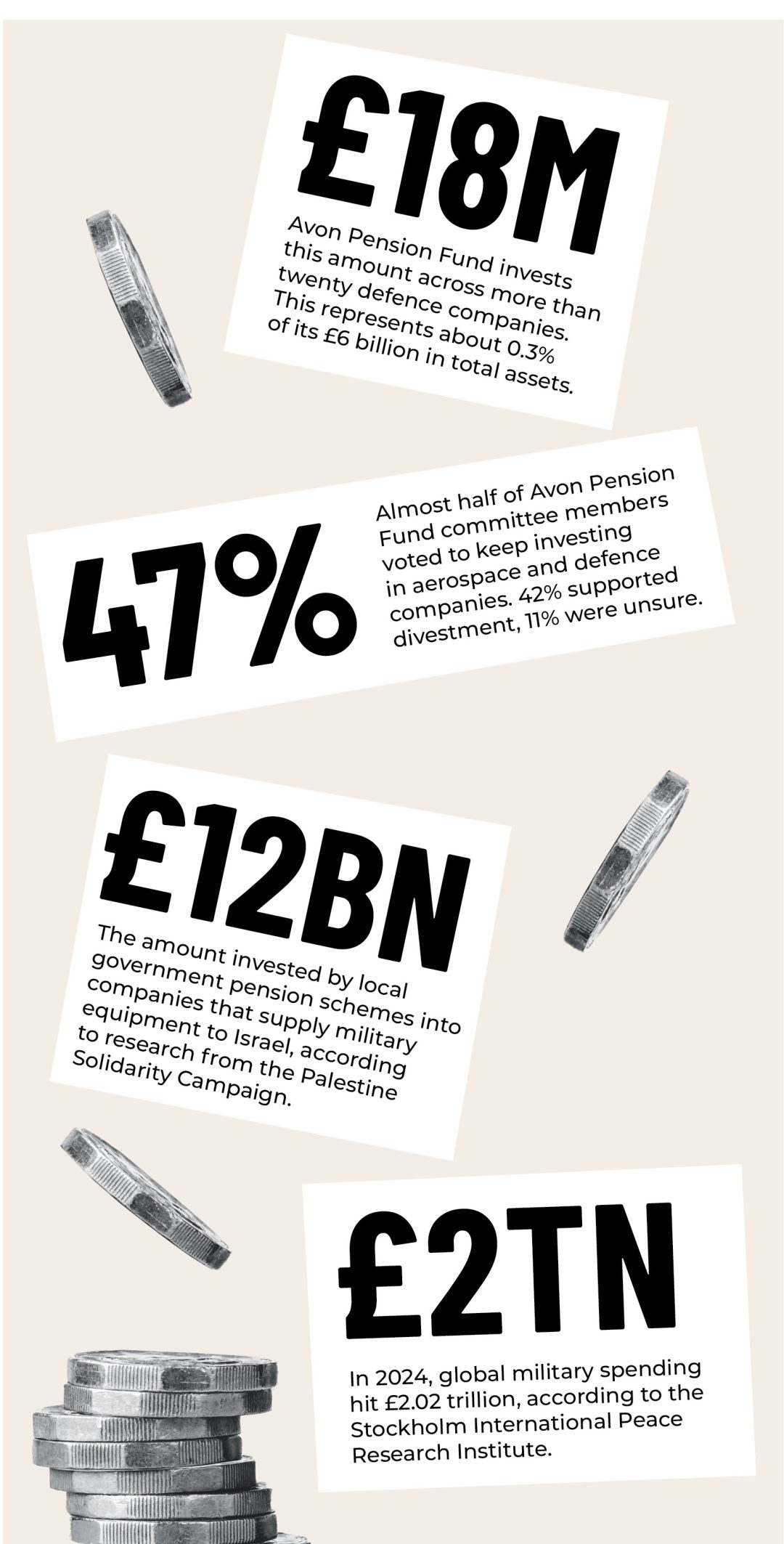
Local government pension schemes (LGPS) have faced growing pressure to divest from arms companies in recent years. A report published in early 2025 by Bath and North East Somerset Council — which administers Avon Pension Fund but leaves investment decisions to its committee — shows that the fund invests nearly £18 million across more than twenty defence companies, representing roughly 0.3% of its £6 billion in total assets.
Public concern has focused on firms supplying arms to Israel, including defence giants BAE Systems, General Dynamics, Transdigm Group, and Safran. Some companies are deliberately excluded from the fund’s portfolio because they make controversial weapons or have broken international guidelines, such as the UN Global Compact Principles. The report notes that over 90% of these companies’ weapons sales go to the UK government or NATO allies, rather than elsewhere.
Dr Eldin Fahmy, Branch Secretary of Bristol Palestine Solidarity Campaign (PSC), tells The Cable that public‑sector workers’ pay is being used “to fund an arms race which is undermining people’s welfare around the world.” For campaigners in Bristol — a hub for major defence manufacturers — the question of local complicity is not abstract.
Ethical vs. financial duty
Pension funds are guaranteed by the government, but committees have a fiduciary duty to act in members’ best financial interests. That means councillors on the committee must balance ethical concerns with legal and financial obligations.
Green Councillor Fi Hance, representing Redland and a member of the fund committee, describes the tension as “wearing two hats.” She explains: “You’re not there to express your own opinions or act as a political campaigner — you’re there to ensure legislation is followed.”
When the committee voted 8‑2 to confirm remaining invested in aerospace and defence, Hance says she accepted the result of a member survey: 47% favoured staying invested, 42% supported divestment, and 11% were unsure. “It was heartbreaking,” she says. “I really couldn’t, in all honesty, vote anything other than to accept the findings of that survey.”
Dr Fahmy acknowledges the difficulty for campaigners but notes that committee members are in a “difficult position.” Any decision to divest would have to avoid financial detriment and show clear member support. “A&D investment is a sensitive issue,” says Nick Dixon, Head of Avon Pension Fund. “The Committee followed a robust process informed by legal advice and survey findings.”
Can we turn the tanker?
The landscape is changing. Government proposals, known as Fit For The Future, will shift investment responsibilities to six national pools. Avon Pension Fund will join Local Pension Partnership Investments (LPPI) in April. While the fund will set overall strategy, LPPI will handle implementation. Dr Fahmy worries this could make local funds “less accountable to members.”
Campaigners continue to push. According to PSC research, LGPS funds collectively invest over £12 billion in companies supplying to Israel. There is no single blueprint for divestment, but the Bristol campaign has made progress by building alliances with employers and trade unions.
“Pension funds are like an oil tanker — incredibly large, slow and heavy,” says Cllr Hance. But she adds that divestment is “not completely out of reach.” Dr Fahmy echoes this cautiously optimistic note: “There are positive benefits, despite that setback, that we’ll build on in the future. So it’s not over.”
From arms to oil, divestment debates aren’t going away — and they raise bigger questions about whose pockets pension money ends up in, and who it might harm. According to the Stockholm International Peace Research Institute, global military spending hit $2.7 trillion in 2024, underlining the stakes of these investment choices.
Independent. Investigative. Indispensable.
Investigative journalism strengthens democracy – it’s a necessity, not a luxury.
The Cable is Bristol’s independent, investigative newsroom. Owned and steered by more than 2,600 members, we produce award-winning journalism that digs deep into what’s happening in Bristol.
We are on a mission to become sustainable, and to do that we need more members. Will you help us get there?
Join the Cable today










Report a comment. Comments are moderated according to our Comment Policy.
This article shows that the BCC “Gaza” Motion was just performative virtue signaling as there is actually nothing that the Council can do (or is prepared to do) that would have any material impact on the situation in Palestine.
The Council cannot dis-invest from arms manufactures.
The Councill cannot stop doing business with companies that use equipment from suppliers who are on the database of businesses involved in Israeli settlements in occupied West Bank (e.g. JCB)
The Council cannot stop spending millions with Ameresco, a company with indirect links to Banks that facilitate Israel’s breaches of international law.
But there is something BCC could do to support human rights in China. Specifically related to the abuse of workers who produce goods for Shein, and condemnation of the genocide being carried out against the Uyghur people.
Bristol is twinned with Guangzhou in China, and in March 2026 Bristol’s Lord Mayor visited Guangzhou on a trip paid for by Bristol University which was mainly about drumming up foreign student “business” for the University. This trip was not reported on by the Council or the local media.
I think the Council should pass a “Guangzhou Motion” and stop the twinning arrangement and show solidarity with abused workers in Guangzhou and the Uyghur people.